
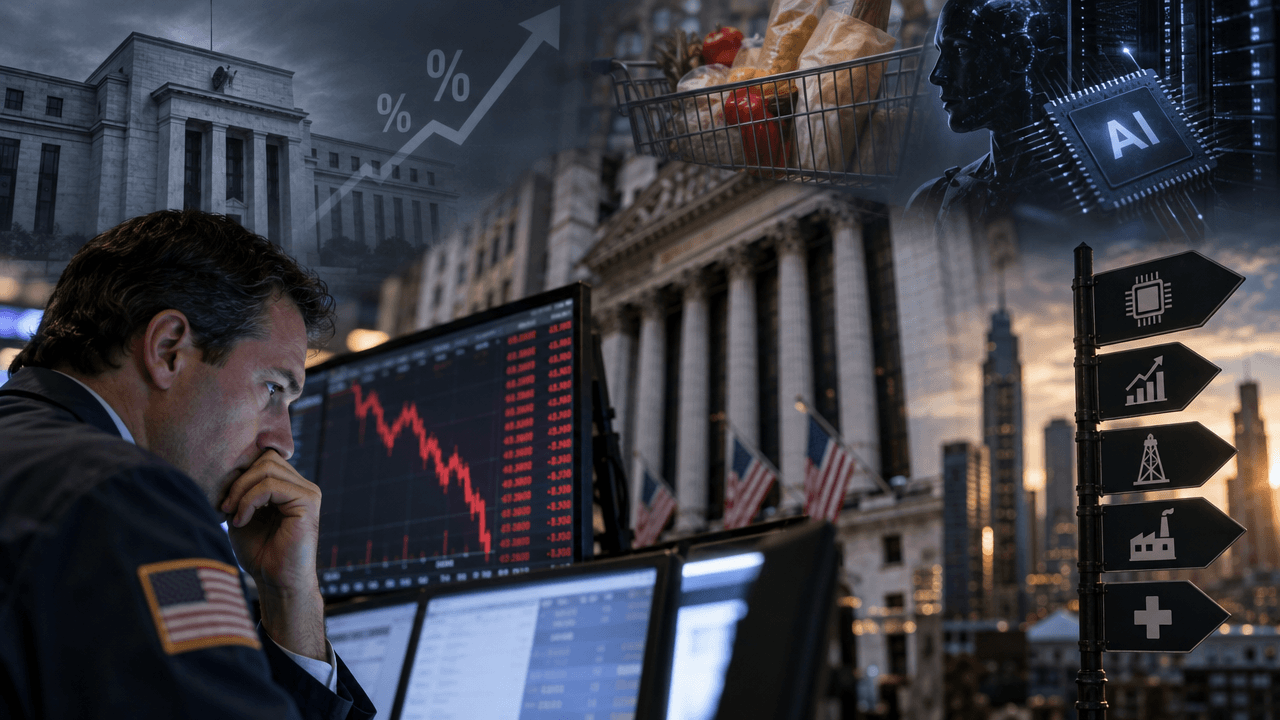
U.S. equity-index futures remain under pressure as investors digest a sharp technology-led selloff, hotter inflation data and renewed doubts about how easily the artificial intelligence investment boom can be financed. Early Thursday trading pointed to a weaker opening for the S&P 500 and Nasdaq, while Dow futures showed more resilience. Nasdaq 100 futures were down about 1.26%, S&P 500 futures fell 0.35%, and Dow futures gained approximately 0.39% in premarket trading. [1]
The uneven futures performance highlights an important feature of the current market: weakness is concentrated in growth-oriented technology shares, while more traditional and economically sensitive companies are holding up better. That does not necessarily mean the broader market is insulated. Instead, it suggests investors are reassessing the highest-priced areas first, particularly stocks whose valuations depend on strong future growth and continued access to inexpensive capital.
What Is Driving The Pressure
The latest selling began after inflation data increased concerns that interest rates could remain higher for longer. On Wednesday, the S&P 500 declined 1.11% and the Nasdaq Composite dropped 1.88%, with both indexes recording their worst daily performance since July. The Dow fell a more modest 0.09%. [2]
Higher inflation affects equities through several channels. First, it can reduce the likelihood of near-term interest-rate cuts or increase expectations for additional Federal Reserve tightening. Second, higher bond yields raise the discount rate used to value future corporate earnings. When those future earnings are discounted more heavily, high-growth stocks can experience especially large valuation declines.
Markets were pricing in a 27% probability of a Federal Reserve rate increase later in October, up from 20% one week earlier, according to CME Group’s FedWatch tool cited by Reuters. [1] Even when an immediate rate increase is not the base case, a shift in expectations can quickly change investor positioning.
Why The Ai Trade Is Vulnerable
Artificial intelligence remains a powerful long-term investment theme, but its near-term market performance depends on more than revenue growth. Investors are increasingly examining how companies are funding data centers, chips, networking equipment and other infrastructure required to expand AI capacity.
Higher borrowing costs make that buildout more expensive. They can also pressure companies that are taking on debt before AI-related revenue fully catches up with investment spending. Concerns about debt-financed expansion have spread beyond the largest technology companies, adding to worries that enthusiasm may have moved faster than underlying cash flows. [7]
This distinction is important for traders. A decline in AI-related shares does not automatically disprove the long-term business case for artificial intelligence. It may instead signal that investors are demanding stronger evidence of profitability, sustainable demand and acceptable returns on capital.
The market is therefore separating companies with established earnings and robust balance sheets from those whose valuations rely heavily on projected growth. During periods of rising yields, that separation can become more pronounced.
What Traders Should Watch Next
The next market reaction will depend heavily on incoming economic data and corporate earnings. Producer-price data, retail sales and weekly jobless claims are among the key releases investors are monitoring Thursday. These reports can influence expectations for both inflation and economic momentum. [14]
A combination of firm inflation and resilient consumer demand could reinforce the view that interest rates will remain elevated. That scenario would likely continue to challenge long-duration technology stocks. Conversely, signs of moderating price pressures or weakening demand could reduce rate fears, although a sharp economic slowdown would create a different set of risks for corporate earnings.
Earnings guidance will also matter. Investors are likely to scrutinize spending plans, financing costs and commentary about AI demand rather than focusing only on headline revenue. Companies that can demonstrate rising productivity, improving margins and disciplined capital allocation may be better positioned than businesses that simply promise future growth.
Practical Takeaways For Simfi Traders
For traders using simulated finance platforms, the current environment offers a useful exercise in risk management. Futures prices indicate market expectations, not guaranteed opening levels. Overnight moves can reverse after the cash session begins as liquidity improves and new information reaches investors.
One practical approach is to define the trade thesis before entering a position. For example, a trader betting on continued Nasdaq weakness should identify the catalyst, the invalidation level and the maximum acceptable loss. Entering after a sharp decline without a plan can create poor risk-reward conditions, especially if a relief rally develops.
Position sizing is equally important. Technology indexes can move rapidly when rates and valuation expectations change. A smaller position with a clearly defined stop may provide better control than attempting to recover losses through larger trades.
Traders should also avoid treating the S&P 500, Nasdaq and Dow as interchangeable. The Nasdaq has greater exposure to high-growth technology companies, the S&P 500 combines technology with a broader group of sectors, and the Dow can behave differently because of its blue-chip composition and price-weighted structure.
The Broader Market Message
The pressure on U.S. equity-index futures reflects a repricing of risk rather than a single isolated event. Inflation, interest rates, financing conditions and AI expectations are interacting at the same time. That combination can produce swift rotations between sectors and sharp changes in market leadership.
For investors and SimFi traders, the central lesson is to focus on process rather than prediction. Monitor rates and economic data, evaluate the quality of corporate cash flows, and distinguish a temporary pullback from a deterioration in the underlying business outlook.
The AI trade may remain an important force in markets, but investors are demanding more proof that ambitious spending will translate into durable profits. Until that confidence returns, higher-rate risks are likely to keep U.S. equity-index futures volatile and technology shares particularly sensitive to every new inflation, earnings and financing signal.