
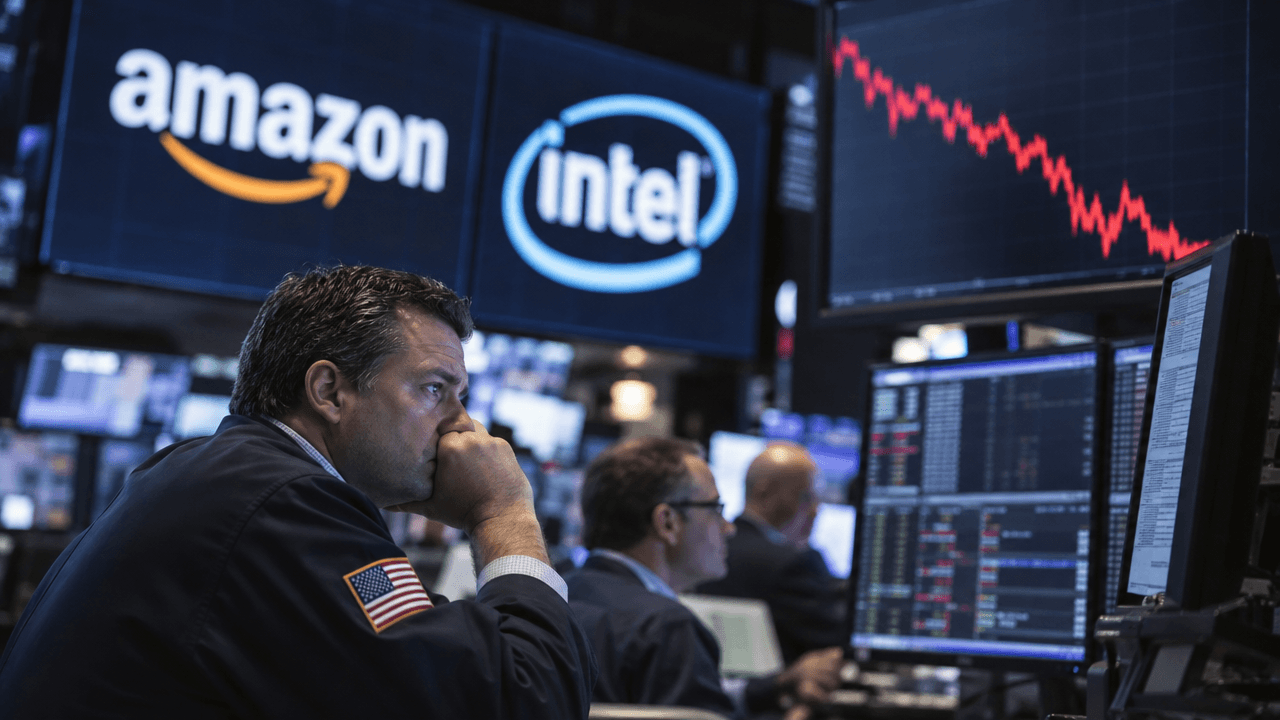
U.S. equity futures fell sharply as disappointing technology earnings intensified concerns about the cost, pace, and eventual payoff of artificial intelligence investment. Nasdaq 100 futures dropped 2.7%, while S&P 500 futures declined 1.1% and Dow futures slipped 0.2%. The uneven performance highlights how heavily the current market’s risk appetite remains concentrated in technology and AI-related companies. [4]
The Earnings Trigger
Amazon and Intel supplied the immediate catalyst for the sell-off. Amazon shares fell nearly 8% before the opening bell after the company reported quarterly revenue and earnings below Wall Street expectations, alongside negative free cash flow. Investors were especially concerned that heavy AI-related spending could continue to pressure cash generation even as Amazon Web Services maintains strong growth. [1]
Intel delivered a different warning. Although the chipmaker reported better-than-expected third-quarter earnings, its outlook for the following quarter disappointed investors. The company also warned about cash burn linked to weak personal-computer demand, manufacturing bottlenecks, and spending to expand production. Intel shares fell more than 25% in premarket trading. [3]
These reactions show that investors are no longer rewarding technology companies simply for participating in the AI buildout. Markets are demanding evidence that enormous investments in data centers, chips, power infrastructure, and software will produce durable revenue and earnings.
The Ai Trade Faces A Higher Standard
The latest decline reflects a broader debate about whether AI spending is moving faster than AI returns. Big technology companies have committed billions of dollars to computing capacity, specialized chips, and cloud infrastructure. That spending may support long-term innovation, but it also creates near-term financial pressure.
Amazon’s results demonstrate the tension clearly. Its cloud business can benefit from rising demand for AI services, yet building the capacity to meet that demand requires substantial capital. If revenue growth does not accelerate enough to offset those expenses, investors may assign lower valuations even when the underlying business continues to expand.
Intel’s report adds another layer of uncertainty. The company is exposed not only to the AI infrastructure cycle but also to traditional semiconductor demand, including personal computers. A softer PC market, production challenges, and expansion costs can combine to weaken cash flow at precisely the moment investors are looking for financial discipline.
The important lesson for traders is that an AI connection is not automatically positive. Companies must show improving margins, credible guidance, manageable capital expenditure, and a clear path from investment to free cash flow.
Why The Nasdaq Is More Vulnerable
The Nasdaq 100 contains a high concentration of large technology and growth companies. These businesses often carry elevated valuations because investors expect strong future earnings. When interest rates, growth expectations, or profit forecasts change, those valuations can adjust quickly.
That sensitivity helps explain why Nasdaq 100 futures declined far more than Dow futures. The Dow’s comparatively modest 0.2% decline suggests that investors were rotating away from growth and toward companies viewed as less exposed to AI spending concerns. Healthcare, utilities, consumer staples, and other defensive areas may attract attention when market participants prioritize stability over aggressive expansion.
For SimFi traders, the index gap is useful information. It shows that the headline decline is not evenly distributed across the market. A trader who treats the S&P 500, Nasdaq 100, and Dow as interchangeable may overlook important differences in sector exposure and volatility.
Risk Aversion And The Dollar
A technology-led sell-off can extend beyond equities. When investors reduce exposure to higher-risk assets, demand for defensive holdings and liquid currencies can increase. The U.S. dollar may benefit from broader risk aversion as international investors seek liquidity and safety, although currency markets will also respond to interest-rate expectations, economic data, and Federal Reserve policy.
The dollar should therefore be viewed as part of the wider market reaction rather than as an automatic one-way trade. If the equity sell-off raises expectations for slower growth, traders may anticipate easier monetary policy, which could weigh on the currency. If the dominant response is a flight to liquidity, however, the dollar may strengthen. Monitoring both forces is more reliable than assuming that falling stocks always produce a stronger dollar.
Practical Takeaways For Traders
First, distinguish between an earnings miss and a guidance problem. Intel’s results show that a company can beat recent estimates and still decline sharply if its forward outlook disappoints.
Second, watch cash flow as closely as revenue growth. AI investment can support future expansion, but negative or deteriorating free cash flow may become a major valuation concern when spending remains elevated.
Third, compare relative strength across indexes and sectors. Weakness concentrated in the Nasdaq 100 may indicate a technology repricing rather than a uniform collapse in equities.
Fourth, avoid entering trades solely because a market has moved dramatically. Large overnight futures declines can produce both continuation and sharp reversals after the opening bell. Predefined risk levels, smaller position sizes, and confirmation from volume and price action can help reduce emotional decisions.
Finally, remember that simulated trading is an opportunity to test process rather than predict every headline. Record the reason for each trade, identify the sector exposure involved, and review whether the position matched the broader risk environment.
Conclusion
The latest futures decline is more than a reaction to two disappointing earnings reports. It is a test of the market’s confidence in the economics of the AI boom. Investors are beginning to demand measurable returns from unprecedented spending, while companies with weaker guidance or strained cash flow face immediate scrutiny.
For traders, the central message is discipline. Track earnings quality, forward guidance, cash generation, index leadership, and defensive rotation together. In a market where technology sentiment can shift rapidly, understanding the transmission from company results to sector risk is often more valuable than chasing the first move.