
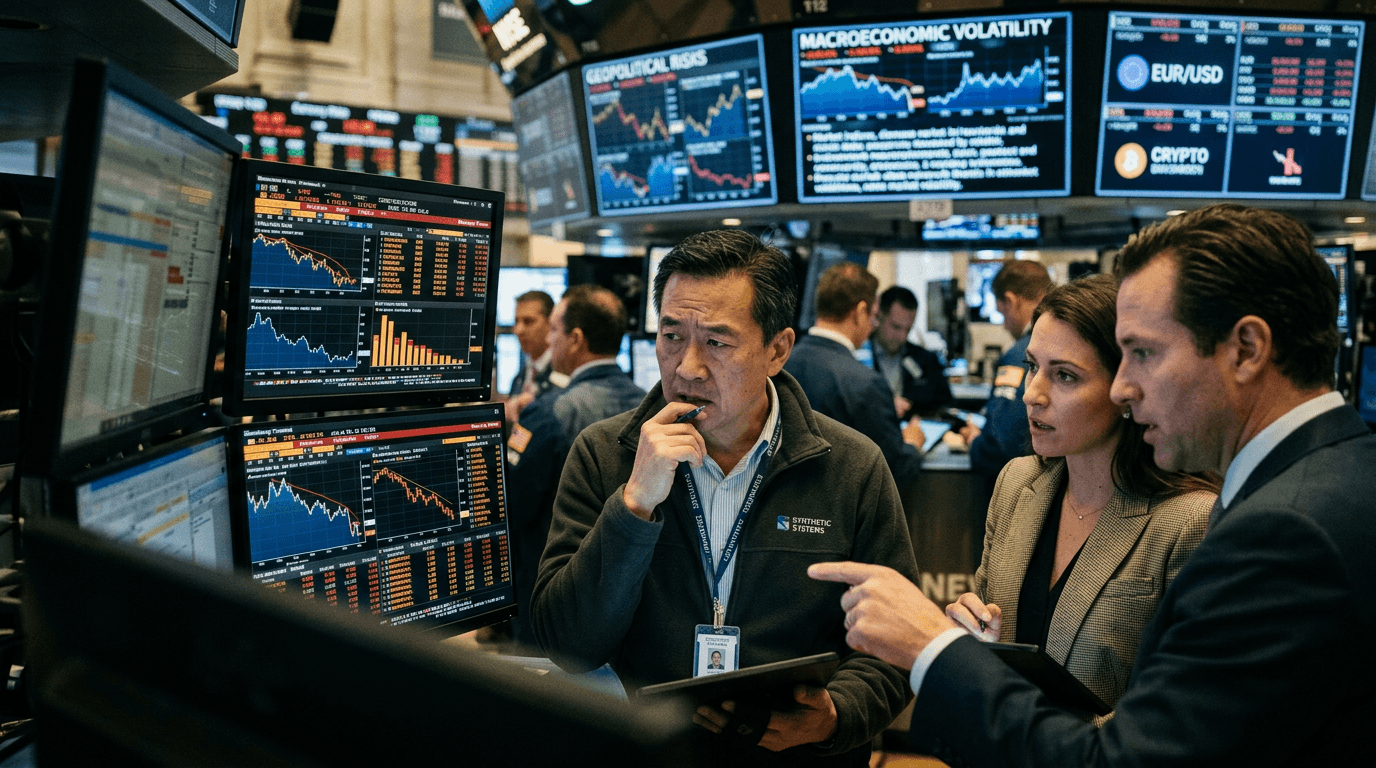
For much of the recent rally, a handful of AI‑driven US tech giants have carried Wall Street higher, pulling indices, currencies and even crypto along with them. Now those same market leaders are under pressure as investors lock in profits and reassess risk in light of rising geopolitical tensions and an uncertain macro backdrop. The result is a more volatile trading environment where positioning and risk management matter as much as the AI story itself.
Ai Mega-caps Face A Reality Check
The AI boom has concentrated market gains in a small group of US technology names—semiconductor leaders, hyperscale cloud platforms and consumer tech platforms with ambitious AI roadmaps. These companies have benefited from surging enthusiasm around generative AI, data center spending and the idea that “AI winners” will dominate future cash flows.
Surveys show a majority of Americans consider U.S. leadership in AI crucial for both economic and national security, reinforcing the narrative that these firms sit at the heart of strategic growth[10]. That narrative helped justify stretched valuations and crowded long positions as investors chased the AI theme.
But even in structurally strong stories, price and positioning eventually matter. As earnings expectations get revised, regulatory scrutiny increases and the cost of capital stays elevated, investors have begun to question how much future growth is already priced in. When a trade becomes crowded, even small disappointments—or simply a lack of fresh positive surprises—can trigger sharp reversals. That is what we are seeing as AI‑linked mega‑caps experience renewed selling pressure and short‑term volatility.
Macro And Geopolitical Risks Driving Rotation
The recent weakness in AI leaders is not happening in isolation. It sits within a broader environment of rising Middle East tensions and a murky outlook for interest rates and corporate earnings. Geopolitical stress tends to raise risk premiums, especially when energy routes, supply chains or global trade flows might be affected. That alone can reduce investor appetite for highly valued, long‑duration growth assets.
At the same time, the rate backdrop remains uncertain. If inflation proves sticky or growth data surprises to the upside, markets may have to price in “higher for longer” policy rates. Higher real yields pressure the valuations of growth companies whose cash flows lie far in the future, making richly valued AI leaders particularly sensitive to rate expectations. Conversely, signs of economic slowdown can hurt cyclical demand for hardware, cloud services and advertising, complicating the earnings picture.
Faced with these cross‑currents, many institutional investors are rotating. Capital is being reallocated from concentrated tech and AI exposures into sectors seen as more resilient or less crowded—such as defensive equities, value plays, energy and even cash‑like instruments. That rotation isn’t necessarily a rejection of AI as a long‑term theme; it is often a tactical response to macro uncertainty and the need to rebalance risk.
Ripple Effects Across Nasdaq, Fx, And Crypto
Because AI‑driven mega‑caps dominate the Nasdaq and exert heavy weight in broader US indices, their reversals have outsized effects on equity futures. When these names sell off, volatility spikes in Nasdaq contracts and can spill over into the S&P 500 and global equity markets. Short‑term traders see thicker order books, wider bid‑ask spreads and more frequent intraday swings.
The knock‑on effects extend to risk‑sensitive currencies. Historically, high‑beta FX such as the Australian dollar, New Zealand dollar and certain emerging market currencies tend to trade in line with global risk sentiment. When tech leadership falters and equity volatility rises, these currencies can weaken as investors de‑risk, while safe‑haven flows move into the US dollar, yen or Swiss franc.
Crypto markets, increasingly intertwined with tech sentiment, also feel the impact. Digital assets often behave like leveraged bets on liquidity and risk appetite. When AI leaders struggle and equity investors step back from high‑growth stories, crypto can see parallel bouts of profit‑taking and volatility. For active traders, this means that a headline about AI mega‑caps can translate into price action across seemingly unrelated assets, from FX pairs to Bitcoin.
What Investors Are Really Pricing In
Beyond the day‑to‑day moves, the current rotation reflects deeper questions about the AI trade. Investors are asking whether the market has properly distinguished between companies already showing tangible AI‑driven earnings and those mostly selling a long‑term vision. They are also assessing how much of the expected AI spending boom is incremental versus merely replacing other IT budgets.
In many portfolios, AI leaders have become “core holdings,” not just tactical trades. That status can create vulnerability when everyone is positioned similarly. A modest macro shock, a geopolitical headline or a guidance downgrade can force simultaneous de‑risking, intensifying downside moves even if the long‑term thesis remains intact.
Importantly, this phase does not invalidate AI as a structural theme. Instead, it reminds investors that even transformative technologies travel through cycles of hype, repricing and consolidation. Periods of pressure can separate durable business models from speculative narratives and reset entry points for long‑term investors willing to look through short‑term noise.
Practical Lessons For Traders And Simfi Participants
For traders and simulated finance (SimFi) participants, the current environment offers several practical lessons.
First, avoid overconcentration in single themes. It can be tempting to pile into “obvious winners” during a strong rally, but crowded trades become fragile when macro and geopolitical risks rise. In a simulated environment, test how your strategies perform when leadership rotates—from growth to value, from tech to energy, or from US to global equities.
Second, build an explicit macro and geopolitical framework. Map out scenarios: higher rates, lower rates, escalation or de‑escalation of regional tensions, stronger or weaker global growth. For each scenario, analyze how AI‑driven tech leaders, indices, risk currencies and crypto might respond. SimFi platforms are ideal for running these what‑if analyses without real capital at risk.
Third, pay attention to cross‑asset correlations. Use simulated portfolios to observe how moves in Nasdaq futures affect FX pairs, crypto and commodities. Practice risk management techniques such as position sizing, diversification, and using hedges—index futures, options or sector rotation—to dampen portfolio volatility when a single group of stocks drives market direction.
Finally, refine your time horizons. Short‑term traders might focus on intraday volatility around AI names, while longer‑term participants should evaluate whether pullbacks are creating better entry points into high‑quality businesses. SimFi lets you backtest both approaches, compare performance and develop a playbook for future episodes of theme‑driven rotations.
Conclusion
AI‑driven US tech leaders are experiencing a healthy, if uncomfortable, reality check as investors confront macro uncertainty and geopolitical risk. Profit‑taking and rotation away from crowded trades are amplifying volatility in Nasdaq futures and radiating across risk‑sensitive currencies and crypto. For traders, this is less a reason to abandon AI than a reminder that no theme moves in a straight line.
In both real and simulated markets, the edge lies in preparation: understanding how macro shocks interact with crowded positions, recognizing cross‑asset linkages, and building strategies that can adapt when yesterday’s leaders come under pressure. AI may still shape the next decade of market growth, but in the short term, risk management and disciplined rotation are the technologies that matter most.