
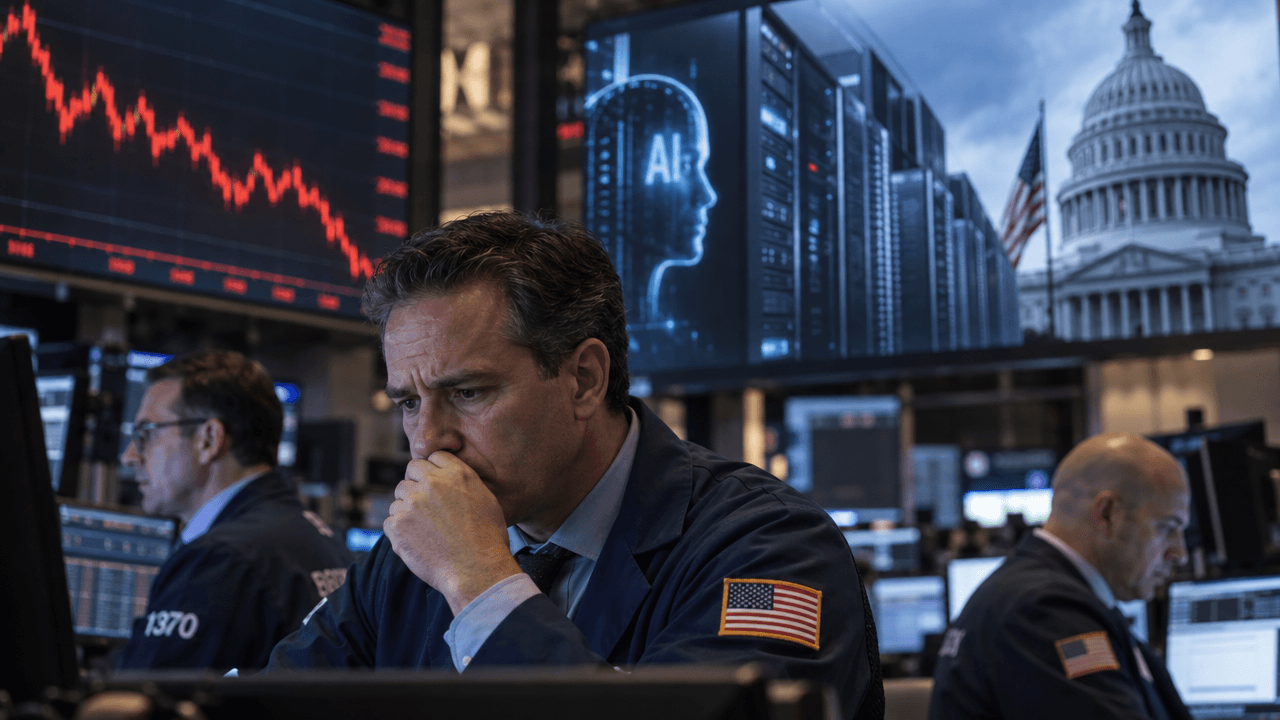
Uncertainty around the profitability of artificial intelligence infrastructure is weighing on U.S. equity futures, reminding investors that enthusiasm for AI can shift quickly when spending rises faster than revenue. Technology-heavy contracts have absorbed the greatest pressure: S&P 500 futures previously fell as much as 1.2%, while Nasdaq 100 futures dropped as much as 2.2%. [8]
The moves reflect a broader reassessment of the AI investment boom. Investors are no longer asking only whether companies can build faster chips, larger data centers, and more powerful models. They are also asking when those investments will produce durable cash flow, whether customers can afford the resulting services, and how much debt companies may need to finance the buildout.
Why Ai Spending Is Under Scrutiny
The central concern is the widening gap between capital expenditure and demonstrated profitability. Major technology companies are committing enormous sums to data centers, semiconductors, networking equipment, and energy capacity. Yet the revenue generated by many AI products remains difficult to measure, particularly when companies are still offering discounts to attract users and developers.
That does not mean demand for AI has disappeared. Industry feedback has indicated that customer demand visibility may extend through 2027 and into early 2028. [10] The concern is whether demand will translate into returns high enough to justify the scale and speed of current investment.
Amazon and Intel recently intensified those worries. Amazon’s plans for continued heavy AI spending and Intel’s warning about cash burn fueled concerns about rising infrastructure costs, financing requirements, and the timeline for returns. [8] When investors see spending increase while near-term cash flow weakens, even strong long-term growth forecasts may fail to support current valuations.
Higher interest rates add another layer of pressure. Companies that rely on debt to fund data-center construction face greater financing costs, while lenders are becoming more selective about projects and borrowers. [12] This can make an investment that appears attractive under low borrowing costs far less appealing when rates remain elevated.
The Midterm Election Effect
The U.S. midterm elections have introduced a separate source of uncertainty. Investors are considering whether a new political environment could bring tighter oversight of artificial intelligence, stricter standards for data centers, or additional restrictions on construction and energy use.
Reports following the election pointed to concerns that increased regulatory scrutiny could affect planned data-center projects and raise compliance costs. [1] Such policies would not necessarily stop AI development, but they could slow permitting, limit available locations, or make new facilities more expensive to operate.
For markets, uncertainty is often more disruptive than a clearly defined rule. Companies can adjust to known regulations by changing project schedules, budgets, or business models. It is more difficult to value an investment when the future policy framework remains unclear.
This is especially important for companies whose valuations depend on years of rapid expansion. If regulatory delays reduce expected growth, investors may revise earnings forecasts before any rule formally takes effect.
Why Nasdaq Futures Are More Vulnerable
The Nasdaq 100 has a heavy concentration of technology and communication companies, making it particularly sensitive to changes in expectations for AI spending, interest rates, and future earnings. When investors reduce exposure to expensive growth stocks, the index can decline more sharply than broader benchmarks.
The S&P 500 is also affected because its largest constituents include many companies leading the AI buildout. However, its wider composition provides some diversification through financial, industrial, consumer, energy, and healthcare stocks.
The futures market therefore offers an early indication of where investor confidence is weakest. A sharp decline in Nasdaq futures does not automatically predict a similar loss at the closing bell, but it signals that traders are reassessing risk before regular trading begins.
Investors should also distinguish between a broad technology selloff and weakness concentrated in companies with the highest spending commitments. Businesses with strong free cash flow, diversified revenue, and disciplined capital allocation may be better positioned than firms dependent on external financing or a single AI-related revenue stream.
What Traders Should Watch Next
Upcoming earnings reports will be important because they can provide evidence beyond market speculation. Results from companies including CoreWeave, Applied Materials, and Cisco are expected to offer insight into demand for AI infrastructure, networking equipment, and related services. [1]
Traders should focus on several details: capital-expenditure guidance, customer concentration, backlog quality, operating cash flow, debt issuance, and management’s expected timeline for returns. Revenue growth alone may not be enough if margins decline or spending accelerates even faster.
Inflation data will also matter. Investors are awaiting key U.S. inflation reports for clues about the Federal Reserve’s future policy path. [3] Higher-than-expected inflation could push interest rates upward and place additional pressure on long-duration technology valuations. Softer inflation could support growth stocks by reducing concerns about financing costs and discount rates.
Practical takeaways are straightforward. Avoid treating a futures decline as a complete investment thesis. Compare companies by cash generation rather than AI headlines, watch spending relative to revenue growth, and use position sizing to manage volatility. Simulated Finance traders can also test these scenarios without committing real capital: a regulatory delay, a weaker earnings forecast, higher borrowing costs, or a sudden recovery in AI demand.
The Bigger Market Lesson
The AI story is moving from a period of unquestioned optimism into a more demanding phase. Investors still recognize the technology’s long-term potential, but they increasingly want proof that infrastructure spending can produce sustainable profits.
That shift can create sharp price swings without invalidating the broader AI opportunity. The strongest companies may continue investing, while weaker business models face pressure to reduce spending or secure additional financing.
For traders, the key is to separate technological promise from financial performance. U.S. equity futures may remain sensitive to election policy, interest rates, and corporate guidance, but the most important question is becoming clearer: not whether AI will matter, but which companies can turn AI investment into dependable cash flow.