
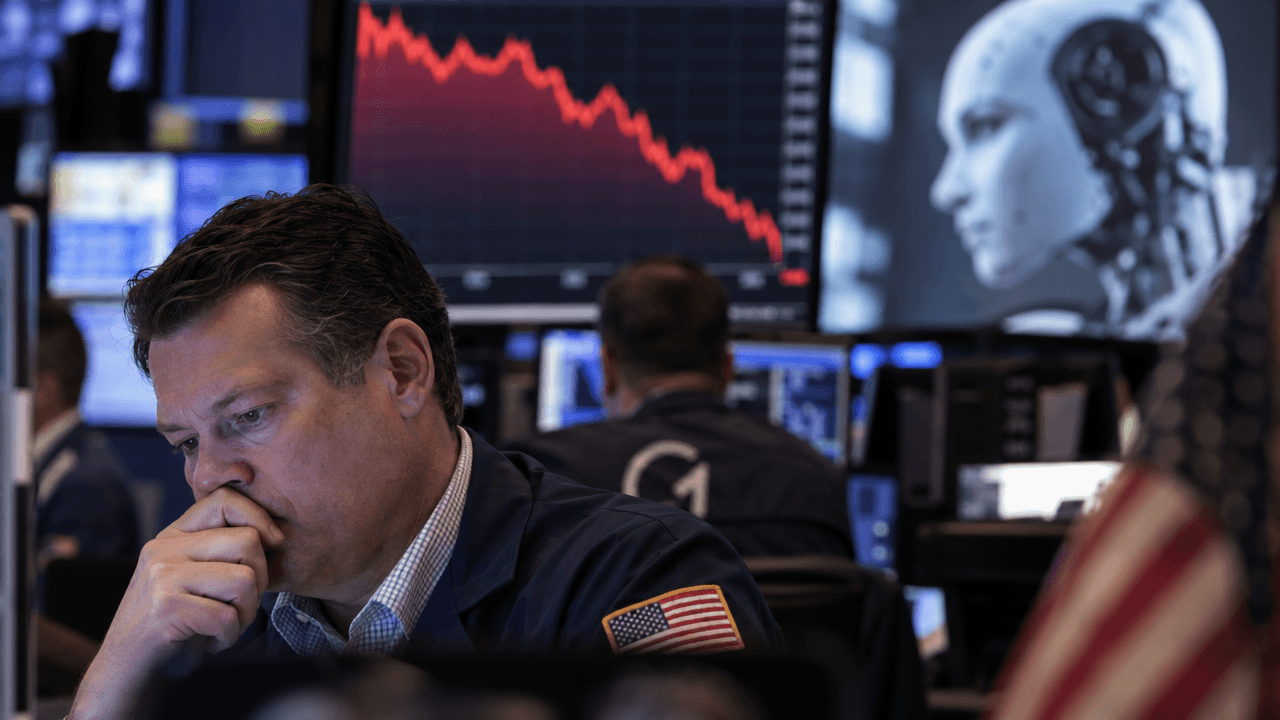
The latest slide in U.S. equity futures is a reminder that strong artificial intelligence demand does not automatically justify unlimited valuations. On Friday, Nasdaq 100 futures fell about 1.5%, while S&P 500 futures declined roughly 0.7%, signaling renewed pressure on technology stocks and a broader retreat from risk. [8][13]
The move reflects a shift in investor priorities. Instead of asking only how quickly AI-related companies can grow, markets are increasingly asking how much that growth will cost, when it will become profitable, and whether current valuations already assume an almost perfect outcome.
What Is Driving The Sell-off
A major catalyst was the pullback in Anthropic shares following the company’s highly anticipated public-market debut. The listing initially raised hopes that strong demand for a prominent AI company could restore confidence in the broader sector. Instead, the retreat revived concerns that excitement surrounding AI businesses may be running ahead of their underlying financial performance. [1][2]
Investors are also questioning the sustainability of the enormous capital spending required to build AI infrastructure. Data centers, advanced chips, networking equipment and energy systems require significant investment before they generate dependable returns. If corporate customers slow their spending or if AI revenue growth decelerates, companies throughout the supply chain could face pressure.
This concern is particularly important because many technology companies have been valued on expectations of rapid future expansion. When those expectations weaken, even a company that continues to report strong revenue growth can see its share price fall if investors believe the growth rate is not high enough to support the valuation.
Why Valuations Matter
Valuation is the price investors pay for a company’s expected future earnings and cash flow. A high valuation can be justified when a business has durable competitive advantages, strong margins and significant room to expand. However, the higher the valuation, the more dependent the stock becomes on continued execution.
For AI-linked companies, the market has often rewarded projections involving years of powerful demand. That creates a narrow margin for disappointment. Slower revenue growth, larger operating expenses, higher borrowing costs or delayed product adoption can all change the assumptions behind a stock’s price.
Analysts have also raised questions about the pace of revenue growth at Anthropic and whether the company can achieve the expansion needed to support its market value. Those questions are influencing sentiment beyond one company. Investors are reassessing chipmakers, cloud providers, software businesses and data-center operators that have benefited from the same AI investment cycle. [3]
Interest rates add another layer of pressure. Higher borrowing costs reduce the present value of profits expected far in the future, which tends to affect growth stocks more severely than mature companies with stable near-term cash flows. Hawkish signals from Federal Reserve officials have therefore amplified the valuation reset. [1][4]
The Effect On Risk Appetite
The impact is spreading beyond technology shares. When investors reduce exposure to high-growth stocks, they often cut positions in other assets that depend on strong liquidity and optimistic expectations. Crypto, speculative software companies, smaller technology firms and other high-beta assets can all experience sharper declines during a risk-off move.
Bitcoin and other cryptocurrencies came under pressure as the technology sell-off reduced demand for speculative positions. Reports indicated that Bitcoin approached a five-month low below $62,000 as global investors responded to the broader decline in risk appetite. [12]
This relationship does not mean that AI stocks and crypto always move together. Rather, both can be sensitive to the same market forces: interest rates, liquidity, momentum and investor confidence. When traders become more focused on preserving capital, assets with elevated volatility often face the greatest selling pressure.
For traders, the futures market is an important sentiment indicator, but it is not a guarantee of where the regular session will finish. Futures can change as earnings reports, economic data, Treasury yields and policy comments enter the market. The most useful signal is often whether weakness persists after the opening bell and whether selling expands beyond a small group of AI leaders.
Practical Lessons For Traders
First, avoid treating a major theme as a one-way trade. AI may remain one of the most important technological developments in modern markets, but a strong long-term narrative does not prevent short-term corrections. Traders should separate confidence in the technology from confidence in a specific company’s valuation.
Second, monitor position size and correlation. A portfolio containing several semiconductor, cloud and software names may appear diversified while remaining heavily exposed to the same AI spending cycle. Adding crypto or other high-beta assets can increase that concentration during a market-wide risk-off move.
Third, define risk before entering a position. Stop levels, maximum loss limits and planned holding periods become especially important when futures point to a volatile open. Chasing a sharp rebound without understanding the catalyst can produce poor risk-reward outcomes.
For SimFi traders, this environment offers a useful training opportunity. A trader can test whether a bearish strategy works better at the market open or after a failed rebound, compare the behavior of the Nasdaq 100 with the S&P 500, and study how technology weakness affects correlated assets. The objective should not be to predict every move, but to develop a repeatable process based on volatility, confirmation and disciplined execution.
What To Watch Next
Market participants will focus on corporate guidance, AI infrastructure spending and evidence that demand is translating into sustainable cash flow. They will also watch interest-rate expectations, Treasury yields and any additional comments from Federal Reserve officials.
A stabilization in futures alone may not be enough to restore confidence. Investors may want to see improving breadth, stronger participation outside a handful of megacap technology stocks and evidence that earnings can catch up with valuations.
The current decline is best understood as a reality check rather than a final verdict on artificial intelligence. AI adoption can continue to expand while related stocks undergo a significant repricing. For traders and investors, the central question is not whether the technology matters. It is whether the price paid for future growth leaves enough room for delays, higher costs and disappointing results.