
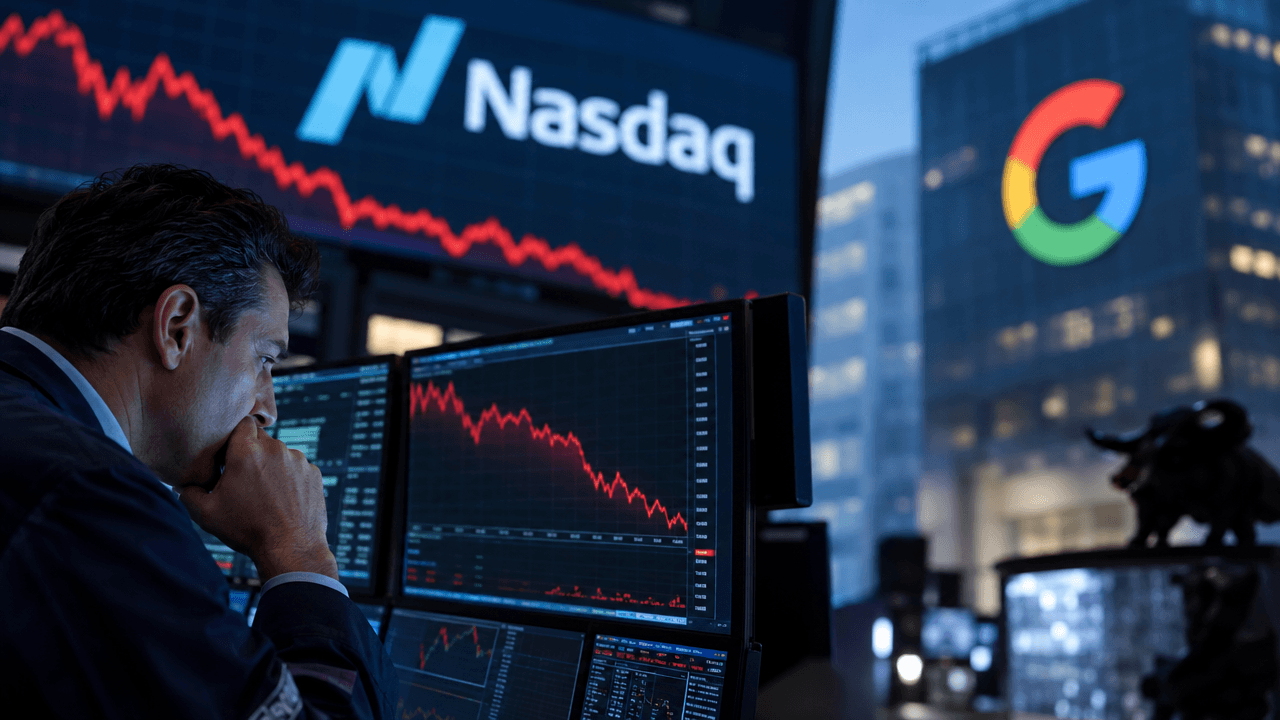
U.S. equity futures turned lower Thursday after Alphabet delivered a rare double miss on revenue and adjusted earnings, putting fresh pressure on technology stocks and reviving concerns about whether enormous artificial intelligence investments can generate sufficient returns. S&P 500 futures fell approximately 0.4%, while Nasdaq futures weakened more sharply. Dow futures, by contrast, gained about 0.4%, highlighting a clear rotation away from growth-oriented technology shares and toward a more mixed market backdrop. [9]
The Earnings Miss Behind The Market Reaction
Alphabet reported third-quarter revenue of $127.6 billion, below the $128.2 billion expected by analysts. Adjusted earnings per share came in at $2.67, compared with an expected $3.02. The results represented Alphabet’s first simultaneous revenue and earnings miss since the fourth quarter of 2022, making the report more significant than a routine variance from forecasts. [1][4]
The weakness was especially notable in Google’s core advertising business. Advertising revenue reached approximately $82.01 billion, around $1.4 billion below expectations. Search advertising remains central to Alphabet’s financial model because it generates the cash needed to fund newer businesses, including cloud computing, artificial intelligence infrastructure, and advanced model development. [2]
Alphabet’s shares fell roughly 10% in after-hours trading and remained under pressure before the opening bell. Because Alphabet is one of the largest companies in major stock indexes, a move of that size can affect index futures even before the broader market opens.
Why Ai Spending Is At The Center Of The Concern
Investors have accepted extraordinary spending by major technology companies as they compete to build data centers, acquire advanced chips, and develop increasingly capable AI systems. The argument has been straightforward: large investments today could establish dominant platforms and produce substantial revenue in the future.
Alphabet’s latest results made that argument more difficult to defend in the short term. The company spent $51.36 billion on capital expenditures during the quarter, below the $55.09 billion analysts had expected but still representing an enormous level of investment. Alphabet maintained its full-year capital expenditure forecast of approximately $195 billion to $205 billion and indicated that spending could rise significantly in 2027, potentially exceeding $300 billion. [1]
That combination creates a demanding test for investors. Capital spending is rising, but advertising growth is slowing and free cash flow has come under pressure. Alphabet reportedly posted negative free cash flow of $9.1 billion for the quarter, adding to worries that the AI buildout may consume cash faster than it produces measurable returns. [14]
The market is not necessarily rejecting AI as a long-term opportunity. Instead, investors are asking more immediate questions. How quickly will AI products generate revenue? Can cloud growth offset slower search advertising? Will AI-powered search reduce the number of traditional advertising opportunities? And what level of spending is required before returns become visible?
Valuations Make Disappointments More Powerful
High-growth technology shares are particularly sensitive to earnings disappointments because their valuations often depend on strong future expansion. When investors pay a premium for expected growth, even a relatively modest shortfall can lead to a significant repricing.
Alphabet’s report therefore affected more than one company. It pressured the Nasdaq because technology stocks tend to carry substantial index weight and because investors often compare the spending plans of Alphabet, Microsoft, Amazon, Meta Platforms, and other major AI participants. If one company’s results raise doubts about monetization, traders may reassess the entire sector.
The reaction also demonstrates the difference between operational strength and investor expectations. Alphabet’s overall revenue still increased sharply from the prior year, while Google Cloud reportedly outperformed expectations. However, strong growth was not enough to satisfy investors because the results fell short of already elevated forecasts. [3][8]
For traders, this is an important lesson: a company can grow rapidly and still see its stock decline when expectations grow even faster.
What Traders Should Watch Next
The first signal is whether weakness remains concentrated in technology or spreads into the broader market. The gap between lower Nasdaq futures and firmer Dow futures suggests that investors initially favored companies with more defensive or economically sensitive characteristics. That gap could narrow after the opening bell, but it provides an early indication of risk reduction in high-valuation growth stocks.
The second signal is the performance of other large technology companies reporting results. Investors will compare their cloud growth, AI revenue, capital expenditures, and commentary about customer demand. Strong results from peers could limit the damage from Alphabet’s miss. Similar warnings, however, could reinforce the view that AI spending has moved ahead of near-term monetization.
The third signal is market breadth. If Alphabet falls sharply while most other stocks remain stable, the event may represent a company-specific repricing. If semiconductor stocks, software companies, cloud providers, and other growth shares decline together, the market may be reassessing the broader AI investment cycle.
Traders should also avoid treating futures as a guaranteed forecast for the regular session. Futures reflect overnight positioning and can change quickly as new analyst research, economic data, bond-market moves, or corporate earnings emerge.
The Bigger Market Lesson
Alphabet’s earnings miss is a reminder that artificial intelligence remains both a powerful growth theme and a major capital-allocation challenge. The technology may transform search, cloud computing, software, and numerous other industries, but investors still need evidence that spending will translate into sustainable profits.
For now, the market is demanding more than ambitious forecasts. It wants accelerating revenue, disciplined investment, durable cash flow, and clear signs that AI products can justify their cost. Until those signals become more consistent, disappointing results from a major technology company may continue to trigger outsized moves across indexes.
The immediate takeaway is not that the AI trade is over. It is that the trade has entered a more demanding phase. Future gains may depend less on broad enthusiasm and more on identifying which companies can convert massive AI spending into measurable earnings growth.