
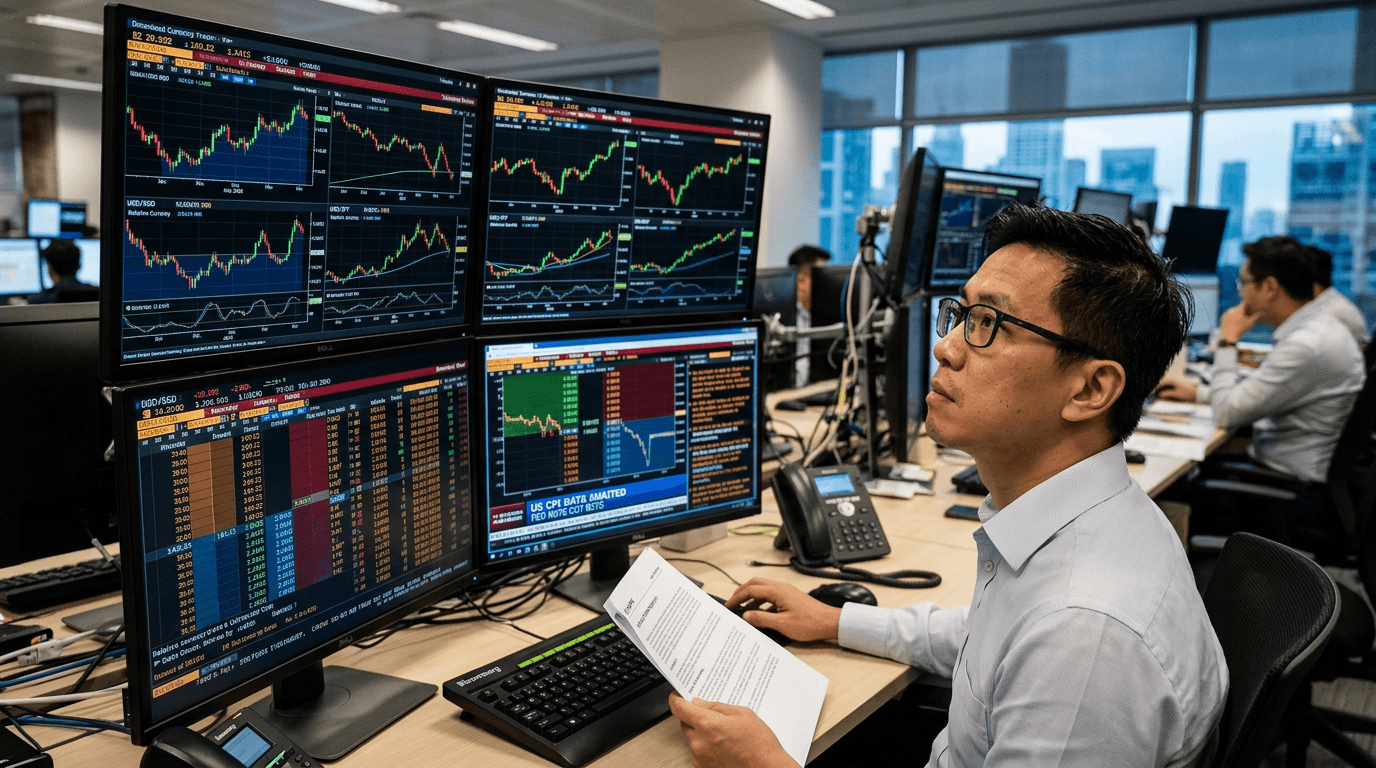
Asian foreign exchange markets often act like an early-warning system for global macro trends. When regional currencies trade in unusually tight ranges, as they have while the U.S. dollar stays fragile ahead of key inflation data, it usually signals not complacency, but intense focus. Traders are effectively holding their breath, waiting for a number that could reset expectations for the Federal Reserve – and with it, the entire FX complex.
Why Asia Fx Is Quiet When The Stakes Are High
Muted price action in Asia FX does not mean nothing is happening. It usually means a temporary balance of forces:
On one side, the dollar is under pressure from rising expectations of U.S. rate cuts. Markets are increasingly pricing in the possibility that the Federal Reserve could start easing as early as September if inflation continues to cool.
On the other side, traders are reluctant to push Asian currencies much higher until they see confirmation in the next U.S. CPI print. A softer number would support the “Fed cut” narrative; a surprise upside miss could force a swift repricing.
The result is a kind of “tense equilibrium”:
- Spot moves in pairs like USD/JPY, USD/CNH, USD/SGD, and AUD/USD are small and choppy.
- Volatility is expressed more through options pricing and positioning than through big intraday swings.
- Liquidity can be patchy around key data windows, with dealers widening spreads as the release time approaches.
For newer traders, this can be confusing: the news tone feels urgent, but the charts look calm. Understanding that quiet price action often reflects uncertainty, not certainty, is a key mindset shift.
WHY U.S. INFLATION DATA MATTERS SO MUCH
U.S. CPI has become one of the single most important data points for global FX because it feeds directly into expectations for the Fed’s policy path.
Think of the chain reaction as
U.S. CPI → Fed rate expectations → U.S. yields → U.S. dollar → Asia FX
If CPI runs lower than expected: - Markets may increase bets on earlier and/or larger rate cuts. - U.S. Treasury yields tend to fall, making dollar assets relatively less attractive. - The dollar often weakens, especially against higher-yielding or “risk” currencies like AUD and some emerging Asian units.
If CPI surprises higher: - Markets may push back the timing or scale of Fed cuts. - Yields can rise, giving the dollar a yield advantage again. - The dollar may strengthen broadly, pressuring Asia FX pairs.
Because so much of this reaction is about expectations, not just the headline number, even a small deviation from consensus can trigger outsized moves. That is why markets can stay so subdued beforehand: traders know things can change very quickly.
WHAT A “FRAGILE” DOLLAR MEANS FOR ASIAN CURRENCIES
Describing the dollar as “fragile” does not mean it is crashing; it means its direction depends heavily on incoming data and sentiment. In that environment, Asian currencies tend to show some common patterns:
AUD and NZD: - Often behave as high-beta plays on risk sentiment and global growth. - Benefit if a weaker dollar coincides with improving risk appetite and commodity demand. - Can sell off sharply if CPI is hot, yields spike, and traders rotate back into defensive dollar positions.
JPY: - Sensitive to the spread between U.S. and Japanese yields. - A softer CPI (and lower U.S. yields) can reduce that spread, offering some support to the yen. - However, if risk sentiment improves strongly, the yen can weaken as carry trades re-engage, even with a softer dollar.
CNH and other Asian EM FX: - React not just to the dollar, but also to global growth and capital flow expectations. - A fragile dollar and prospect of Fed cuts can support capital flows into Asia, helping currencies like CNH, KRW, IDR, and MYR. - But these currencies can be hit if CPI rekindles fears of “higher for longer” U.S. rates, tightening global financial conditions.
A key point for traders: the same CPI print can have different impacts across Asia pairs depending on how they are positioned structurally (carry, growth sensitivity, policy backdrop) and how the market is positioned tactically.
How Traders Can Navigate A Data-sensitive Fx Market
For both live and simulated traders, a quiet Asia session before U.S. data is not a time to switch off; it is a time to prepare. A structured approach can make the difference between being reactive and being ready.
1. Map the scenarios in advance - Define clear “soft CPI,” “in-line,” and “hot CPI” scenarios. - For each scenario, outline your directional bias for the dollar, and for key Asia pairs (e.g., AUD/USD, USD/JPY, USD/SGD). - Think in terms of both the first move and what happens after the initial spike (fades vs follow-through).
2. Watch rates and yields, not just FX - U.S. 2-year and 10-year yields are important drivers of dollar direction. - A move in yields that contradicts the FX move can signal potential mean reversion or a short-lived knee-jerk reaction.
3. Respect liquidity and volatility shifts - Spreads often widen and slippage can increase around the release. - In a SimFi environment, you can practice adjusting position sizing, entry timing, and stop placement for high-volatility windows without capital at risk.
4. Use options concepts, even if you trade spot - Even if you are not trading options, pay attention to implied volatility levels and positioning narratives. - Elevated implied vol in Asia FX going into CPI often signals expectation of a large move; low vol may set the stage for a bigger surprise reaction.
5. Focus on process over prediction - You do not need to “guess” the CPI number to trade this environment well. - Build a repeatable process: assess expectations, define scenarios, plan your responses, and review afterwards.
Practical Takeaways For Simulated Traders
A muted Asian FX session with a fragile dollar ahead of U.S. CPI is a textbook environment to hone macro and event-trading skills in a simulated setting.
Key habits to build
- Always link FX moves to the underlying macro drivers: inflation, rates, policy expectations, and risk sentiment.
- Use quiet sessions to prepare playbooks for both bullish and bearish outcomes on data.
- Treat event risk as an opportunity to test discipline: avoid overtrading the pre-event chop, and focus on clarity after the initial move.
- Review your trades not just on P&L, but on whether your reasoning aligned with how the market ultimately reacted.
By reframing a “muted” market as a preparation phase rather than a dead zone, traders can turn periods of low volatility into some of their most valuable learning time. When the data finally hits and the dollar either finds its footing or loses it, those who have used the quiet to prepare will be best placed to navigate the storm that follows.