
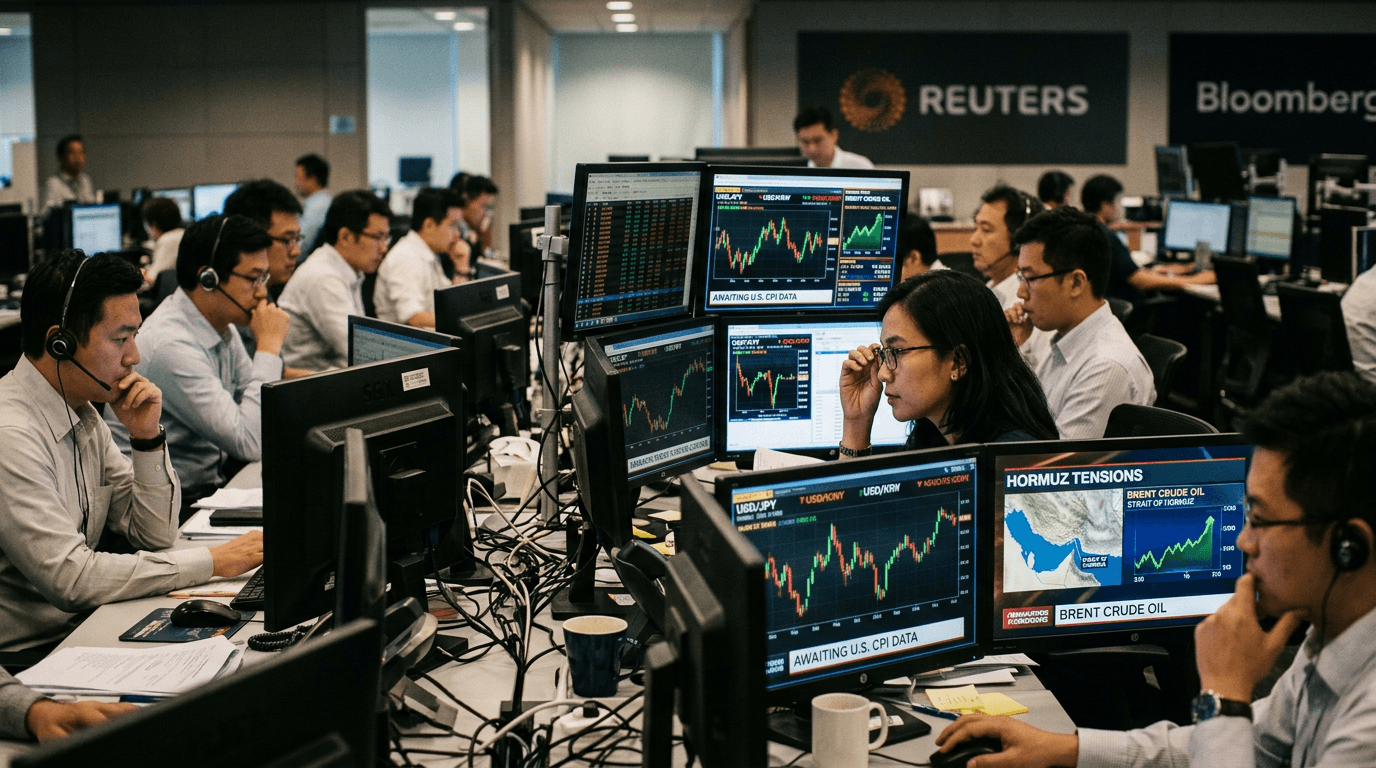
Asia’s currency markets entered the latest U.S. inflation test in a holding pattern, with most regional FX pairs trading in tight ranges as investors waited for the next read on the U.S. Consumer Price Index (CPI).[11] This pause reflects a familiar dynamic: when a major U.S. data release is imminent, global traders tend to reduce risk, compress volatility, and let the dollar set the tone once the numbers hit.[11] At the same time, renewed tensions around the Strait of Hormuz have pushed oil prices higher, injecting an extra layer of caution into risk-sensitive FX crosses and commodity-linked currencies.[20] For traders, both in live markets and SimFi environments, this kind of setup is a live case study in how macro data and geopolitics intersect in FX.
GLOBAL MACRO BACKDROP: WHY U.S. CPI MATTERS FOR ASIA FX
U.S. CPI is one of the most closely watched data points globally because it shapes expectations for Federal Reserve policy, which in turn drives the U.S. dollar—the anchor currency for most Asia-Pacific FX pairs.[11] A hotter-than-expected inflation print tends to reinforce expectations of higher-for-longer interest rates, supporting the dollar and putting pressure on emerging-market and high-beta Asian currencies.[11] Conversely, a softer CPI can revive hopes of earlier rate cuts, easing dollar strength and giving Asia FX some room to appreciate.[11]
That linkage is particularly important because Asia’s FX markets have deepened significantly in recent years, with growing turnover and more active cross-border trading.[3][18] Higher liquidity means Asia FX can adjust quickly to new information, but it also means macro surprises can translate into rapid price moves and short-term volatility spikes.[18] In this context, the pre-CPI “steady” price action is less about complacency and more about disciplined positioning: many traders prefer to run lighter risk and wait for confirmation rather than front-run a binary macro event.
Key takeaway: U.S. CPI is a primary driver of dollar direction, and Asia FX tends to trade cautiously ahead of the release because the outcome can quickly reprice interest-rate expectations and FX valuations.[11]
Asia Fx: Steady Does Not Mean Quiet
Describing Asia FX as “steady” can be misleading if it suggests nothing is happening under the surface. On most such days, spot ranges narrow, but options markets, positioning data, and cross-currency flows still reflect active risk management.[11] Institutional investors often rebalance hedges, trim carry trades, or rotate exposure among regional currencies rather than simply “sit it out.”[5]
Structurally, Asia-Pacific FX markets have become more sophisticated and globally integrated.[3][18] Turnover in major centers such as Singapore and Hong Kong has grown rapidly, supported by offshore trading and non-deliverable forward (NDF) markets that allow investors to express views even when onshore markets are less accessible.[3][13] This maturation means that when risk events like U.S. CPI hit, the region can absorb flows more smoothly, reducing the odds of disorderly moves, even if directional pressure on specific currencies is still significant.[18]
For traders, “steady” conditions ahead of data are often a signal to focus on scenario planning rather than chasing intraday momentum. That can mean mapping out:
- A strong CPI scenario: stronger dollar, pressure on Asia FX, potential resilience in currencies backed by hawkish local central banks.
- A weak CPI scenario: softer dollar, relief rallies in high-yielders, rotation into growth and carry trades.
Key takeaway: Sideways price action in Asia FX ahead of major data is usually a sign of active, but cautious, positioning rather than a lack of opportunity.[11]
Oil And Hormuz: Energy Risk As A Currency Driver
The Strait of Hormuz is one of the world’s most critical energy chokepoints, and renewed tensions in the area typically translate quickly into higher crude prices and wider risk premiums in energy-sensitive assets.[20] For Asia, that matters because many regional economies are significant net importers of oil and gas. Higher crude prices can feed directly into domestic inflation via fuel costs, transport, and production inputs, complicating central bank policy decisions and weighing on growth.[6]
Research on Asia FX has highlighted how energy price shocks tend to hit consumption harder in some economies—such as Indonesia and the Philippines—because energy carries a heavier weight in local inflation baskets.[6] When oil rises on geopolitical risk, markets often reassess the outlook for those currencies, especially if higher import costs widen current-account deficits or force monetary authorities into a more delicate balancing act between inflation control and growth support.[6] On the other side, more diversified or higher-income economies, such as Singapore, may show relatively more resilience, particularly if they are perceived as regional safe havens.[6]
Tensions around Hormuz therefore create a two-layer effect on Asia FX: direct pressure via energy-import costs and indirect pressure via risk sentiment, which can reduce appetite for carry trades and risk-sensitive currencies.[7] In periods when oil was cheaper, investors have historically been more willing to turn bullish on Asia FX, as lower energy costs eased import-driven inflation fears.[7] Rising oil prices tend to reverse some of that optimism, at least temporarily.
Key takeaway: Geopolitical risks that lift oil prices can weaken energy-importing Asian currencies and dampen risk appetite, amplifying the impact of other macro events like U.S. CPI.[6][7]
Trading Implications: Navigating Macro And Geopolitical Overlays
For traders, days when Asia FX holds steady ahead of U.S. CPI while oil rises on Hormuz tensions are not “quiet”—they are complex. You are dealing with a macro trigger (CPI), a geopolitical overlay (Hormuz), and a regional structure where energy prices matter unevenly across currencies.[6] That mix calls for a clear framework rather than instinctive reactions.
Practical takeaways for both live and simulated trading include:
- Separate the drivers: Treat U.S. CPI and oil/geopolitics as distinct inputs, then consider how they interact for each currency pair you trade.
- Map currency-specific vulnerabilities: Identify which Asian currencies are more sensitive to energy prices and external financing (for example, those with higher imported energy dependence or current-account fragilities).[6]
- Use scenarios, not single forecasts: Build bullish, base, and bearish cases for CPI and oil, and consider how your positions behave under each.
- Respect correlation shifts: In periods of geopolitical tension, correlations between oil, equities, and FX can change quickly; what worked in calm markets may not hold.
Risk management becomes especially critical when multiple macro forces converge. Position sizing, use of options, and clear exit rules help ensure that a surprise in either CPI or geopolitical headlines does not derail your broader strategy.
Key takeaway: Treat multi-driver environments as an opportunity to apply structured macro analysis, rather than a signal to trade blindly on headlines.
Simulated Trading: Turning Market Themes Into Learning Edge
For SimFi traders, an environment where Asia FX is steady, U.S. CPI is pending, and oil is rising on Hormuz tensions is ideal for testing and refining strategies without capital at risk. You can design simulations that stress-test:
- How your FX portfolio reacts to different CPI outcomes.
- How energy-sensitive Asian currencies respond to 5–10% oil price shocks.
- How correlation patterns between FX, commodities, and indices shift in periods of heightened geopolitical risk.
Because Asia’s FX markets have become deeper and more globally connected, they offer a realistic laboratory for exploring cross-asset dynamics and macro trading frameworks.[3][18] Practicing in a simulated setting allows you to make mistakes, refine your scenario planning, and understand how liquidity and volatility behave around major data releases—all before applying those lessons in live markets.
Key takeaway: Use simulated trading to turn complex, multi-factor market days into repeatable playbooks, building confidence and discipline that transfer directly to real-world FX trading.