
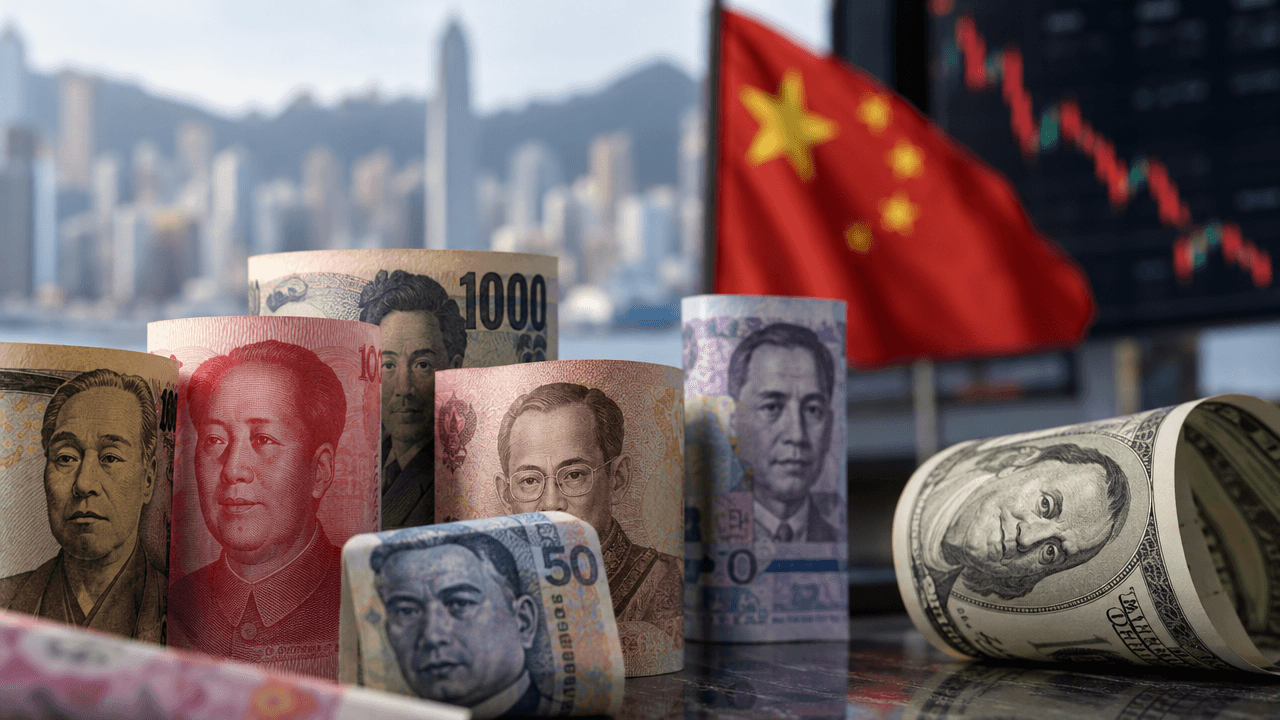
Asian currencies moved higher on Wednesday as the U.S. dollar retreated, but the Chinese yuan moved in the opposite direction. The divergence highlights an important market lesson: regional currencies do not respond only to broad dollar trends. Central-bank policy, trade flows, political uncertainty, and the pace of previous gains can create very different outcomes from one economy to another.
The dollar weakened as investors assessed uncertainty surrounding U.S. midterm election results. A softer dollar generally provides relief for emerging-market currencies because it reduces the local-currency cost of dollar-denominated debt, imports, and corporate funding. It can also encourage investors to seek higher returns in Asian markets, supporting currencies such as the South Korean won and other regional units. [2]
Yet the yuan underperformed after the People’s Bank of China signaled that it was uncomfortable with the speed of the currency’s recent appreciation. The onshore yuan fell to around 6.68 per dollar, reaching its weakest level in more than two weeks after Beijing announced measures designed to slow the rally. [4]
THE DOLLAR’S RETREAT SUPPORTS ASIAN CURRENCIES
Currency markets often move in relative terms. When the dollar declines, Asian currencies can gain even if their domestic economic conditions have not changed dramatically. Traders may reduce defensive dollar positions, while investors reassess expectations for U.S. interest rates, fiscal policy, and political stability.
U.S. political uncertainty can increase short-term volatility in both directions. Initially, investors may seek the safety of the dollar. However, if political developments are interpreted as limiting the prospect of aggressive policy changes or creating uncertainty around future government decisions, the dollar can lose momentum. The resulting weakness gives Asian currencies room to strengthen.
A softer dollar also improves the outlook for economies that rely heavily on imported commodities or dollar-priced raw materials. If the local currency appreciates, import costs may become more manageable, potentially easing pressure on inflation and corporate margins. For central banks, that can reduce the urgency to maintain restrictive interest rates.
However, currency gains are rarely uniform. Investors still distinguish between countries based on growth prospects, interest-rate differentials, current-account balances, and exposure to global trade. The latest session demonstrates why traders should treat “Asian currencies” as a broad category rather than a single market.
Why The Yuan Underperformed
The yuan’s weakness was driven primarily by policy rather than by a sudden deterioration in China’s economic outlook. On Tuesday, the PBOC announced that it would raise the foreign-exchange reserve requirement ratio for financial institutions from 4% to 6%, effective November 15. [5]
The measure requires banks to hold a larger share of their foreign-currency deposits as reserves. By reducing the amount of foreign currency available for immediate use in the banking system, the policy can discourage institutions from selling dollars aggressively. That, in turn, reduces upward pressure on the yuan.
The move followed a powerful yuan rally. The currency had recorded 13 consecutive sessions of gains, its longest winning streak since 1996, before the PBOC intervened to moderate its pace. [9] From Beijing’s perspective, a rapidly appreciating currency can create problems even when it reflects strong export earnings or large capital inflows.
A stronger yuan makes Chinese exports more expensive for overseas buyers and can reduce the local-currency value of exporters’ foreign revenue. It can also attract speculative inflows if investors believe appreciation will continue. By signaling that it wants a smoother and more controlled advance, the PBOC is attempting to limit both economic disruption and one-way market positioning.
What Traders Should Watch Next
The key question is whether the PBOC’s action marks a temporary pause or the beginning of a broader shift in yuan policy. A single reserve-ratio adjustment does not necessarily indicate that Chinese officials want a substantially weaker currency. It may simply establish a slower pace of appreciation after an unusually strong move.
Traders should monitor the daily yuan fixing, official language from Chinese policymakers, and the relationship between onshore and offshore yuan markets. A consistently weaker fixing would suggest that authorities are becoming more comfortable with depreciation. By contrast, stable or firm guidance could indicate that Beijing is managing volatility rather than reversing the currency’s broader trend.
The dollar’s direction will remain equally important. Further U.S. political uncertainty, changing expectations for Federal Reserve policy, or weaker American economic data could extend dollar losses and support Asian currencies. Conversely, a renewed demand for safe-haven assets could quickly restore dollar strength and place pressure on regional foreign-exchange markets.
Investors should also track China’s export performance, domestic demand, capital flows, and the interest-rate gap between China and the United States. Strong exports may continue supporting the yuan, while weaker domestic conditions could encourage policymakers to resist excessive appreciation.
Practical Takeaways For Simfi Traders
For SimFi traders, this market offers a useful scenario-building exercise. The first scenario is a broad dollar decline: Asian currencies rise, risk appetite improves, and emerging-market assets attract capital. The second is a policy-driven divergence: most regional currencies strengthen while the yuan falls because Beijing acts to slow appreciation. The third is a reversal, in which political uncertainty triggers renewed demand for dollars and pressures the entire Asian currency complex.
Rather than trading a headline mechanically, compare the fundamental driver behind each currency move. A weaker dollar may be supportive, but central-bank intervention can override that influence. Position sizing should reflect this possibility, especially when official policy announcements are expected.
The broader lesson is that currency markets price both direction and speed. The PBOC did not necessarily reject a stronger yuan; it objected to the pace of the rally. That distinction matters for anyone evaluating whether a move represents a lasting trend or a temporary adjustment.
Asian currencies may continue benefiting if the dollar remains under pressure, but the yuan’s underperformance shows that regional momentum is not guaranteed. Successful traders will watch the interaction between global risk sentiment and local policy decisions, using both to form balanced, clearly defined scenarios.