
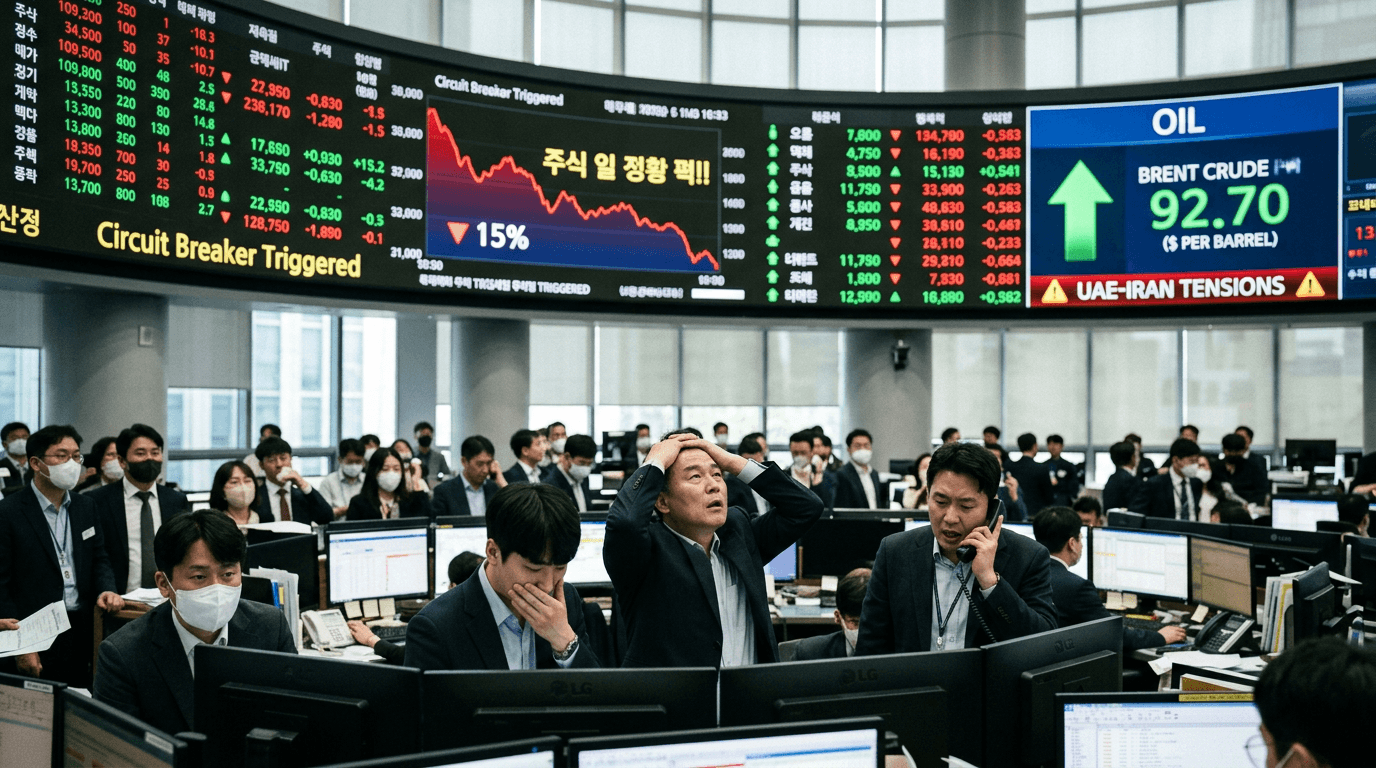
Asian equity markets were jolted by a sharp risk-off move as renewed UAE-Iran tensions pushed oil higher for a fourth straight session and triggered circuit breakers in South Korea, underscoring how geopolitics can rapidly reprice risk across asset classes[1][6][9]. The selloff is reinforcing safe-haven flows into FX and high-quality sovereigns, while leaving energy-sensitive sectors and futures under pressure as traders reassess growth and inflation expectations[7][9].
Market Snapshot
The latest bout of volatility has been driven by escalating confrontation between Iran and key Gulf states, including the UAE, with missile and drone attacks prompting temporary trading suspensions in parts of the region and broad declines in local equity indices[1][3][13]. Gulf markets including Dubai and Qatar have already recorded sizeable drawdowns this year whenever the conflict narrative has intensified, reflecting investor sensitivity to any disruption in trade routes and energy exports[1][3][15].
Across wider Asia, benchmark indices in Japan, South Korea, Australia and mainland China have all traded lower when Middle East tensions have flared, highlighting Asia’s exposure to both higher energy import costs and global risk sentiment swings[7]. In South Korea, the KOSPI has seen multiple sessions of double-digit percentage declines since the Iran conflict broke out, with circuit breakers triggered as losses exceeded 8% in a single day[6][9][10].
Oil prices have extended gains as traders price in higher probability of supply disruption or logistical bottlenecks in the Gulf, a region that remains central to global crude exports[1][15]. With crude rising for a fourth consecutive day, the move is feeding into inflation expectations and compressing equity valuations for energy-importing economies, particularly in Asia where many countries remain net importers of oil[7][9].
Geopolitics, Oil And Risk Sentiment
Geopolitical shocks in energy-producing regions typically transmit to markets through three main channels: higher expected energy prices, increased uncertainty premia, and shifts in capital flows toward perceived safe havens. The UAE-Iran tensions encapsulate all three, with crude rallying, volatility rising, and equities weakening in tandem[1][3][15].
Higher oil prices act as a tax on growth for net importers, squeezing corporate margins and household purchasing power. Equity investors respond by rotating out of cyclical sectors—such as consumer discretionary, travel, and manufacturing—and into defensive areas like utilities, staples, and select energy producers that benefit from higher prices[7][9].
At the same time, geopolitical risk lifts the “uncertainty discount” markets apply to future earnings. Price multiples compress as investors demand higher returns to hold risk assets, particularly in markets geographically closer to the conflict or heavily reliant on trade routes that pass through the Gulf[7][13]. These dynamics help explain why Asia, despite being physically distant, tends to react strongly whenever Middle East tensions flare.
For traders on simulated finance platforms, this environment is an opportunity to study how macro shocks propagate through indices, sectors, and single stocks. By observing how Asian benchmarks move in response to each escalation or de-escalation headline, SimFi participants can build intuition about correlations, beta, and cross-asset contagion.
Safe-haven Flows And Fx Dynamics
As equities decline and volatility rises, capital typically migrates toward safe-haven assets such as the U.S. dollar, Japanese yen, Swiss franc, and high-grade government bonds. Episodes of Middle East tension have repeatedly coincided with stronger demand for these currencies, tightening financial conditions for emerging markets and higher-beta equity indices[7][9].
In the current episode, the combination of oil’s persistent strength and sharp equity drawdowns is likely to reinforce demand for safe-haven FX while weighing on regional currencies exposed to energy imports and risk sentiment, such as the Korean won and some Gulf FX proxies[6][7][9]. When Korean stocks posted their worst daily loss on record amid Iran conflict concerns, the won simultaneously weakened to multi-year lows, illustrating the feedback loop between equity stress and currency depreciation[6].
For traders, monitoring FX alongside equities and commodities is critical. A spike in oil and a simultaneous slide in local currencies can compound the impact on foreign investors, who see both asset prices and FX translation moving against them. In simulations, stress-testing portfolios under combined equity and FX shocks provides a more realistic picture of risk than looking at each asset class in isolation.
Impact On Futures And Energy-sensitive Assets
Energy-sensitive futures—such as contracts linked to airlines, shipping, petrochemicals, and broader cyclical indices—are particularly exposed when oil rallies on geopolitical risk. As crude rises, markets often price in higher input costs and potential margin compression, leading to lower fair values for futures tied to those sectors[7][9].
In South Korea, circuit breaker events on the KOSPI have coincided with heavy selling in tech and cyclical futures, reflecting both fundamental concerns and forced de-risking by leveraged participants[6][9][10]. Circuit breakers, which halt trading when indices fall beyond predefined thresholds (often starting at 8% intraday), are designed to slow panic selling and give market participants time to reassess information[8][9][10].
Understanding how these mechanisms work is vital for both live and simulated trading. When a circuit breaker is triggered, liquidity temporarily evaporates, spreads can widen, and order execution risk increases once trading resumes. SimFi platforms can replicate such conditions, allowing traders to experiment with strategies for managing slippage, adjusting position sizes, or using options and volatility products to hedge against violent price moves.
For energy-sensitive equities and futures, scenario analysis is especially useful. Traders can construct “oil shock” scenarios—for example, a 10–20% jump in crude—then observe how different sectors and indices respond. Over time, this builds a playbook for reacting when real-world events, such as UAE-Iran tensions, produce similar patterns.
Key Takeaways For Traders
Recent market action around UAE-Iran tensions and the associated move in oil prices offers several practical lessons for traders and investors across both live and simulated environments:
- Link news to markets: Map each geopolitical headline to observable price changes in equities, oil, FX, and futures to strengthen macro-to-market intuition.
- Respect cross-asset risk: Treat energy price shocks, currency moves, and equity volatility as interconnected rather than isolated events.
- Study market microstructure: Learn how circuit breakers and trading halts work, and how they influence liquidity, execution, and slippage during stress.
- Build scenarios in advance: Use simulations to pre-test responses to oil spikes, FX swings, and index drawdowns, so decisions are faster and more disciplined when volatility hits.
- Focus on risk management: Position sizing, diversification, and hedging matter more during geopolitical episodes than chasing short-term moves.
Conclusion
Asian equities sliding alongside a multi-day oil rally on UAE-Iran tensions is a textbook example of how geopolitics can quickly reshape the risk landscape across regions and asset classes[1][3][7][9]. The activation of circuit breakers in markets like South Korea, the pressure on energy-sensitive sectors, and the rotation into safe-haven FX all reflect a common theme: in a globally connected market, local events rarely stay local[6][9].
For traders, especially those honing their skills on SimFi platforms, this episode is a reminder that success in markets depends not only on chart patterns or single-stock stories, but on understanding macro narratives and cross-asset relationships. By using simulated environments to practice under stress, develop scenario playbooks, and refine risk management, traders can be better prepared for the next time geopolitics and energy markets collide—and avoid being caught off-guard when the circuit breakers flip and risk assets suddenly reprice.