
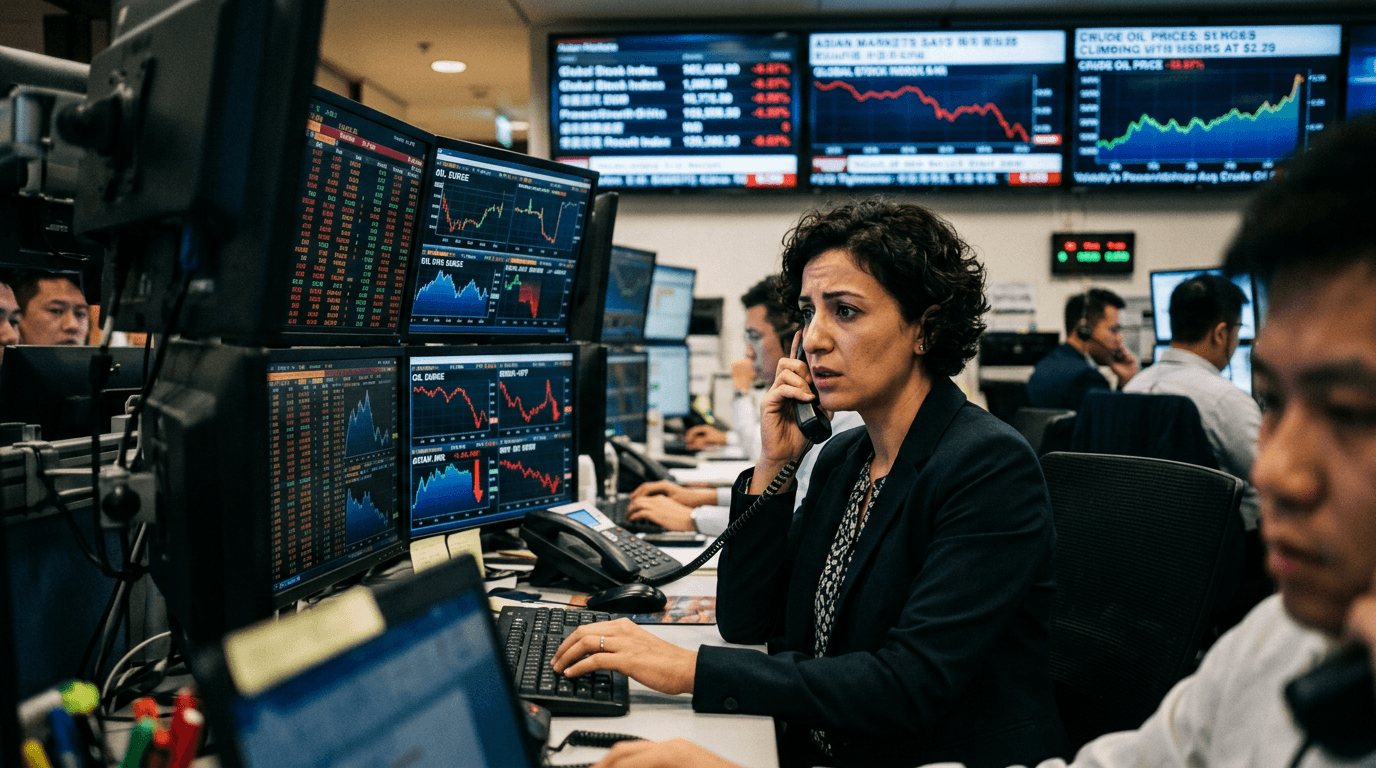
Asian equities are under pressure as renewed Middle East tensions and a persistent rally in oil prices push global investors into a defensive, risk-off stance[3][4][7]. South Korea’s Kospi has slumped in extremely volatile trade, triggering circuit breakers after double-digit intraday losses, while other regional benchmarks like Japan’s Nikkei and Hong Kong’s Hang Seng have also dropped sharply[4][15]. At the same time, crude has extended gains for a fourth consecutive session, reinforcing fears that energy-driven inflation could stay higher for longer and supporting the dollar at the expense of pro-cyclical currencies and risk assets[3][4][7][8].
ASIA’S RISK-OFF OPEN: WHAT JUST HAPPENED
Recent sessions in Asia have seen broad-based weakness, with MSCI’s Asia-Pacific ex-Japan index, the Nikkei, and the Kospi all registering meaningful declines as tensions between Iran, the U.S., and regional players like the UAE escalate[3][4][8][15]. In South Korea, the Kospi has been particularly hard hit, tumbling around 12% intraday as exporters, shippers, and energy-intensive sectors sold off on fears of higher fuel costs and disrupted shipping routes[15]. Other major markets, including Hong Kong and Singapore, have seen losses in the 2–3% range, reflecting a generalized de-risking across the region[15]. Oil benchmarks such as Brent and WTI are trading in the high‑80s to high‑90s per barrel, with recent swings taking Brent above the 90–95 range and, in some episodes, briefly above $100[3][4][7][8]. This combination of elevated oil and geopolitical uncertainty is classic risk-off fuel, pushing investors toward cash and safe havens and away from cyclical equities and emerging-market FX[2][5][7].
Why Middle East Tensions Hit Asian Equities
The Middle East remains central to global energy supply, and any conflict that threatens key transit routes like the Strait of Hormuz or major producing countries tends to be priced immediately into oil and risk assets worldwide[1][7][15]. When traders see UAE-Iran tensions rising or strikes on oil and transport infrastructure, the first instinct is to build in a geopolitical risk premium to crude, which in turn raises expected energy costs for Asian importers like South Korea, Japan, and India[7][13][15]. Higher energy costs squeeze corporate margins, especially in transport, manufacturing, and consumer sectors, and can ultimately weigh on earnings forecasts and price-to-earnings multiples for equity markets across the region[5][7]. At the same time, the possibility of shipping disruptions and insurance cost spikes adds another layer of uncertainty for Asian exporters that rely on stable maritime trade routes through the Middle East[1][15]. The result is a feedback loop: geopolitical headlines push oil higher, oil strength feeds inflation and growth worries, and equities sell off as investors demand higher risk premia[5][7].
Oil, Inflation And The Macro Narrative
Oil is not just a commodity story in this environment; it is a macro story about inflation, growth, and central bank reaction functions[1][2][7]. Brent crude has recently traded in the low‑90s and at times surged above $100 per barrel, while WTI has climbed into the mid‑ to high‑90s, marking one of the strongest rallies since earlier geopolitical shocks[1][2][3][7]. For Asia, where many economies are energy importers, sustained high oil prices quickly translate into higher headline inflation and wider trade deficits[5][7][8]. Investors are already worried that an extended oil spike could derail the disinflation narrative and trigger talk of stagflation, recalling the combination of slowed growth and high prices seen in previous oil crises[5][7]. Central banks that had been inching toward rate cuts may need to pause or even reconsider their path, which further pressures equity valuations, particularly in growth and high‑duration assets that are sensitive to real yields[1][7]. This is one reason why recent weakness in Asia has coincided with an unwinding of crowded trades in themes like artificial intelligence, as rising real yields and risk aversion prompt investors to rotate away from expensive future‑earnings stories[4][7].
Currency Impact: Dollar Strength And Pro-cyclical Fx
Risk-off episodes driven by geopolitics and oil typically show up quickly in currency markets, and this environment is no exception[7]. The dollar tends to benefit as global investors seek liquidity and perceived safety, while pro‑cyclical and commodity‑linked currencies such as the Korean won, Australian dollar, and various emerging Asian FX often weaken[5][7]. Higher oil also pressures current accounts for energy importers, adding fundamental justification for currency depreciation alongside the risk‑sentiment effect[5][8]. Safe‑haven currencies like the Japanese yen and Swiss franc can see bouts of strength, although the yen’s behavior is complicated by yield differentials and domestic monetary policy[7]. For traders, this means that FX is a key transmission channel of Middle East risk into Asian portfolios: equity selling is often accompanied by currency moves that can either amplify or hedge exposure, depending on positioning.
Sector And Style Rotation To Watch
Geopolitical shocks do not hit all sectors equally, and the current episode is showing familiar patterns in cross‑sector performance[6][15]. Airlines, tourism, and shipping firms are under pressure as investors price in higher fuel costs, potential route disruptions, and softer travel demand in a more uncertain environment[6][15]. Cyclical sectors tied to global trade and manufacturing, such as autos, semiconductors, and industrials, are also vulnerable as risk appetite fades and earnings visibility becomes cloudy[4][15]. In contrast, energy producers and some commodity‑linked names have been relative winners, benefiting directly from higher oil and the prospect of wider margins[6][7]. In the Gulf, for example, the Iran war has already wiped around $120 billion off the value of Dubai and Abu Dhabi stock markets, with indexes down double digits since hostilities escalated and broader regional benchmarks also retreating[11][13]. This underscores how even markets that might benefit from higher oil prices are not immune to risk‑premium-driven equity selling when geopolitical uncertainty dominates[10][11][14].
How Traders Can Navigate This Environment
For both live and simulated traders, geopolitical‑oil shocks are valuable case studies in risk management, scenario planning, and cross‑asset thinking. One practical approach is to build simple scenarios around three variables: the path of the conflict, the level of oil, and central bank response. Traders can map how different combinations—for example, rapid de‑escalation with oil back below $85, versus prolonged tensions with Brent above $105—might affect equities, FX, and rates, and then stress‑test positions against these paths[1][2][7]. On a SimFi platform like E8 Markets, this can translate into simulated portfolios where users experiment with hedging equity exposure via energy stocks, options, or FX, and observe how correlation structures change in risk‑off regimes. Another key discipline is position sizing and diversification: concentrating exposure in a single region, sector, or theme (such as AI or cyclicals) increases vulnerability when a shock hits, whereas balanced allocations across defensives, energy, and different geographies can smooth drawdowns[4][6][7]. Finally, traders should avoid over‑reacting to every headline; instead, use predefined levels, volatility triggers, and economic data points to guide decisions rather than trading purely on emotion.
In practical terms, three actionable takeaways stand out. First, keep a close eye on oil curves and real yields; persistent moves higher in both are a clear warning sign for equities and high‑beta FX[1][7]. Second, monitor sector performance for signs of rotation—such as energy and defensives outperforming travel, tech, and cyclicals—which can reveal how institutional money is repositioning and where relative opportunities may lie[4][6][15]. Third, use simulated trading or paper portfolios to rehearse risk‑off playbooks: when volatility spikes, execution is easier for traders who have already tested how to hedge, reduce, or rotate positions rather than improvising in real time.
The latest slide in Asian equities, driven by Middle East tensions and higher oil, is a reminder that geopolitical risk can quickly override local fundamentals and turn a calm market into a risk‑off environment[3][4][7][15]. While this episode is not yet on the scale of a major central bank shock or a global financial crisis, it is significant enough to reshape short‑term positioning, revive inflation concerns, and test traders’ risk management frameworks[5][7]. For active and simulated traders alike, treating events like these as live drills—observing how oil, equities, FX, and rates interact—can build the skills and confidence needed to navigate the next bout of market stress more effectively.