
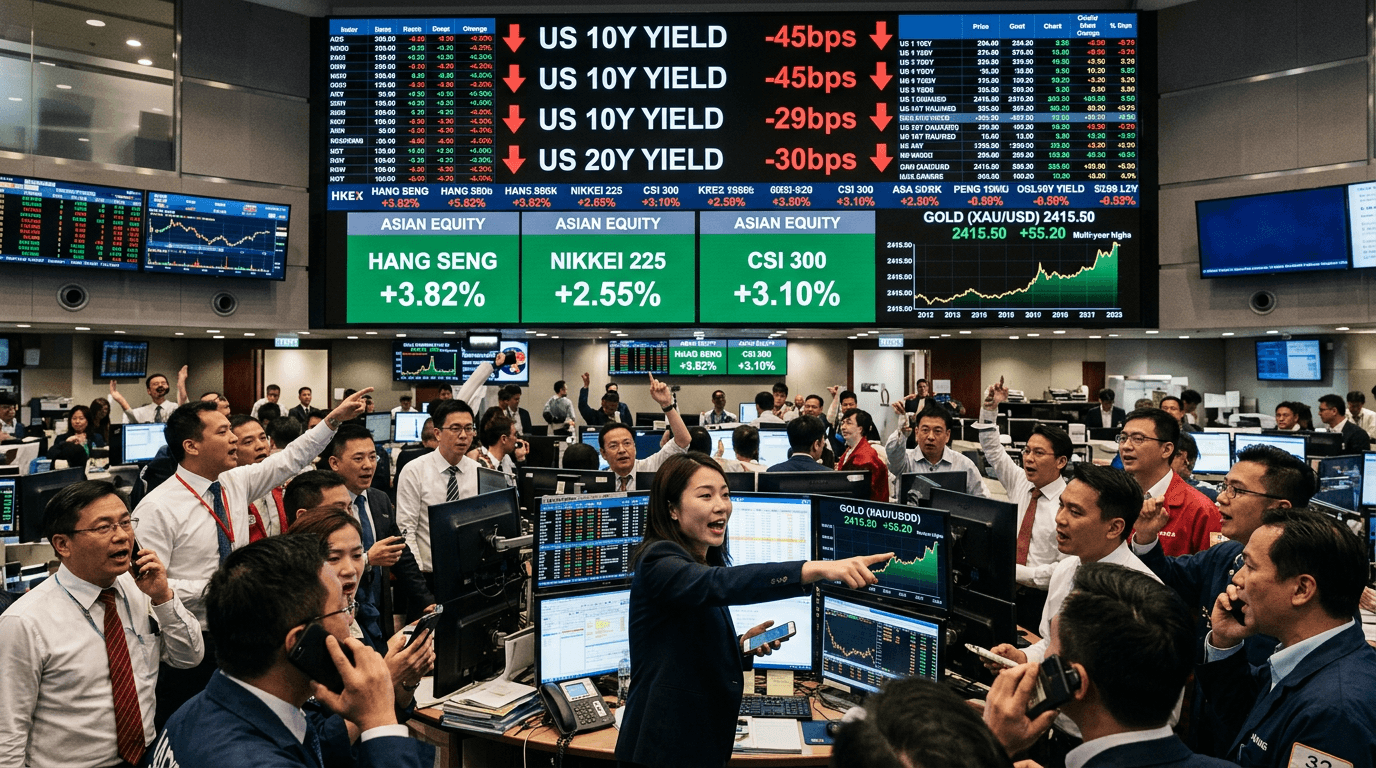
Asian markets woke up to a potent mix of falling U.S. yields, a softer dollar, and a sudden return of risk appetite after the U.S. Treasury shocked investors with an aggressive expansion of its bond buyback program.[8][11] The move cooled a relentless rise in long-term borrowing costs, helping Asian equities rally while gold surged to multi-year highs as investors rebalanced between risk assets and safe-haven hedges.[1][7][9]
Market Reaction At A Glance
The U.S. Treasury’s announcement to double the size of “liquidity support” buybacks for longer-dated bonds, particularly those in the 10- to 30-year sector, immediately pushed prices higher and yields lower across the curve.[9][10][11] Thirty-year Treasury yields dropped by almost 10 basis points from multi-decade highs, easing some of the pressure that had been building in global funding costs.[8][10][11]
Lower yields and a weaker dollar created a supportive backdrop for dollar-priced assets, with gold futures jumping around 3–4% and spot prices climbing toward or above the $4,450–$4,500 per ounce area, levels not seen since early June.[1][2][14] Asian trading hours amplified these moves: Treasuries held their gains, the dollar stayed on the back foot, and that combination underpinned both a broad equity bid and strong demand for precious metals.[7][8][11]
In equity space, futures and cash markets across key Asian indices caught a tailwind from the U.S. move, as investors priced in lower effective term premia and improved liquidity in global bond markets.[8][11][14] The relief in yields acted like a pressure valve, lifting sectors that had been under strain from higher discount rates and reigniting risk sentiment in the region.[4][6][15]
WHY THE U.S. BOND BUYBACK MATTERS
At the core of the move is the Treasury’s decision to significantly scale up its repurchases of older, less-liquid “off-the-run” bonds, effectively injecting liquidity into segments of the long-end market that had become fragile as yields climbed to multi-decade highs.[9][10][14] Individual buyback operations are set to rise from around $2 billion to at least $4 billion, signaling a concerted effort to ease market functioning stresses and smooth the supply of long-dated paper.[2][9][10]
Practically, buybacks reduce the amount of outstanding longer-term bonds available to investors, which tends to push their prices up and yields down.[12][14] When the supply of certain maturities tightens, term premia—the extra compensation investors demand for holding long-term debt—can compress, easing overall financial conditions even if policy rates remain restrictive.[8][11][12]
Markets interpreted the move as both a liquidity backstop and a subtle signal that policymakers were uncomfortable with the speed and level of the recent rise in yields.[8][11][14] That perception fed into a rapid reassessment of risk across asset classes: equities gained breathing room, credit spreads stabilized, and safe-haven flows into Treasuries and gold intensified simultaneously.[1][7][10]
For traders, this episode underscores how micro-structure decisions—such as the size and focus of Treasury buybacks—can have macro-level ripple effects on currencies, rates, equities, and commodities in a matter of hours.[8][11][14] Simulated environments that integrate these cross-asset linkages give participants a chance to rehearse how to react when policy tweaks trigger large repricings.
ASIAN EQUITIES: RELIEF RALLY OR DURABLE TURN?
Asian equity markets responded swiftly to the reset in global yields, with benchmark indices across Japan, South Korea, and broader regional gauges extending gains that had been primed by prior strength in Wall Street and AI-related names.[4][6][15] Lower U.S. yields reduce the relative attractiveness of dollar assets and can lessen pressure on Asian currencies, which in turn supports local risk assets by easing capital outflow concerns.[8][11]
Rate-sensitive sectors such as technology, growth stocks, and heavily leveraged companies tend to benefit most when discount rates fall, as the present value of their future earnings streams rises.[4][5][15] Investors leaned back into these segments during the Asia session, helped by the perception that the Treasury’s actions could keep long-term borrowing costs from spiraling higher, at least in the near term.[8][11][14]
However, the relief is not without caveats. The same Reuters coverage that documented the bounce in Treasuries and risk assets also highlighted lingering worries about persistent inflation and ballooning U.S. debt loads, both of which could put upward pressure on yields again over time.[8][11] In other words, Asia’s rally may represent a tactical response to a policy surprise rather than a guaranteed turning point in the broader rates cycle.[6][8]
For SimFi participants, this is an ideal case study in scenario analysis: one path assumes sustained yield moderation and continued multiple expansion in equities; another assumes buybacks offer only temporary relief before renewed bond selling tests risk assets again. Simulated portfolios can be stress-tested against both narratives.
GOLD’S SAFE-HAVEN ROLE REINFORCED
Gold’s reaction to the Treasury announcement was textbook: as yields and the dollar fell, the opportunity cost of holding a non-yielding asset dropped, prompting a sharp move higher in bullion.[1][7][14] Spot and futures markets saw brisk buying, with prices leaping roughly $100 in less than an hour and pushing toward or above $4,450–$4,500 per ounce, the highest levels since early June.[1][2][10]
The dual driver of lower real yields and a weaker dollar gave gold a “double boost,” amplifying the move beyond what might typically be expected from a single policy headline.[3][9][14] Silver also joined the rally, reversing earlier losses and underscoring the broader constructive tone across precious metals.[9][10]
What is notable is that gold rallied alongside equities rather than in opposition to them, reflecting a more nuanced risk environment where investors simultaneously sought risk exposure and hedges.[1][7][10] This coexistence reinforces gold’s role not just as a crisis asset, but as a strategic portfolio diversifier that can benefit from shifts in monetary and liquidity conditions.
For traders, the episode highlights the importance of monitoring cross-asset signals: when policy actions compress yields, gold can respond as quickly—and sometimes more violently—than equities, particularly if speculative positioning and options flows are skewed.[1][7][14] Simulated trading environments that allow experimentation with gold, equity indices, and currency hedges help build an intuitive sense of how these relationships evolve in real time.
Takeaways For Traders And Simfi Users
A few practical lessons stand out from this bond buyback shock and its ripple through Asian equities and gold:
First, liquidity operations can be as market-moving as rate decisions. The Treasury did not change policy rates, yet the decision to double buybacks at the long end delivered an immediate tightening or easing of financial conditions via lower yields and a weaker dollar.[8][11][14] Traders who focus only on central bank meetings risk missing these equally impactful announcements.
Second, cross-asset awareness is essential. The sequence—Treasury buybacks, bond rally, yield drop, dollar weakness, gold surge, equity rally—illustrates how one policy lever can propagate across markets within a single session.[1][7][8] A well-structured trading or simulation framework should track these links and allow for multi-asset strategies that respond dynamically.
Third, risk management remains critical. While markets embraced the buyback news, concerns over inflation and fiscal sustainability remain unresolved.[8][11] A prudent approach uses days like this to rebalance, lock in gains, and test portfolios against adverse scenarios where yields resume their climb and risk assets give back recent advances.
In a SimFi context, traders can use this event as a template for building “policy shock” playbooks. That might include pre-defined rules for adjusting duration exposure, rotating between cyclical and defensive equities, or scaling into and out of gold and currency hedges as yields and the dollar move. Practicing these responses in a risk-free environment can improve execution discipline when similar shocks hit live markets.
Conclusion
The U.S. Treasury’s surprise move to ramp up long-dated bond buybacks has reverberated quickly through global markets, easing long-term yields, weakening the dollar, and sparking a synchronized rally in Asian equities and gold.[1][7][8] While the relief is tangible, the underlying debates around inflation, debt dynamics, and the durability of lower yields remain unresolved, ensuring that volatility will likely persist.[8][11][14]
For traders and SimFi participants alike, this episode offers a powerful reminder that market regimes can shift abruptly when policy makers adjust the plumbing of the financial system. Those who understand the mechanics, monitor cross-asset signals, and rehearse their responses in simulated environments will be better positioned to navigate the next bond buyback shock—or whatever surprise comes next.