
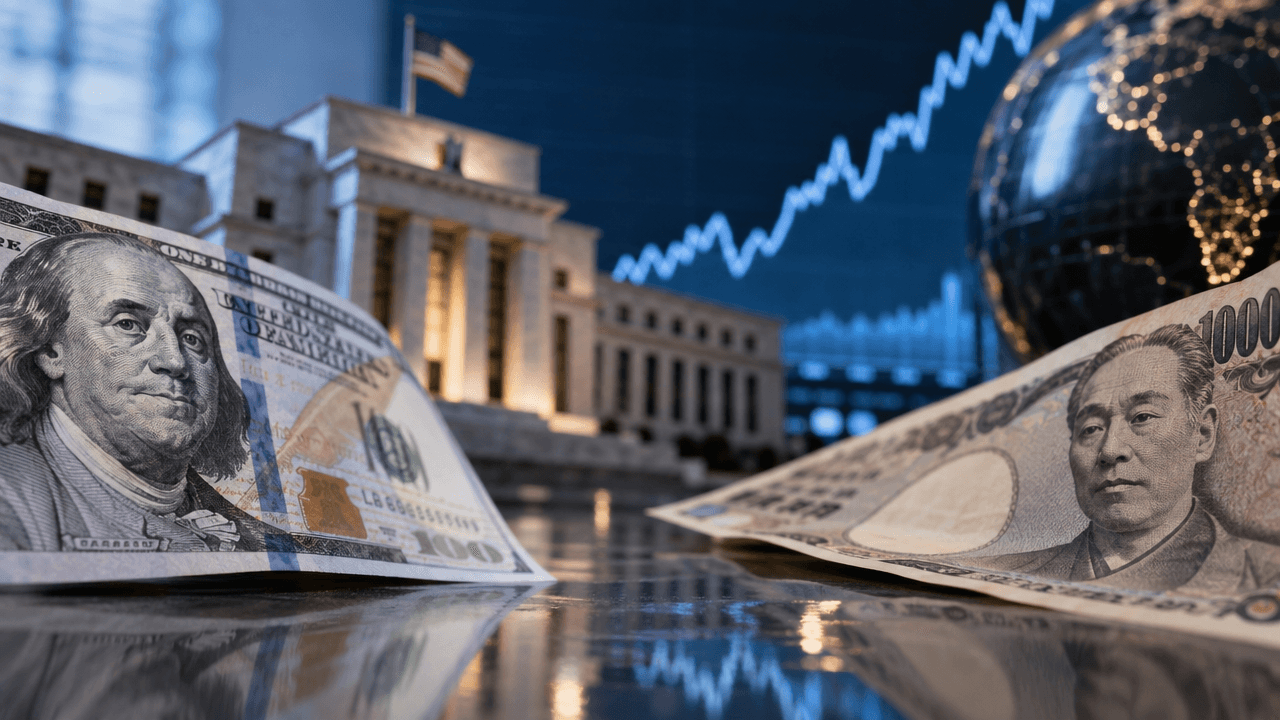
The US dollar is holding its ground as US Treasury yields surge to levels last seen before the global financial crisis, reshaping the landscape for FX, rates, and risk assets. A sustained climb in the 10-year Treasury yield to around 5.29% has pushed borrowing costs higher and reinforced demand for dollar-denominated assets, keeping the greenback supported against a broad basket of currencies.[1][2][3][4] For traders, this environment is about more than a single headline: it reflects deeper shifts in growth expectations, inflation risks, and central bank policy trajectories.[9][10][13]
CURRENT BACKDROP: YIELDS AT MULTI‑DECADE HIGHS
US Treasury yields have broken to fresh multi-year highs, with the 10-year benchmark hovering near 5.29%, up roughly 50 basis points over the past month and more than a full percentage point above levels seen a year ago.[1][2][3][4] Market data show the 10-year yield now sitting well above its long-term average, signaling a significant repricing of the cost of capital in the world’s largest economy.[2][5] This move has not been confined to one point on the curve; longer-dated maturities such as the 30-year have also reached levels last seen in the mid‑2000s, underlining how broad the bond selloff has become.[9][10][15]
Several drivers sit behind this rise in yields. Strong US economic data and persistent inflation pressures have sustained the case for interest rates to remain higher for longer.[9][10][13] At the same time, the market is digesting heavier government borrowing needs and heightened geopolitical risks, including energy-related concerns that could keep inflation elevated.[9][10][15] Together, these factors encourage investors to demand higher compensation for holding longer-term US debt, pushing yields upward.
As yields climb, the dollar index has moved toward multi-month highs, reflecting renewed demand for the currency across major pairs.[10][13] Analysts at major institutions now project continued dollar strength into year-end and beyond, revising earlier expectations for a broad USD decline.[6][9] For traders, this reinforces the classic linkage: when US real and nominal yields rise relative to global peers, the dollar tends to benefit.
Why Treasury Yields Matter For Fx Markets
Treasury yields sit at the heart of global asset pricing because they represent the “risk-free” benchmark used to discount cash flows and value everything from equities to real estate.[15] When those yields rise, the relative attractiveness of dollar assets improves, drawing in capital from global investors seeking higher returns on safe instruments.[9][10][15] This capital inflow typically supports the dollar, as foreign buyers must convert their home currencies into USD to purchase Treasuries and other US securities.[15]
Higher US yields also tighten global financial conditions. As US borrowing costs rise, financing for lower-rated companies, indebted governments, and emerging markets generally becomes more expensive, particularly for those issuing debt in dollars.[15] This can pressure their currencies and widen spreads, prompting periods of risk aversion that further reinforce demand for the dollar as a defensive asset.[9][10][13][15]
From a trading perspective, the key concept is the interest rate differential—the gap between yields and policy rates in different economies. When US yields move sharply higher while other major central banks keep rates low or move more cautiously, the differential widens in favor of the dollar.[9][10][13][15] FX pairs that are sensitive to rate spreads, such as USD/JPY and USD/EM currencies, often respond quickly to these shifts.
Widening Rate Differentials And The Pressured Yen
USD/JPY has been a prime example of how widening rate differentials can drive currency moves. As US yields have surged, the pair has rebounded sharply, keeping the yen under sustained pressure.[9][10][13] Even as Japanese inflation has ticked higher, the Bank of Japan has remained far more accommodative than its global peers, with meeting minutes and communications signaling a cautious approach to normalizing policy.[7][15] That stance leaves short-term Japanese rates near zero while US rates and yields sit at multi-decade highs, creating a wide and persistent yield gap.
For global investors, this gap makes the yen a popular funding currency for carry trades. Borrowing in yen at low cost and investing in higher-yielding dollar assets becomes more attractive as the spread widens.[9][10][15] The resulting flows tend to weaken the yen while supporting the dollar, especially during periods when risk sentiment is stable or improving.
Traders watching USD/JPY should monitor three variables closely: the level and direction of US yields, BoJ communication around yield-curve control and policy normalization, and broader risk appetite in global markets.[7][9][10][13][15] Sudden changes in any of these can trigger sharp reversals, particularly if authorities in Japan become uncomfortable with excessive yen weakness and hint at intervention.
Implications For Active Traders And Investors
The current environment of firm dollar and elevated US yields has several practical implications. First, FX traders need to embed rate expectations and yield dynamics into their strategies rather than treating currency pairs as purely technical instruments.[9][10][13][15] Watching the 2-year and 10-year Treasury yields alongside policy-rate expectations can provide important context for moves in the dollar index and major crosses.[6][9][10][13]
Second, bond and equity traders should recognize that higher yields reshape valuation frameworks. As the discount rate rises, long-duration assets—such as high-growth stocks—face greater pressure, while sectors with strong cash flow and pricing power may hold up better.[9][10][15] This can influence sector rotation and correlations between equities, bonds, and FX.
Third, risk management becomes more critical. Rapid increases in yields can trigger volatility spikes across asset classes, especially if markets begin to question fiscal sustainability or the path of central bank policy.[13][15] Position sizing, diversification, and scenario analysis are essential tools to navigate this type of regime without overexposing capital to a single macro narrative.
On simulated finance platforms, traders can practice expressing macro views through multi-asset strategies—combining USD exposure, yield-sensitive currencies like JPY, and rate-linked instruments—without the capital risk of live markets. This helps refine playbooks for environments where yield moves drive cross-asset repricing and FX trends.
OUTLOOK: WHAT COULD CHANGE THE DOLLAR’S TRAJECTORY?
Although current conditions favor a strong dollar, the story is not one-directional. Several developments could alter the trajectory. A clear shift in US data toward weaker growth or faster disinflation could reduce the need for higher-for-longer rates, easing upward pressure on Treasury yields.[9][10][13] Any move by the Federal Reserve to signal an earlier pivot or greater concern about financial stability could also pull yields lower and narrow rate differentials with other economies.[10][13][15]
On the global side, more assertive tightening by other central banks—or a move by the Bank of Japan toward less accommodative policy—would reduce the relative advantage of US yields.[7][15] Additionally, if markets become more focused on US fiscal risks and political uncertainty, confidence in dollar assets could be tested even with high yields.[13][15]
For now, however, the combination of resilient US data, elevated inflation risks, and a determined stance on policy has pushed Treasury yields to their highest levels since the mid‑2000s, reinforcing the dollar’s strength against many peers.[9][10][13][15] Traders who understand how these forces interact—and who systematically track yield curves, central bank messaging, and cross-asset correlations—will be better positioned to navigate this regime, whether in live markets or simulated environments.