
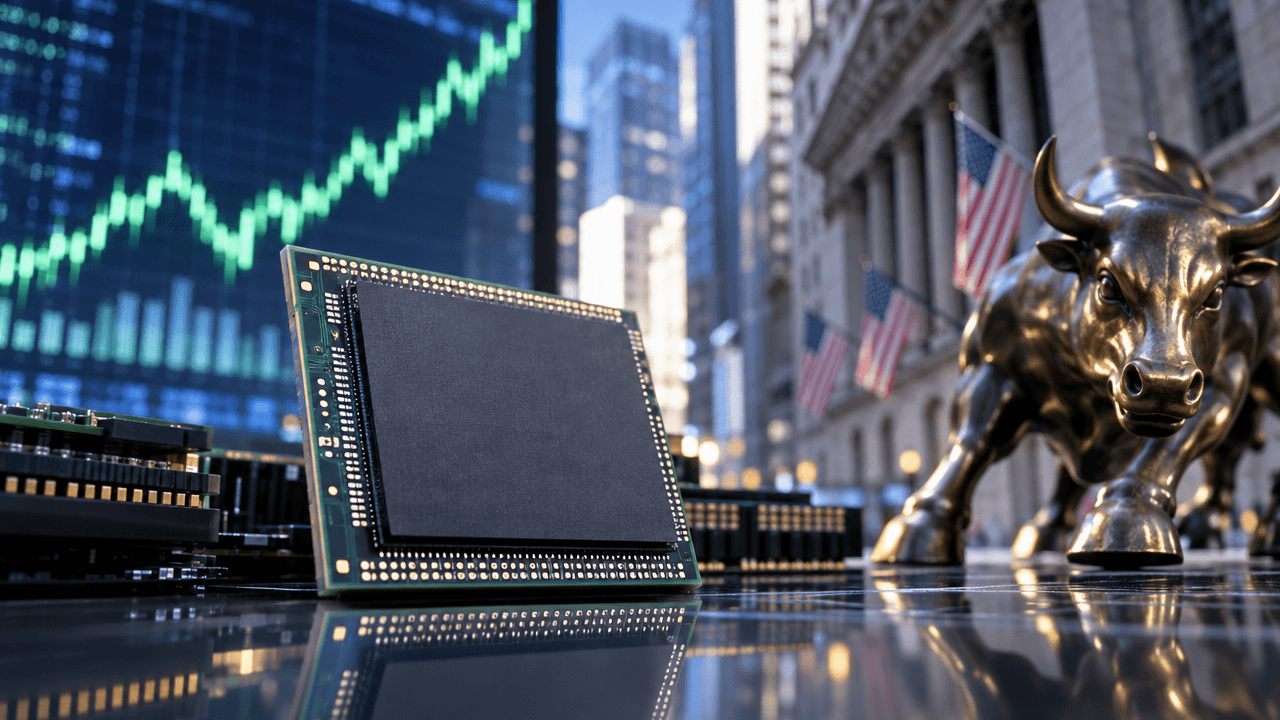
US equity futures are snapping back after a bout of macro-driven selling, with traders seizing on Micron’s upbeat outlook as fresh confirmation that the artificial-intelligence trade remains alive and well.[1][3][15] Nasdaq 100 futures have rebounded around 1%, outpacing a roughly 0.6% rise in S&P 500 futures as investors rotate back into semiconductors and high-growth technology after the earnings beat.[1][6] The move is meaningful because it comes despite still-elevated long-term yields and a firm US dollar, both of which normally weigh on risk appetite.[1][6]
Market Reaction: Why Futures Are Bouncing
Micron’s latest earnings report delivered stronger-than-expected results alongside guidance that topped Wall Street forecasts, reinforcing the narrative of durable demand for AI-related memory and data center chips.[1][3][14] Revenue surged several hundred percent year-on-year, driven by DRAM, NAND, and high-bandwidth memory demand from AI data centers, lifting margins and boosting sentiment across the chip complex.[14][11] In response, Micron shares rallied sharply in after-hours trading, and futures on the Nasdaq 100 and S&P 500 quickly followed as traders priced in stronger earnings visibility for the broader tech sector.[10][12][15]
For equity index futures traders, this type of reaction illustrates how a single, sector-leading earnings release can become a macro signal.[1][15] When a heavyweight in semiconductors beats estimates and raises guidance, it suggests the AI capex cycle is not only intact but potentially accelerating, which feeds into expectations for other names in the ecosystem—from GPU producers to software and cloud platforms.[12][13] The initial move in futures is often fast and liquidity-driven, as systematic strategies and discretionary traders alike seek to re-add exposure they had recently trimmed amid rate and currency volatility.[1][6]
Micron, Semis, And The Ai Growth Narrative
Semiconductors now account for nearly one-fifth of the S&P 500’s market capitalization, a record weighting that underscores how central the sector has become to US equity performance.[13] Within that group, AI-oriented names—ranging from GPU manufacturers to memory and high-bandwidth solutions like Micron—have been key drivers of index-level returns in 2026.[8][13] Strong Micron guidance, including expectations for ongoing constrained supply and robust pricing, suggests that AI infrastructure build-out is still in an early innings phase rather than nearing exhaustion.[14][11]
The earnings beat is particularly important because investors had already been expecting a strong quarter; delivering upside on top of elevated expectations signals genuine demand strength, not just conservative guidance or one-off factors.[6][14] Analysts responded by lifting price targets across the board, reinforcing a bullish consensus on the medium-term outlook for AI-related chipmakers.[11][14] For traders, this reaffirms the idea that AI remains a structural growth story rather than a short-lived thematic trade, even as macro conditions fluctuate.
Macro Headwinds: Yields And The Dollar Still Matter
Despite the relief rally, the backdrop is not entirely benign. Long-term US Treasury yields remain elevated, tightening financial conditions and raising the discount rate applied to future earnings, particularly for growth and tech sectors.[1][6] A strong dollar continues to pressure US multinationals by making overseas revenues worth less in dollar terms and potentially dampening foreign demand.[1][7] These factors explain why the move in futures, while notable, is still characterized as a rebound rather than a full reversal of recent risk-off sentiment.
This tension between robust micro-level earnings and challenging macro-level conditions is a core dynamic traders must navigate. On one hand, AI and semiconductors are delivering exceptional growth, driving index concentration and sector leadership.[8][13] On the other, rates and FX conditions can compress valuations even if earnings stay strong, leading to higher volatility and sharper intraday swings around data releases, central bank speeches, and earnings beats or misses.[1][6][7] Understanding both sides of this equation is essential for constructing resilient strategies.
How Simulated Traders Can Use This Move
For traders operating in a simulated finance environment, Micron’s-driven futures rebound is a live case study in how earnings and macro forces interact. One practical exercise is to map out different scenarios: an earnings-beat-led rally that extends, a fade as yields push higher, or a rotation within tech and semis where leaders outperform laggards.[1][6][12] Simulated trading allows exploration of position sizing, stop placement, and hedging choices without capital at risk, helping refine decision-making before applying similar strategies in live markets.
Another useful framework is sector-relative and factor-based trading. With semiconductors now a dominant slice of the S&P 500, traders can study how chip stocks move relative to broader tech, cyclicals, and defensives around major earnings events.[13] Simulated portfolios can test long-semiconductor versus short-broad-index or dollar-hedged approaches, assessing how sensitive those structures are to macro surprises like inflation prints or policy shifts.[7][15] Over time, this builds intuition about when to lean into the AI narrative and when to step back due to tightening financial conditions.
Key Takeaways For Active Market Participants
First, single-stock earnings from sector bellwethers can have index-level impact, particularly when they sit at the center of a dominant investment theme like AI.[1][3][15] Second, strong micro data does not eliminate macro risks; elevated yields and a firm dollar can coexist with a bullish semiconductor outlook, leading to choppy, headline-driven markets.[1][6] Third, concentration risk is real: with semiconductors nearing 20% of the S&P 500, volatility in this group can translate directly into broader index swings.[13]
For traders and investors, the message is clear: respect the power of theme leaders, but do not ignore the macro currents underneath.[1][6][8] Simulated environments offer an ideal sandbox to practice responding to earnings shocks, testing AI and semiconductor exposure, and building rules for when to add or cut risk based on the interplay between company-specific news and global conditions.[12][15] As Micron’s outlook shows, the AI story remains a dominant driver of US equity sentiment—yet it is playing out on top of a still-unfinished macro chapter.