
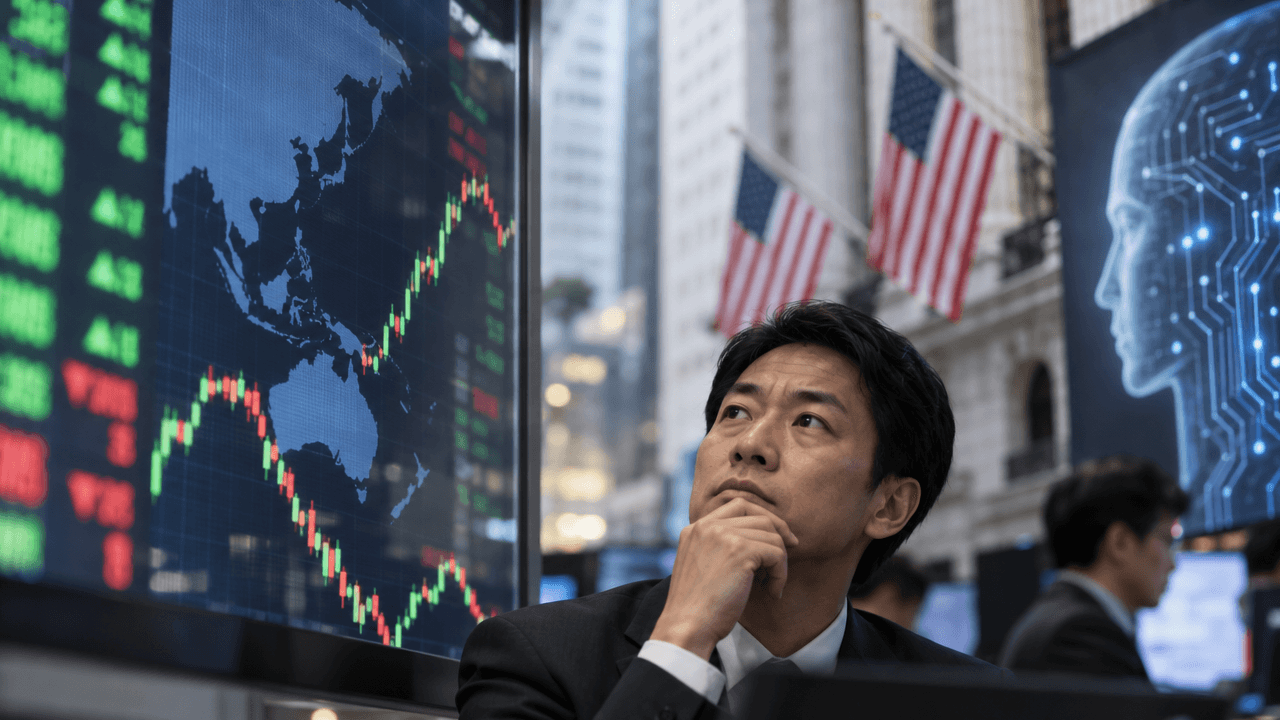
Asian equities staged a measured rebound on Thursday as investors returned to technology and other risk-sensitive assets after Wall Street recovered from steep early losses. Japan’s Nikkei 225 rose 1.6%, South Korea’s Kospi gained 1.9%, and Taiwan’s benchmark added 1.4%, while broader Asia-Pacific shares outside Japan advanced about 1.5%. [3][9]
The recovery, however, was far from a decisive shift in market sentiment. Traders remained cautious as two major uncertainties continued to shape the outlook: proposed U.S. tariffs on 14 trading partners and growing questions about whether the artificial intelligence investment boom can maintain its extraordinary pace. The result was a relief rally rather than a clear return to risk-taking.
What Drove The Asian Rebound
The immediate catalyst was Wall Street’s ability to claw back much of its earlier decline. U.S. technology shares had suffered heavy selling pressure as investors questioned elevated valuations and the enormous capital spending required to build AI infrastructure. When those losses moderated, Asian markets—particularly those with large semiconductor and technology sectors—found room to recover.
The rebound also reflected bargain hunting. After several volatile sessions, investors bought shares that had fallen sharply, especially in markets closely linked to the global chip supply chain. South Korea and Taiwan were natural beneficiaries because their companies supply memory chips, processors, advanced manufacturing equipment, and other components used in data centers and AI systems.
A recovery following a sharp sell-off can be powerful, but it does not necessarily mean the original concerns have disappeared. Traders often use these sessions to reduce short positions or purchase temporarily discounted assets. For a longer-lasting advance, markets will need evidence that corporate earnings, demand, and economic conditions justify current valuations.
Tariffs Keep Inflation Risks Alive
The White House proposed new tariffs affecting 14 major trading partners, including China, Japan, South Korea, India, Taiwan, the European Union, and several Southeast Asian economies. The measures followed a months-long investigation into alleged excess industrial capacity. [1][10]
Markets reacted with relative calm partly because the proposed duties were not as damaging as some investors had feared. Crucially, the new tariffs are not expected to be added on top of duties introduced in July. That distinction reduced the risk of an immediate and dramatic increase in import costs. [1][6]
Nevertheless, the proposals add another layer of uncertainty for companies that depend on cross-border manufacturing and sales. Businesses may respond by raising prices, changing suppliers, delaying investment, or passing higher costs to consumers. Each response has economic consequences, particularly when central banks are already monitoring inflation carefully.
For traders, tariffs matter not only because they can hurt individual companies. They can also influence currencies, bond yields, interest-rate expectations, and the profitability of entire industries. Export-heavy markets may face pressure if tariffs weaken external demand, while domestic companies could also suffer if imported materials become more expensive.
The Ai Trade Faces A Reality Check
Artificial intelligence remains one of the most important investment themes in global markets, but its scale has created new questions. Investors are no longer focused only on whether AI adoption will grow. They are asking how quickly massive investments in chips, data centers, electricity, and cloud infrastructure will produce sufficient revenue and profits.
Those concerns intensified after the initial enthusiasm surrounding Nvidia chief executive Jensen Huang’s return to the company faded. Technology shares had rallied earlier in the week, but that optimism proved fragile as traders returned to questions about valuation, financing, and the sustainability of AI-related spending. [2][12]
A key risk is circular financing. AI companies, chipmakers, cloud providers, and infrastructure developers may invest heavily in one another or depend on continued access to cheap capital. If funding conditions tighten or customers slow their spending, expected returns could be pushed further into the future.
That does not mean the AI story is ending. It means markets are becoming more selective. Companies with strong balance sheets, visible cash flow, genuine demand, and a credible path to profitability may continue to attract buyers. Businesses valued primarily on distant expectations could remain vulnerable to sharp reversals.
What Traders Should Watch Next
The most important signal will be whether the rebound broadens beyond a narrow group of technology shares. A healthier market would include participation from financials, industrials, consumer companies, and smaller businesses. Broad participation would suggest improving confidence; a rally concentrated in a few heavily traded technology names would indicate continued fragility.
Traders should also monitor official details surrounding the tariff proposals. Implementation dates, product coverage, exemptions, and the possibility of negotiations could significantly change the economic impact. Headlines may produce rapid movements in equities and currencies before the long-term consequences become clear.
Finally, interest-rate expectations remain central. Tariffs can increase inflation, while a sharp equity decline or weaker AI investment could slow economic growth. Central banks may therefore face a difficult balance between containing price pressures and supporting demand. Bond yields and currency markets could provide early clues about how investors are weighing that trade-off.
Practical Takeaways For Simfi Traders
Avoid treating a one-day rebound as confirmation that volatility has ended. Use smaller position sizes when policy headlines and technology valuations are moving markets simultaneously.
Separate the market’s broad direction from individual opportunities. A strong index performance can conceal weakness in many companies, while a volatile sector may still contain businesses with solid fundamentals.
Define risk before entering a trade. Stop levels, maximum daily loss limits, and predetermined profit targets can help prevent emotional decisions when markets reverse quickly.
Track relationships across asset classes. Rising bond yields, a stronger dollar, or falling semiconductor shares may signal that tariff and AI concerns are again dominating sentiment.
The Asian equity rebound shows how quickly markets can recover when forced selling eases, but it also demonstrates why relief rallies deserve careful scrutiny. Trade policy and AI investment are not isolated stories; they influence inflation, corporate earnings, interest rates, and global supply chains at the same time.
For now, the market is offering opportunity alongside uncertainty. The most disciplined traders will focus less on predicting the next headline and more on managing exposure, assessing the quality of each rally, and waiting for evidence that optimism is supported by durable earnings and economic growth.