
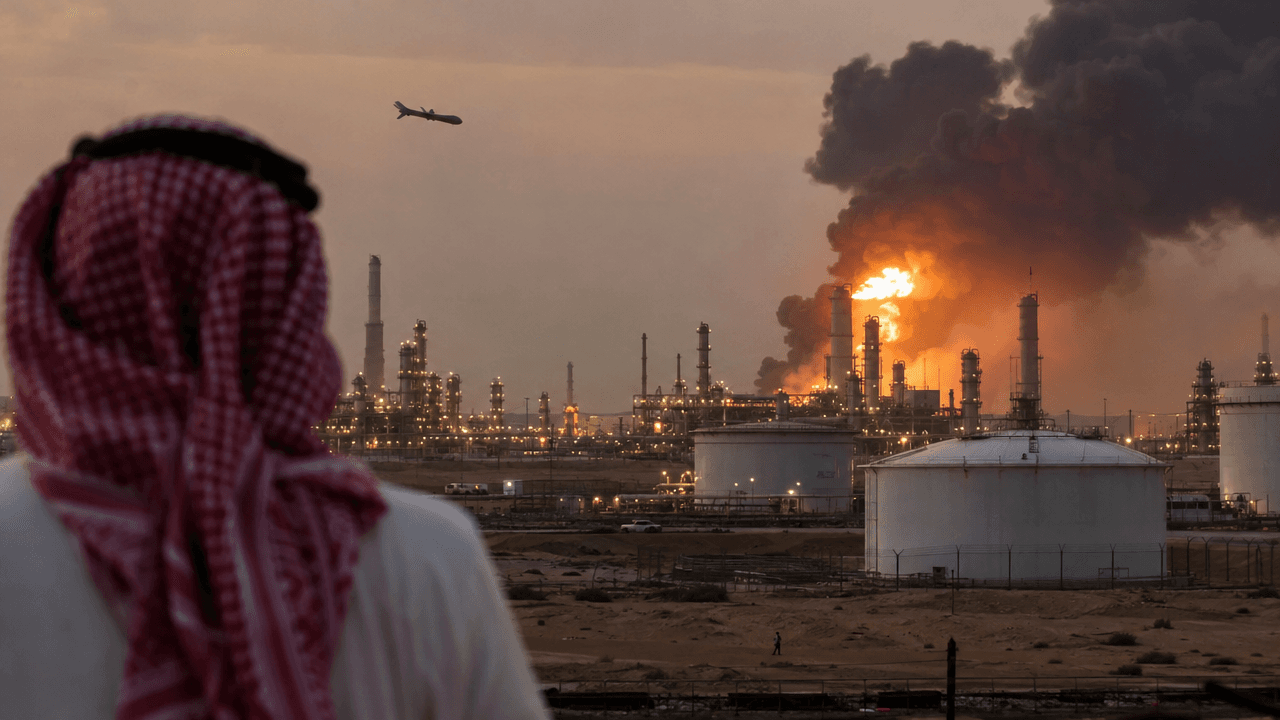
Oil futures moved sharply higher after Yemen’s Iran-aligned Houthi movement reportedly attacked Ras Tanura, Saudi Arabia’s largest oil refinery. The incident revived concerns that a wider regional conflict could disrupt production, refining capacity, or exports from one of the world’s most important energy hubs.
Brent crude futures approached $94.80 per barrel, while U.S. West Texas Intermediate crude moved toward $84.24. Other market updates placed Brent near $94.61 at settlement and WTI near $83.68, highlighting the rapid price movement and changing risk assessment as traders evaluated the report. [3]
The Market Reaction
The initial oil-price response reflected a familiar pattern: geopolitical risk creates a premium before the full extent of any physical supply disruption is known.
Ras Tanura is strategically important because it combines substantial refining capacity with access to a major crude-export terminal. Any sustained damage could affect both the availability of refined petroleum products and the flow of crude into international markets. Reuters reported that the facility sits beside one of the world’s largest crude export terminals, while satellite imagery showed thick black smoke over the installation. [13]
The market’s reaction was also amplified by uncertainty. Saudi authorities and the Saudi-led coalition reportedly acknowledged or intercepted some incoming projectiles but did not immediately confirm the full extent of damage to the refinery. When information is incomplete, traders often price in the possibility of a more serious outcome until operational details become clearer.
For futures traders, this means price volatility can remain elevated even if the initial attack causes limited physical damage. A risk premium can rise quickly and then fall just as quickly if officials confirm that production and exports are continuing normally.
Why Supply Disruption Matters
Saudi Arabia remains one of the central pillars of the global oil market. Its production capacity, export infrastructure, and role in balancing supply make any threat to its energy facilities a significant market event.
A refinery attack can affect prices through several channels. First, damage may reduce the supply of gasoline, diesel, jet fuel, and other refined products. Second, disruptions at export terminals can delay crude shipments even when oil remains available in storage. Third, a successful attack may encourage additional strikes against energy infrastructure, increasing the perceived risk of a broader supply shock.
Oil markets are particularly sensitive to threats near major shipping routes and export facilities. Traders also watch the Strait of Hormuz, the Red Sea, and the Bab el-Mandeb because disruptions in these areas can increase shipping costs, lengthen delivery times, and force vessels to take longer routes.
However, not every attack produces a lasting price rally. The durability of the move depends on whether production is actually lost, how quickly repairs can be completed, whether strategic inventories can offset the shortfall, and whether the conflict spreads to other infrastructure.
The Inflation Connection
Higher oil prices matter well beyond energy markets. Crude is a major input for transportation, manufacturing, agriculture, chemicals, and logistics. Rising gasoline and diesel prices can increase household expenses directly while also raising the cost of moving goods throughout the economy.
The inflation impact depends heavily on duration. A one-day spike may have limited effects on consumer prices. A sustained increase, however, can influence fuel costs, freight rates, airline expenses, and production budgets. Capital Economics has estimated that a 5% rise in oil prices can add approximately 0.1 percentage points to inflation in developed economies if the increase persists. [12]
This creates a difficult environment for central banks. A supply-driven oil shock can raise inflation even while weakening economic activity. Policymakers may therefore face pressure to keep interest rates higher for longer, despite concerns that expensive energy could slow consumer spending and business investment.
For traders, the key question is not simply whether oil rises. It is whether the move changes inflation expectations and interest-rate pricing. A sustained energy rally can support oil-producing currencies and companies while weighing on airlines, transportation firms, manufacturers, and energy-intensive businesses.
What Traders Should Watch Next
The next phase of the market reaction will depend on verified operational information. Traders should monitor statements from Saudi energy authorities, updates on refinery output, shipping data, and reports of damage to pipelines or export terminals.
Price structure can also provide useful information. If Brent remains elevated and the spread between near-term and later contracts strengthens, the market may be signaling concern about immediate supply availability. If prices retreat quickly while longer-dated contracts remain relatively stable, traders may be treating the incident as a temporary risk event rather than a lasting supply disruption.
Volatility management is essential. News-driven markets can produce sharp gaps, wide spreads, and rapid reversals. Traders should avoid assuming that the first price move will continue. Position sizing, predefined risk limits, and awareness of scheduled data such as inventory reports can help reduce the danger of reacting emotionally.
For SimFi participants, this event offers a practical lesson: geopolitical headlines can affect multiple asset classes at once. Oil may rise, inflation-sensitive bonds may weaken, energy equities may outperform, and equity-index futures may become more volatile. The best analysis connects the initial headline to its potential effects on supply, inflation, interest rates, and corporate earnings.
Conclusion
The reported attack on Saudi Arabia’s largest refinery pushed oil futures higher by reviving fears of a disruption in global energy supplies. Brent’s move toward $94.80 and WTI’s rise toward $84.24 show how quickly geopolitical risk can be reflected in futures pricing.
The most important takeaway is that the initial headline is only the beginning. Traders must distinguish between a temporary risk premium and a genuine, sustained loss of production or exports. Confirmation of physical damage, the possibility of further attacks, and the response from Saudi authorities will determine whether oil prices extend their gains or give back the move.
For now, the incident reinforces a central truth of energy markets: when critical infrastructure is threatened, prices can react long before the full economic consequences become visible.