
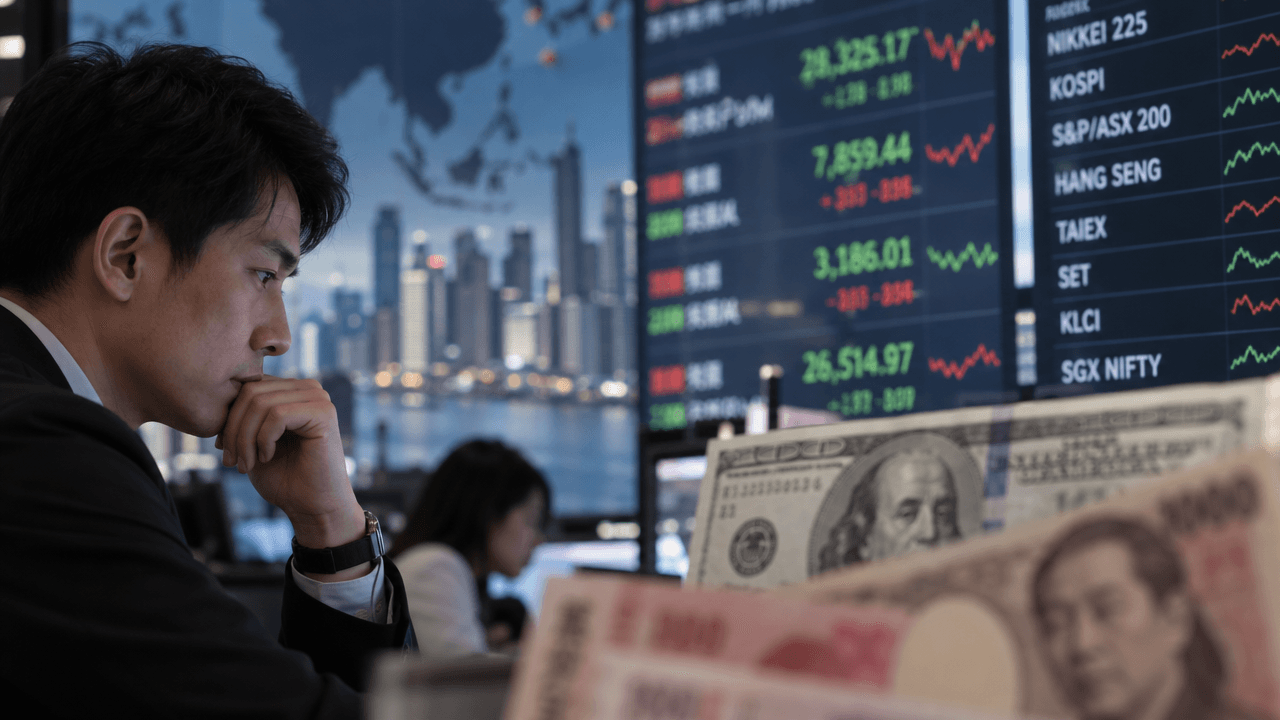
Asian foreign exchange and equity markets are starting the day in a holding pattern, with major currency pairs and regional indices confined to tight ranges as traders wait for a widely expected Federal Reserve rate hike later today.[5][8][10] Demand for the U.S. dollar remains firm, while short‑term volatility is being compressed across spot markets and futures linked to U.S. benchmarks.[5][10] For active traders, this kind of pre‑event calm is both a challenge and an opportunity.
Markets In Wait-and-see Mode
When markets “trade in tight ranges,” prices oscillate within relatively narrow bands, often around well‑watched technical levels such as recent highs, lows, or moving averages.[1][8] In Asian hours, this pattern is visible across key USD pairs like USD/JPY, USD/CNH, and regional equity indices that are tracking U.S. futures rather than forging their own trend.[1][5] Participation is still there, but conviction is muted, with many desks waiting for the Fed’s signal on the path of rates.
The wait‑and‑see stance extends into FX futures and equity index futures tied to U.S. benchmarks, where intraday moves are limited and order flow is dominated by hedging and position‑flattening rather than fresh speculative bets.[5][10] Options markets often echo this with softer realized volatility but relatively firm implied volatility in maturities that straddle the policy announcement, reflecting expectations of a potential breakout once the news hits.
Why A Widely Expected Fed Hike Still Matters
At first glance, a “widely expected” Fed hike might seem like old news: if it is fully priced in, why should markets care?[8] In reality, central bank events often move prices not because of the decision itself, but because of the tone of the statement, the updated economic forecasts, and the guidance around future moves. Traders focus on whether the Fed frames the hike as part of a continued tightening cycle or as a near‑term peak in rates.
This distinction matters greatly for Asian FX and equities. A more hawkish tone typically reinforces dollar strength and can pressure emerging Asian currencies, particularly those with external funding needs or current‑account deficits.[6][13] Equities sensitive to global growth and funding costs—such as tech and highly leveraged sectors—may underperform if markets conclude that restrictive policy will persist longer than previously thought.[11] Conversely, any hint of a slower pace or earlier peak can relieve pressure and trigger a relief rally in risk assets.[5][13]
Implications For Asian Fx And Equity Index Futures
For Asian FX, tight ranges ahead of a Fed meeting usually reflect a balance between two forces: structural demand for dollars from corporates and investors, and tactical positioning by speculative accounts that are reluctant to add exposure without clearer guidance.[1][5][8] Spot traders often see compressing intraday ranges, but cross‑currency correlations can remain high as regional currencies move in sync with the broad dollar index.
On the equity side, regional indices and associated futures often shadow U.S. benchmarks during these periods, with local catalysts taking a back seat.[10][11] Index futures tied to U.S. markets may show low turnover and narrow spreads, as systematic strategies and hedgers adjust exposure incrementally rather than making large directional calls before the Fed outcome.[5][10] This linkage means that Asian traders must watch not only the Fed itself but also how U.S. futures react in the minutes and hours after the announcement.
Trading Strategies In Low-volatility Environments
For discretionary traders, a narrow‑range, pre‑event environment can feel like there is “nothing to do,” but it actually lends itself to specific strategies and risk frameworks. Range‑trading approaches—buying near support, selling near resistance—can be effective when volatility is compressed and liquidity is decent, provided risk is tightly controlled and position sizes are modest. Clear invalidation levels are key; if price starts to break out ahead of the event, the range thesis should be abandoned quickly.
For those working with systematic or rules‑based strategies, upcoming event risk is a reminder to distinguish between realized volatility and event risk. A model calibrated only on recent calm may underestimate the potential post‑announcement move. This is where scenario analysis comes in: mapping possible outcomes (hawkish, neutral, dovish) and stress‑testing P&L for large gaps or sharp trends helps ensure the strategy is robust when the market transitions from quiet to active.
What Simulated Finance Traders Can Learn
In a SimFi environment like E8 Markets, today’s conditions are an ideal case study in how macro events shape market microstructure. Simulated trading allows participants to experience the full life cycle of a major central bank decision: the pre‑event range, the immediate reaction, and the subsequent trend or reversal—without real capital at risk. It is an opportunity to practice execution around key times, such as the opening of the Fed press conference or the release of updated rate projections.
SimFi traders can design specific exercises for days like this. One approach is to run a “pre‑Fed playbook” session, trading within the existing ranges using tight stops and limited leverage, then flattening all exposure before the announcement and evaluating performance. Another is an “event‑reaction drill,” where traders intentionally stand aside during the first volatile minutes after the decision, then look for more structured setups—such as pullbacks to key levels or retests of breakout zones—once the initial price shock has passed.
Conclusion: Prepare For Calm To Turn Into Momentum
The current tight ranges in Asian FX and equities reflect a market that has largely priced in a Fed hike but is still seeking clarity on what comes next.[5][8][10] For traders, the quiet tape ahead of the decision should not be mistaken for a lack of opportunity; rather, it is a signal to prepare. Solid risk planning, scenario analysis, and disciplined execution can turn the transition from low to high volatility into a learning laboratory and, for experienced participants, a source of potential edge.
Whether trading live or in a SimFi environment, the key is to treat the pre‑event calm as part of the process, not dead time. Use it to review positioning, refine levels, and rehearse responses to different policy outcomes. When the Fed finally speaks and markets move out of their tight ranges, those preparations can make the difference between reactive trading and informed, confident decision‑making.