
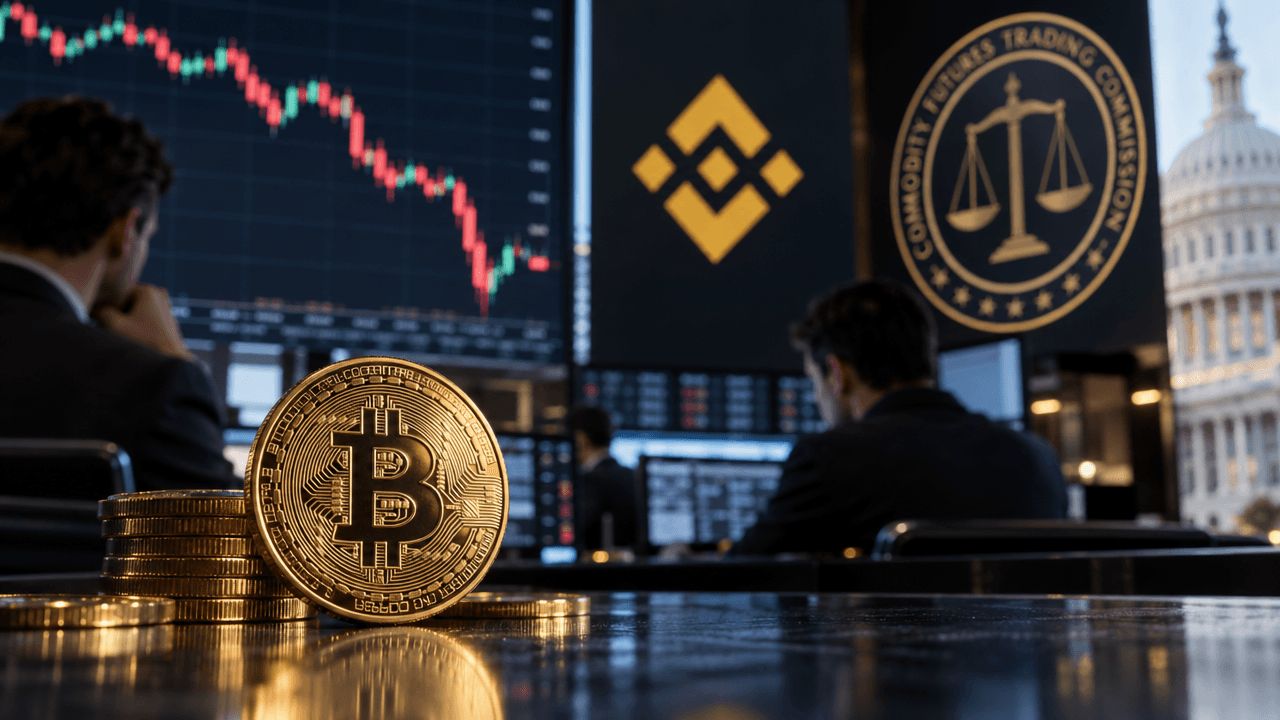
Bitcoin’s latest pullback is a reminder that in crypto, price action is often as much about regulation and market structure as it is about macro and momentum.[1][3] On October 6, Bitcoin slipped roughly 0.9%, consolidating below recent highs as traders digested developments involving Binance and the U.S. Commodity Futures Trading Commission (CFTC).[1][3][4] The move may look modest on a chart, but the underlying story is rich with signals about how professional and retail traders are adapting to a fast-evolving regulatory landscape.[1][3][12]
Market Snapshot: A Small Move With Big Signals
Heading into October 6, Bitcoin was trading in the mid‑$80,000s, having repeatedly tested and failed to hold above resistance clustered near the $87,000 area.[3][4] Derivatives data showed the pullback was more of a controlled pause than a panic, with futures open interest around $54.8 billion and categorized as stable rather than unwinding.[3] Funding rates on perpetual futures turned slightly negative relative to their 30‑day average, signaling a mild tilt toward short positioning and reduced enthusiasm for leveraged longs.[3]
Sentiment indicators painted a nuanced picture: the Fear & Greed Index stood at 71, squarely in “Greed” territory, but above‑average caution was evident in more defensive derivatives positioning.[3] On major venues, roughly 52% of accounts were long and 48% short, suggesting optimism without extreme crowding on one side of the trade.[3] In other words, Bitcoin’s slip was less about a sudden loss of confidence and more about traders stepping back to reassess risk around regulatory headlines.[1][3][12]
Regulatory Pressure: Why Binance And The Cftc Matter
The latest market wobble comes against the backdrop of a long‑running CFTC case against Binance, the world’s largest crypto exchange by trading volume, and its founder Changpeng Zhao.[5][11] The regulator has alleged that Binance operated an unregistered digital asset derivatives platform and maintained what it described as a “sham” compliance program, pushing core questions about how global crypto derivatives should be overseen.[5][11] Recent reporting indicates that Binance and Zhao are seeking dismissal of the complaint, keeping legal uncertainty squarely in traders’ line of sight.[5]
Alongside the case, the CFTC has been steadily updating its approach to crypto policy and guidance.[10][12] Staff recently refreshed FAQs relating to registrants and registered entities involved with crypto assets and blockchain technologies, clarifying expectations for market participants who touch digital assets in regulated derivatives markets.[10] Separate commentary and proposals indicate the CFTC is considering a more comprehensive framework for crypto market structure, filling a gap left by stalled efforts in Congress.[12] In parallel, CFTC staff granted “no‑action” relief to allow certain contracts that already behave like perpetual futures to formally convert into perpetual instruments with no expiration date, a change that directly impacts how crypto leverage and hedging products are designed.[4]
For traders, these developments matter because Binance is deeply embedded in the crypto liquidity stack, and the CFTC is a primary derivatives regulator in the U.S.[5][10][12] Any perceived tightening in oversight or structural rules naturally prompts reassessment of venue risk, product risk, and the durability of current market plumbing.[4][10][12]
How Regulatory News Translates Into Price Action
Bitcoin’s modest decline around October 6 illustrates how regulatory stories can trigger measured, rather than chaotic, risk adjustments.[1][3][12] When a major venue and a key derivatives regulator share the headlines, several microstructure shifts often occur beneath the surface:
1. Liquidity providers widen spreads and reduce inventory as they price in higher event risk around compliance, litigation, or rule changes.[4][12] 2. Leveraged traders pare back exposure, particularly in perpetual futures, which is reflected in slightly negative funding rates and more balanced long/short ratios.[3] 3. Market participants reassess cross‑venue arbitrage strategies, especially when legal uncertainty could affect capital flows or product listings at a large exchange.[5][11][12]
These kinds of adjustments rarely translate into immediate, dramatic crashes when underlying demand remains strong, as it does today with ongoing ETF inflows and resilient institutional interest.[3][5] Instead, they often produce sideways price action with a downside bias near key resistance, as seen in repeated rejections in the $86,000–$87,000 zone.[3][4] The current environment shows that even in “Greed” territory, traders are willing to respect resistance and trim leverage when regulatory risk feels elevated.[3][4][12]
Practical Lessons For Risk Management And Simulated Trading
For traders using simulated finance platforms, this episode is an ideal case study in how to build robust strategies that account for regulatory and venue risk without overreacting to every headline.[3][4][12]
Several practical takeaways stand out
1. Treat regulatory calendars like macro data releases. Track key dates for hearings, policy statements, and enforcement milestones, and pre‑define how much leverage you are willing to carry through those events.[10][12] 2. Incorporate venue concentration risk into your strategy design. If a single exchange dominates your liquidity or execution flow, stress‑test what happens if that venue faces sudden constraints, and explore cross‑venue redundancy in your SimFi environment.[4][5][12] 3. Use derivatives metrics—funding rates, open interest, long/short ratios—as early warning indicators of crowding and stress, not just as trade signals.[3] 4. Build scenario tests around resistance zones. Simulate how your strategy behaves when price stalls just below a well‑defined level (like $87,000) under different mixes of regulatory news, sentiment, and volatility.[3][4]
On a simulated platform, traders can replay days like October 6 with historical data, adjusting their leverage rules, position sizing, and venue selection logic until they observe consistent performance across varying regulatory regimes.[3][10][12] This approach turns compliance risk from a source of anxiety into a variable that can be modeled, managed, and integrated into a disciplined trading plan.[10][12]
Turning News Into An Edge
For both newcomers and experienced participants, the key opportunity in moments like Bitcoin’s recent slip is learning to treat regulatory developments as part of the information set rather than as purely binary threats.[1][3][12] The combination of stable open interest, balanced positioning, and modest price decline suggests that professional traders are factoring Binance‑CFTC headlines into risk frameworks while maintaining confidence in Bitcoin’s medium‑term story.[3][4][5]
By analyzing how sentiment, derivatives data, and legal news interact, traders can refine their ability to distinguish structural risk from routine noise.[3][10][12] In a simulated trading environment, this means building playbooks for different types of regulatory events—enforcement actions, guidance updates, product rule changes—and testing how strategies respond before real capital is at stake.[10][12]
Conclusion
Bitcoin’s 0.9% slide as Binance and the CFTC re‑entered the spotlight is not a crisis point for the asset class, but it is a valuable teachable moment for anyone serious about risk management.[1][3][12] The market’s reaction shows that participants are increasingly sophisticated: they respect clear resistance levels, adjust leverage in response to regulatory uncertainty, and keep an eye on derivatives flows without abandoning bullish long‑term narratives.[3][4][5] For traders leveraging simulated finance, days like this are best seen as live‑fire drills—a chance to sharpen frameworks so that when the next big regulatory or venue story hits, it becomes an edge to exploit, not a shock to endure.[10][12]