
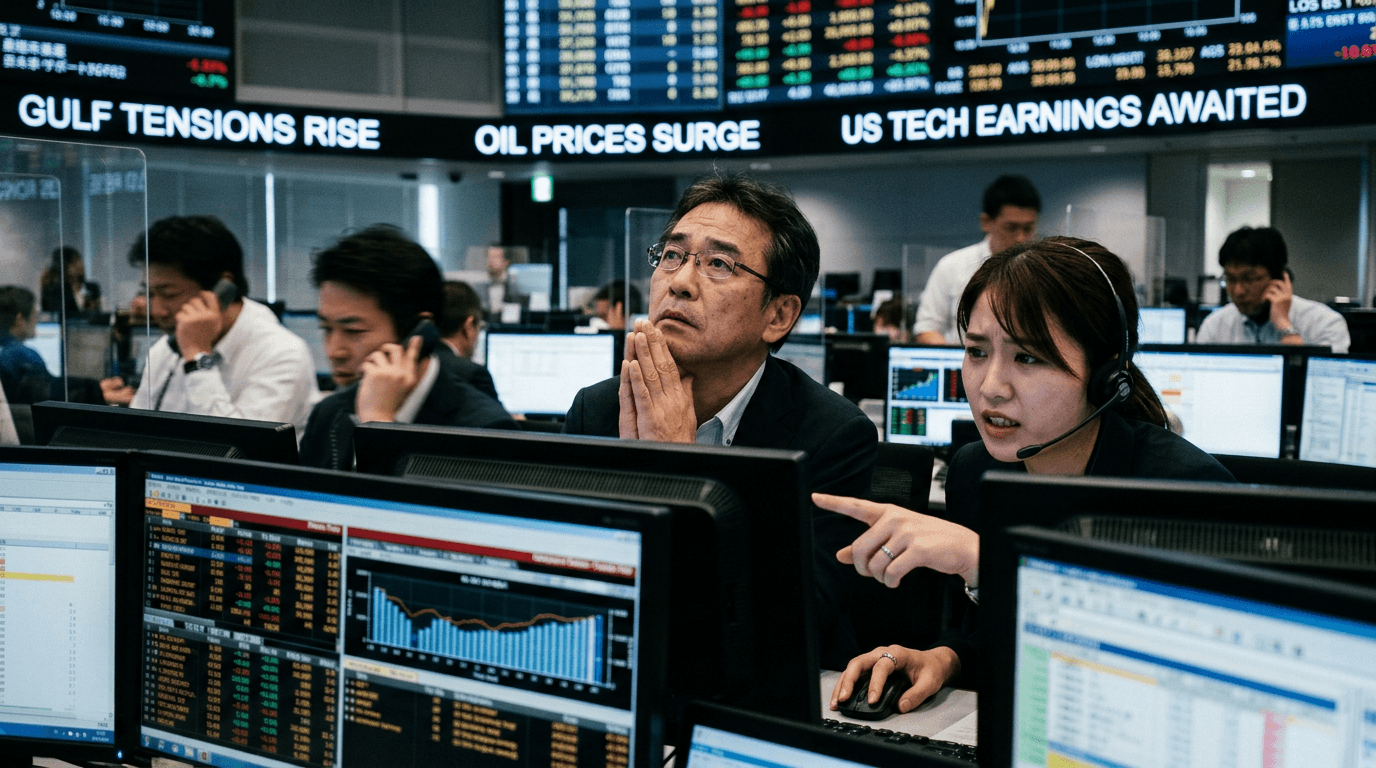
Asian equity markets are entering the week in a cautious mood, caught between escalating Gulf tensions that have pushed oil sharply higher and a crowded slate of US mega-cap tech earnings that could jolt risk sentiment. Investors are reluctant to add exposure at current valuations when both energy-driven inflation risks and earnings-related volatility are rising at the same time.[4]
Markets Pause As Energy Risks Resurface
The latest bout of risk-off trading in Asia has been driven primarily by renewed hostilities in the Gulf, where reports of intensified fighting and disruption around the Strait of Hormuz have fueled a rapid move higher in crude prices.[3][6] This narrow waterway handles a significant share of global oil shipments, so any hint of closure or interruption quickly feeds into fears of supply shortages and higher energy costs worldwide.[3][6]
According to Reuters, Asian shares have “wobbled” as earlier rallies in semiconductors and other growth sectors lost momentum once oil began to surge again on renewed conflict headlines.[4] Benchmarks in Japan, Korea and broader MSCI Asia-Pacific indices have slipped as traders take profits and reassess risk, particularly in AI-related names that had run hard on optimism about global tech demand.[3][8]
At the same time, currency and bond markets are reflecting this tension. Rising oil has pushed investors toward the safety and liquidity of US dollars and higher-yielding sovereign bonds, while currencies of energy-importing economies in Asia have come under pressure.[5][13] Higher energy import bills can widen current-account deficits, weaken local currencies and ultimately raise the cost of capital for corporates.
For traders, the key takeaway is that geopolitical shocks in energy-producing regions can quickly spill over into equity, FX and rates markets. Even if local fundamentals look sound, the macro overlay of oil and inflation can dominate price action in the short term.
Oil, Inflation And Central Bank Expectations
The core macro issue behind the market’s hesitation is not just the level of oil prices, but the inflation pulse that a sustained spike could generate. In recent sessions, oil benchmarks have jumped further, leaving prices around 40% above levels seen before the latest conflict escalation.[5] That magnitude of increase, if persistent, filters into fuel costs, transportation, manufacturing and eventually consumer prices.
Recent Middle East flare-ups have already led investors to pare back expectations of further monetary easing and instead price a higher probability of renewed rate hikes or at least a longer period of restrictive policy in major economies.[3][12] Futures markets have nudged up the odds that the US Federal Reserve could tighten again if inflation fails to glide back to target, particularly with Chair Kevin Warsh preparing for key Congressional testimony.[3]
Higher-for-longer rates matter enormously for equity valuation, especially in growth sectors such as technology. Discounted cash flow models are sensitive to the risk-free rate; when yields rise, the present value of long-dated earnings falls, and price-to-earnings multiples tend to compress. That is one reason why rallies in AI and semiconductor stocks have repeatedly stalled whenever inflation and rate worries resurface.[4][8]
For traders and investors, the practical implication is clear: in an environment where oil is volatile and central bank expectations are shifting, it is dangerous to assume a smooth downward path for inflation. Risk management should allow for scenarios where yields spike again, volatility rises and richly valued growth stocks correct.
Us Tech Earnings: Why Asia Cares
Overlaying this macro backdrop is a packed week of US mega-cap tech earnings, including many of the companies most closely associated with AI, cloud computing and advanced chips. While these firms are listed in the US, their earnings are deeply relevant for Asian markets.
First, US tech giants are major customers of Asian semiconductor manufacturers and hardware suppliers. Weak guidance on data-center spending or device demand can hit order books for firms across Taiwan, Korea and Japan.[8] Conversely, strong AI and cloud capex can revive sentiment in Asian chip and equipment makers that have recently seen pressure as investors questioned whether AI valuations had run too far.[8][11]
Second, US tech earnings shape global risk appetite. When mega-cap results disappoint, S&P 500 and Nasdaq futures often sell off sharply, and that move tends to ripple into Asian index futures and cash markets in the next session.[4][12][13] Reuters has already noted that futures tied to AI-linked stocks have turned more volatile, as traders hedge around potential surprises in earnings and guidance.[4]
Finally, these earnings will influence the narrative around whether the AI investment cycle remains intact despite higher rates and geopolitical uncertainty. If management teams emphasize disciplined spending and profitability over aggressive expansion, the market could rotate toward quality and cash generation rather than pure growth stories—impacting how investors value both US and Asian tech names.
What Traders Can Watch In The Days Ahead
Against this backdrop, the coming days offer several key signposts for traders in both live and simulated environments:
Watch the oil curve, not just spot prices. Backwardation or steepening of the futures curve can signal concerns about near-term supply, while a move toward contango may suggest expectations of easing tension or slower demand.[5][8] These shifts often precede moves in inflation expectations and rate pricing.
Track cross-asset correlations. Periods of stress driven by geopolitics and energy often strengthen correlations between equities, FX and rates. Rising oil alongside a stronger dollar and higher yields has typically coincided with pressure on risk assets in Asia.[3][5][13] Higher correlations can reduce diversification benefits and argue for tighter overall risk limits.
Listen closely to central bank and policy commentary. Minutes from the Fed’s recent meetings have already shown a growing faction concerned that further tightening may be needed if inflation proves sticky.[5][12] Any hawkish tilt in upcoming speeches could magnify the impact of higher oil on rate expectations.
Monitor earnings reactions, not just headlines. Post-earnings price action in US mega-cap tech—especially the size and persistence of moves in after-hours trading—will help gauge how much good news is already priced into AI and cloud names, and how vulnerable global tech is to any disappointment.[4][8][10]
Putting It To Work In Simulated Trading
For traders using simulated finance platforms, this environment is ideal for stress-testing strategies without capital at risk. The combination of Gulf tensions, surging oil and pivotal US tech earnings creates a live laboratory for macro, equity index and volatility trading.
You can build and test scenarios that link geopolitical headlines to oil moves, then to changes in rate expectations and equity index futures. For example, one scenario might assume further escalation and a temporary closure of key shipping routes, driving another leg higher in crude, a jump in inflation breakevens and a sell-off in growth stocks.[3][6][13] Another might assume a surprise de-escalation and strong tech earnings, delivering a relief rally across risk assets.
Simulated environments also allow you to experiment with hedging: pairing long exposure to AI-linked equities with short positions in index futures or options, or using FX and gold as partial hedges against energy and geopolitical risk.[5][13] By tracking how these hedges perform as news flow evolves, you can refine position sizing and correlation assumptions before deploying similar structures in live markets.
The broader lesson from this uneasy mix of Gulf conflict and tech earnings is that markets are rarely driven by a single narrative. Geopolitics, commodities, central banks and corporate profits interact in complex ways. Traders who learn to map these linkages, test their ideas under pressure and adapt quickly are better positioned to navigate the next bout of volatility—whether it comes from another oil shock, an unexpected rate decision or a surprise in the next AI earnings cycle.