
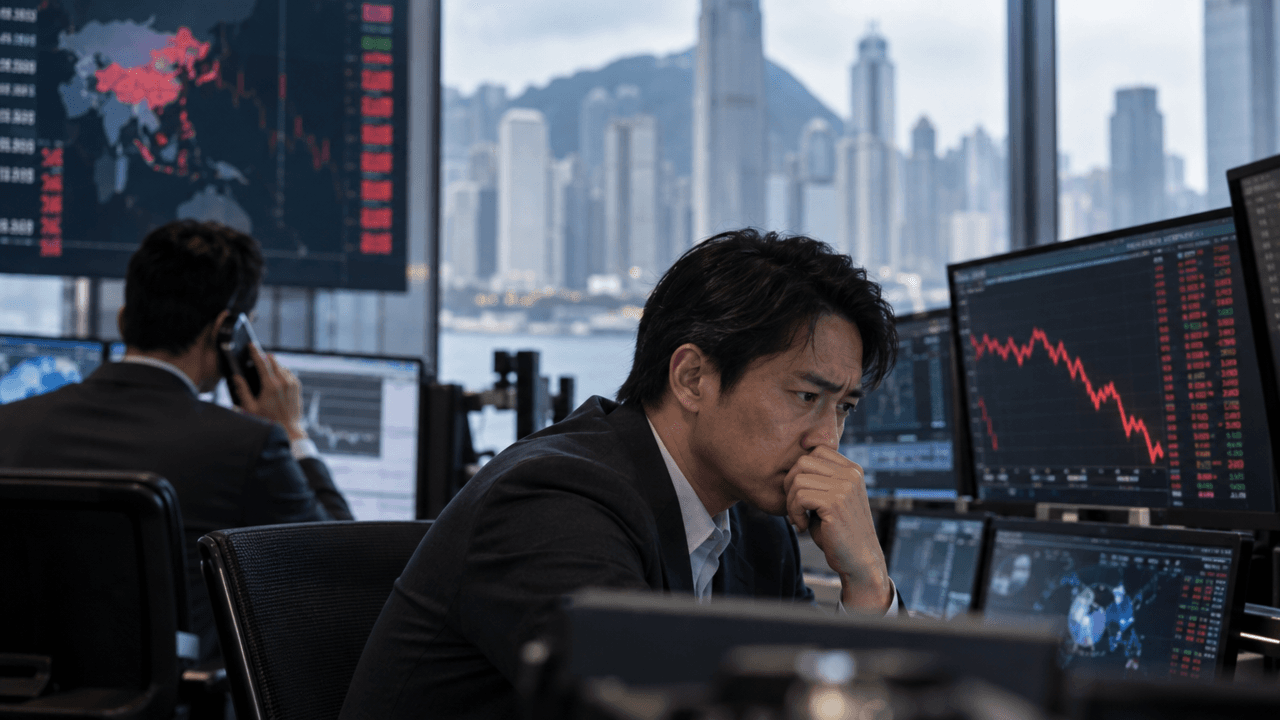
Equity markets are starting Friday on the back foot, as Asian benchmarks and Nasdaq futures slip under the combined weight of rising bond yields, stretched technology valuations, and fresh doubts about the durability of AI-driven earnings growth.[2][10][14] Risk appetite that looked robust only days ago is being re-priced as investors confront the reality of higher funding costs and more demanding expectations for AI leaders.[2][6][14]
Market Snapshot: Asia And Nasdaq Under Strain
Asian indices led the latest pullback, with Japan’s Nikkei dropping around 1.1% and South Korea’s market sliding more than 2%, underscoring how sensitive the region is to global yield moves and tech-sector sentiment.[10] The weakness extended beyond stocks, as higher borrowing costs across Asia amplified concerns about the capital-intensive nature of the AI build-out and corporate leverage.[10][14]
Nasdaq futures followed the overnight lead from Wall Street, where the Nasdaq Composite fell about 1.25% as a broad selloff in semiconductor and AI-linked names weighed on the index.[1][3][9] S&P 500 and Nasdaq futures were modestly lower in early trade, signaling that investors are still in de-risking mode rather than treating the decline as a quick, buyable dip.[2][10]
For traders, the message from the tape is clear: equity markets remain highly sensitive to both rate expectations and narrative shifts around AI, particularly in richly valued growth segments.[2][4][6] That combination tends to produce choppy price action, sharper intraday swings, and more frequent sentiment reversals—conditions that reward disciplined risk management and scenario planning.
Why Higher Yields Are Squeezing Equities
The backdrop to the equity weakness is a powerful move higher in long-term Treasury yields, with the 10-year benchmark recently trading near 5.3%–5.35%, levels last seen in the early 2000s.[2][13][15] These yields now represent a compelling alternative to equities, especially for investors who can lock in near-5% nominal returns with relatively low risk.[12][14]
Higher yields matter because they raise the discount rate used to value future cash flows, putting particular pressure on long-duration assets like growth and technology stocks.[4][14] When the risk-free rate climbs, investors demand lower price-to-earnings multiples or faster earnings growth to justify paying up for expected profits years down the line.[4][12][14]
The recent global bond selloff has also re-ignited inflation worries, with higher oil prices and firm input costs contributing to the move in yields.[2][8][11] As yields push to multi-decade highs, markets are forced to re-evaluate how much good news is already priced into equities, especially after strong year-to-date gains in AI and mega-cap technology leaders.[4][5][15]
Importantly, history suggests that near-5% Treasury yields can coexist with a healthy stock market if nominal growth and earnings remain resilient.[12] However, the transition phase—when markets adjust from ultra-low rates to sustained higher yields—typically involves bouts of volatility, sector rotation, and sharper scrutiny of valuation extremes.[4][12][14]
Ai Boom Faces A Reality Check
The selloff in AI-linked stocks has been exacerbated by reports that OpenAI’s annualized revenue is closer to about $50 billion, below the roughly $70 billion figure previously circulated to some investors.[1][3][9] While the difference largely reflects methodology and comparability with peers, it has nonetheless triggered a reassessment of how aggressively the market has capitalized AI growth stories.[1][3][9]
That reassessment hit semiconductor and AI infrastructure names particularly hard, with major chipmakers such as Nvidia and other leading players seeing notable declines as investors trimmed exposure.[1][3] The move illustrates how quickly sentiment can shift when valuations assume near-flawless execution and uninterrupted demand for AI-related hardware and services.[4][6]
At the same time, yields north of 5% expose the sheer scale of capital required for the AI build-out—data centers, chips, energy—and the rising cost of financing those investments.[6][10][14] The idea of “AI debt” is gaining traction: companies pursuing aggressive AI strategies may need to borrow more, at higher rates, compressing future margins if revenue growth does not keep pace.[6][10][14]
For traders, this is a classic narrative-transition phase. The market is moving from “AI story at any price” toward a more discriminating regime that rewards tangible earnings, cash flows, and capital discipline rather than just top-line growth and model count.[4][5][6] That shift tends to separate durable leaders from more speculative plays, often via periods of elevated volatility.
What This Means For Traders And Simulated Finance Participants
For participants on simulated finance platforms, this environment is an opportunity to stress-test strategies across multiple regimes: high-yield, high-valuation, and AI-specific risk scenarios.[12][14] Rising yields and AI uncertainty together create rich ground for exploring correlations, sector rotation, and the behavior of growth versus value in a controlled setting.[4][5][12]
Equity and futures traders should expect more pronounced reactions to macro data—especially inflation reports, central bank commentary, and bond auctions—given how closely these events tie into yield trajectories.[2][7][11] In addition, idiosyncratic news around key AI names or infrastructure providers can quickly spill over into index-level moves, particularly in tech-heavy benchmarks like the Nasdaq.[1][3][9]
In a simulated environment, traders can experiment with hedging approaches that pair equity positions with rate-sensitive instruments or volatility overlays, helping them understand how to cushion drawdowns when yields spike.[12][14] They can also model scenarios where AI-related revenue disappoints relative to market expectations and observe the resulting impact on sector performance and index behavior.[3][6][9]
Practical Takeaways For Your Trading Playbook
1. Watch the yield curve as closely as you watch price charts. When the 10-year Treasury is testing multi-decade highs, treat rate moves as primary drivers of equity direction, not background noise.[2][13][15]
2. Reassess concentration in richly valued tech and AI names. Elevated multiples and high expectations amplify downside when narratives shift or revenue guidance underwhelms.[3][4][6][9]
3. Embrace sector and factor rotation. In higher-rate regimes, leadership often rotates toward companies with stronger current cash flows, pricing power, and less dependency on distant future growth.[4][5][12]
4. Test hedging and diversification in simulation before committing capital. Explore combinations of equity, futures, and rate-sensitive instruments to understand how your portfolio behaves when yields or AI sentiment change abruptly.[12][14]
5. Plan for headline risk. Build playbooks for AI-specific news shocks—such as revenue revisions or regulatory developments—and macro surprises in inflation and growth, then rehearse execution in a simulated environment.[2][3][6][11]
Conclusion: Navigating An Ai-driven, Rate-sensitive Market
The current pullback in Asian equities and Nasdaq futures is a reminder that even powerful themes like AI must ultimately reconcile with fundamentals, funding costs, and realistic growth trajectories.[2][3][10][14] With long-term yields back at levels not seen in decades and market expectations for AI increasingly tested, traders face a more complex, two-dimensional landscape where both macro and micro forces matter.[2][6][13][15]
For active market participants, especially those honing skills in simulated environments, this is a valuable phase to deepen understanding of how rates, valuations, and narratives interact. By focusing on disciplined risk management, thoughtful scenario design, and selective exposure to AI and growth stories, traders can turn today’s volatility into tomorrow’s experience—and be better prepared when the next leg of the cycle unfolds.