
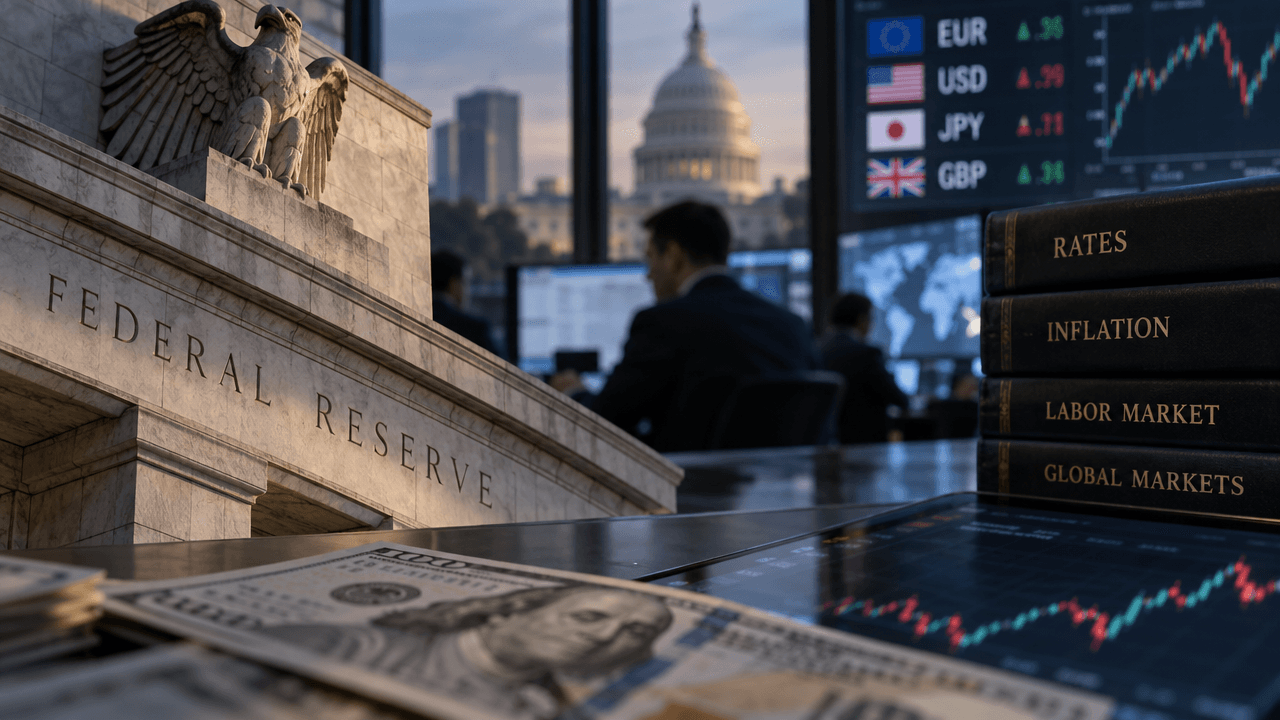
Softer labor data would normally be a signal that monetary policy is starting to bite, but recent comments from Federal Reserve officials show they are not ready to declare victory on inflation just yet.[12][15] Fed Governor Christopher Waller has indicated that additional rate hikes are likely still on the table to push inflation down toward the Fed’s 2% goal, while stressing that policymakers have some flexibility around the exact timing of moves.[12][5][7] For traders, the takeaway is clear: the path of rates remains higher-for-longer and data-dependent, and that keeps volatility elevated across forex and interest-rate markets.[12][15]
FED’S FRAMEWORK: 2% INFLATION AND FLEXIBLE AVERAGE TARGETING
To understand the Fed’s hawkish tone, it helps to revisit its policy framework.[7] The Federal Open Market Committee (FOMC) interprets price stability as inflation running at 2% over the longer run, a target first codified in its statement of longer-run goals in 2012.[10][5] Under the current framework, often described as flexible average inflation targeting (FAIT), the Fed aims for inflation that averages 2% over time rather than treating 2% as a strict ceiling.[9][13][14] After periods when inflation has undershot the target, the Fed is willing to tolerate moderately above-2% inflation for some time, but only as long as expectations remain anchored around the target.[9][11][13][14]
This flexibility is a double-edged sword for markets.[9][11] On one hand, it allows the Fed to respond more forcefully to downturns without immediately tightening when inflation briefly overshoots.[3][9][13] On the other, it gives policymakers room to stay hawkish even when some indicators—like the labor market—start to soften, as long as inflation and expectations are not convincingly back at 2%.[3][11][15] The current messaging from officials like Waller fits this pattern: tightening is not finished in principle, but the pacing of hikes can be adjusted based on incoming data.[12][11]
SOFTER LABOR DATA VS. HAWKISH RHETORIC
Recent labor reports have shown signs of cooling, with slower job gains and a moderation in wage pressures compared with the post-pandemic surge, suggesting that the cumulative impact of prior hikes is reaching the real economy.[15] Historically, the Fed’s framework emphasizes reacting to shortfalls in employment rather than low unemployment, meaning policymakers are more concerned when joblessness rises than when labor markets are merely strong.[14][7] However, the dual mandate also requires that inflation be brought back toward the 2% target, which officials continue to describe as primarily driven by monetary policy over the long run.[5][7]
Because inflation progress has been uneven, Fed speakers have signaled that softer labor data alone is not enough to justify a quick pivot to rate cuts.[12][15] Waller, for example, has highlighted that if incoming data track the Fed’s expectations, he anticipates additional hikes to secure a timelier return to 2% inflation, even while keeping the door open to spacing those hikes out or pausing temporarily.[12][11] This mix of cautious data dependence and persistent hawkish bias explains why market expectations for the policy path remain fluid and why short-term rate futures and yields can swing sharply from one week to the next.[11][15]
Market Reaction: Volatility In Forex And Rates
When the Fed talks hawkishly against a backdrop of softening labor data, the message to markets is that the bar for easing is higher than the bar for staying tight.[12][15] That typically supports the U.S. dollar against currencies whose central banks are perceived as closer to neutral or easing, especially when U.S. short-term yields remain elevated or drift higher on expectations of further hikes.[12][15] At the same time, uncertainty around the exact timing of moves—“flexibility” in Waller’s words—prevents markets from fully pricing in a smooth path, leading to choppy trading conditions and frequent repricing in rate curves.[12][11][15]
For bond markets, this environment can produce a tug-of-war between growth concerns and inflation worries.[11][15] Softer labor data and recession fears may drive demand for longer-dated Treasuries, pulling yields down, while hawkish Fed rhetoric keeps front-end yields sticky or biased higher.[11][15] The result is ongoing volatility in yield curves, with traders constantly reassessing the probability of additional hikes versus the timing of eventual cuts. In forex, similar dynamics show up as rapid swings in carry trades and risk sentiment as investors toggle between “higher-for-longer” and “growth-scare” narratives.[12][15]
Practical Takeaways For Traders
In this kind of regime, data releases and Fed communication matter as much as, if not more than, scheduled policy meetings.[11][15] Short-term traders should treat major macro prints—employment reports, inflation releases, and Fed speeches—as event risk that can reshape expectations for the policy path within hours.[11][15] Position sizing, tight risk management, and clear scenarios for hawkish versus dovish surprises become critical, especially in leveraged products or strategies that depend on stable rate differentials.[11][15]
Medium-term traders and portfolio managers can focus on themes rather than single headlines: the Fed’s 2% target is not going away, and officials have repeatedly underscored their responsibility for keeping inflation close to that level over time.[5][7][10] Until inflation is convincingly back at target and staying there, it is prudent to assume the Fed will err on the side of tightening or maintaining restrictive policy, even when labor data softens.[12][11][15] That supports strategies that respect dollar strength on dips, remain cautious on duration risk at the front end, and use volatility thoughtfully rather than fighting it.[11][15]
Simulated Finance: Learning In A Risk-free Environment
For traders using a simulated finance platform like E8 Markets, this environment offers a powerful learning laboratory. SimFi allows participants to test how hawkish central bank rhetoric interacts with incoming macro data, without the capital risk that comes from trading live during high-volatility periods. By replaying recent sessions around key speeches and data releases, traders can practice building and adjusting macro narratives in real time, honing their ability to interpret Fed messaging against the dual mandate backdrop.[7][11][14]
Simulated trading is particularly useful for stress-testing strategies that rely on rate expectations, such as yield-curve trades, FX carry, or macro trend-following.[11][15] Traders can design scenarios in which the Fed delivers on additional hikes versus ones where data forces an earlier pause, then observe how different asset classes respond. Over time, this builds the discipline to align positions with the Fed’s stated framework—anchored on a 2% inflation target and flexible average inflation over time—rather than reacting only to single data points.[5][7][9][13]
Conclusion: Hawkish Flexibility Keeps Markets Honest
Fed officials maintaining a hawkish stance despite softer labor data is a reminder that inflation, not just employment, drives the policy narrative right now.[7][10][15] The combination of a firm 2% target, flexible average inflation strategy, and Waller’s emphasis on timing optionality means traders must stay nimble and respect the possibility of further tightening even as parts of the economy cool.[9][11][12] For both live and simulated traders, the edge lies in understanding the Fed’s framework, preparing for event-driven volatility, and building robust strategies that can handle a higher-for-longer world rather than betting aggressively on a rapid pivot.[11][15]