
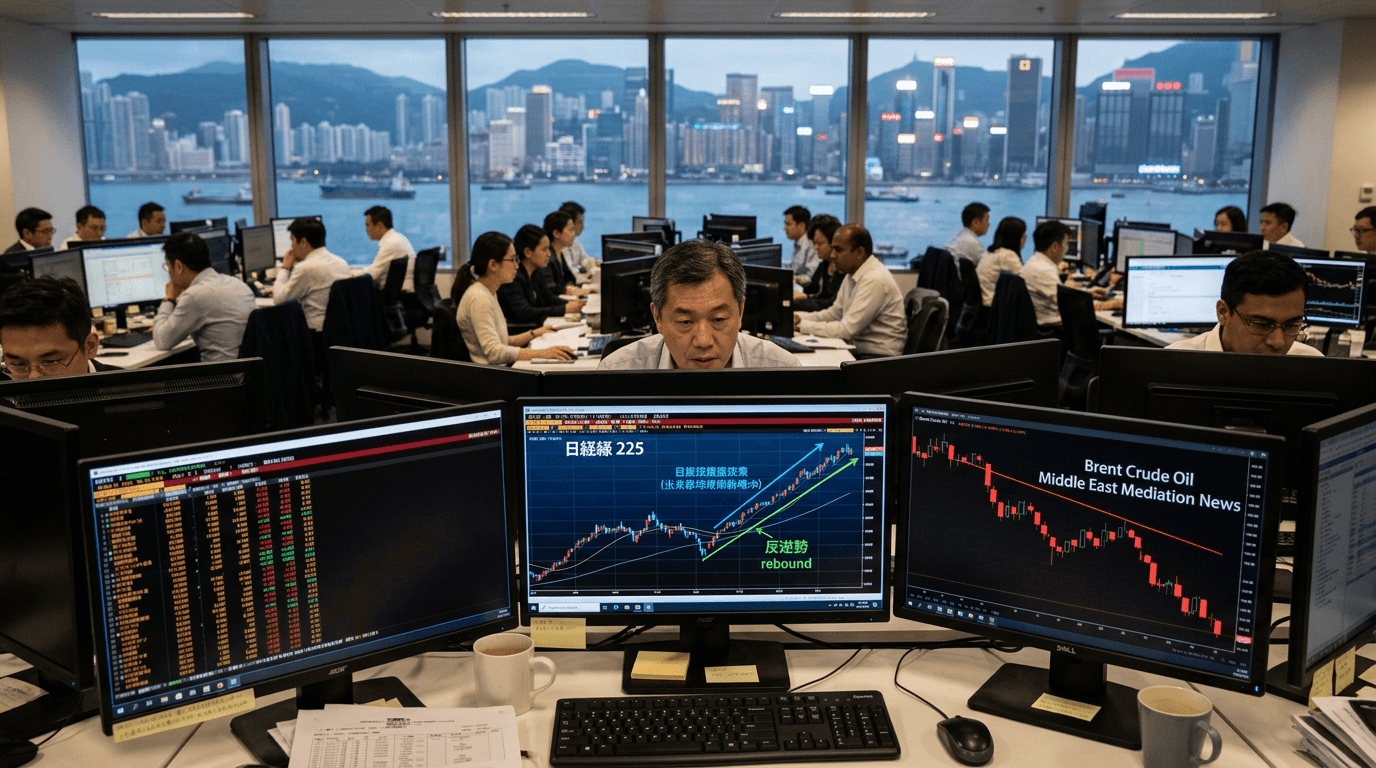
Asian equity markets opened the session in a decisively better mood as signs of mediation in the Middle East nudged oil prices off their recent one‑month highs, easing a key source of anxiety around inflation and global growth.[1][6] Benchmark indices across the region advanced, with MSCI’s broadest index of Asia‑Pacific shares outside Japan up around 0.25% after three consecutive losing sessions, Japan’s Nikkei gaining more than 1%, and South Korea’s KOSPI jumping close to 3%.[1][6] Brent crude, which had been hovering near a one‑month peak, retreated toward about $88.88 a barrel as reports of a 10‑day ceasefire proposal helped trim the geopolitical risk premium built into energy prices.[6]
Market Reaction: Asia Follows Oil Lower
The immediate catalyst for the rebound in Asian stocks is the moderation in crude prices driven by diplomatic signals out of the Middle East.[1][6] Oil had been supported by worries that conflict around key shipping lanes could hamper supply, feeding into higher energy costs for import‑dependent economies. As headlines pointed to mediation efforts and a potential ceasefire proposal from Iran, traders reassessed the likelihood of further supply disruption, and the risk premium embedded in Brent began to unwind.[6]
Equity markets responded quickly. In Japan, renewed risk appetite pushed the Nikkei higher, while South Korea’s KOSPI, which had been under pressure amid volatility in AI‑related names, rallied nearly 3%.[1][6] The broader regional gauge, MSCI Asia‑Pacific ex‑Japan, also broke a three‑day losing streak, reflecting a shift away from the defensive positioning that had dominated when oil was climbing.[1]
This change in tone was not confined to cash markets. U.S. index futures turned slightly firmer, signaling that the improved sentiment in Asia could carry over into the global trading day.[6] For traders, this is a textbook example of how a single macro variable—crude oil—can quickly ripple through cross‑asset pricing when the underlying driver is geopolitical risk.
Why Lower Oil Matters For Asian Economies
For many Asian economies, lower oil prices are more than just a market story; they feed directly into the macro backdrop. The region includes several large net energy importers, so swings in crude prices can materially affect trade balances, corporate margins, and household purchasing power. When oil retreats from recent highs, it reduces cost pressures for manufacturers, airlines, logistics firms, and energy‑intensive industries, improving profit outlooks and supporting equity valuations.
From a policy perspective, softer oil reduces immediate inflation concerns. Previously, higher crude driven by Middle East tensions threatened to complicate the job of central banks that are trying to keep price growth contained without derailing activity. A pullback gives monetary authorities more breathing room, decreasing the urgency for further tightening and improving the medium‑term growth narrative.
This macro channel explains why stock indices can react strongly even to modest moves in oil when those moves are seen as signaling a change in geopolitical risk. A fall from a one‑month high, prompted by mediation efforts rather than purely cyclical factors, suggests that one key tail risk—further conflict escalation—is becoming less dominant in investor calculations.[1][6] That shift alone can justify a re‑rating of equity markets that had been priced for a more adverse scenario.
Index Futures: First Responders To Risk Sentiment
Index futures are often the first instruments to reflect changes in global risk sentiment, and today’s move is no exception. As oil eased and Asian equities climbed, futures on major U.S. indices turned “slightly firmer,” indicating that traders expect the improved tone in Asia to spill over into Western markets later in the day.[6] In related episodes, such as earlier Middle East peace hopes, Nasdaq and S&P futures have similarly strengthened as risk appetite returned.[4]
For traders—whether in live markets or simulated finance environments—index futures serve several critical functions:
They provide a real‑time gauge of global sentiment, often moving ahead of cash markets.
They allow for rapid hedging or expression of macro views, such as positioning for relief rallies when geopolitical risks appear to ebb.
They link regional sessions together, transmitting shocks and relief across time zones.
In the current setting, the combination of firmer futures and higher Asian cash indices suggests a synchronized improvement in risk appetite driven by a common macro theme: reduced concern over oil‑driven inflation and growth headwinds. For SimFi participants, understanding this linkage is essential for building scenarios, testing strategies, and learning how macro catalysts propagate through global indices.
Implications For Fx, Gold And Other Havens
The easing of oil prices has also tempered extreme safe‑haven flows in foreign exchange and precious metals, even as the U.S. dollar remains broadly supported.[1] During periods of heightened Middle East tension and rising oil, investors often flock to perceived safe havens such as the dollar, the Japanese yen, and gold, while trimming exposure to risk‑sensitive currencies and assets.
With mediation efforts gaining attention and crude backing off its highs, the urgency of that rush into havens has diminished. The dollar is described as steady against major currencies, reflecting ongoing support from earlier safe‑haven demand but a lack of fresh escalation that would push it significantly higher.[1] In practice, this kind of environment can lead to:
More range‑bound trading in FX majors, as geopolitical fear premia shrink.
Reduced upside pressure on gold and other precious metals, which had been beneficiaries of risk‑off positioning.
A gradual reallocation back into cyclical or higher‑beta assets as investors regain confidence.
For traders focused on cross‑asset relationships, the lesson is that safe‑haven flows are highly sensitive to changes in narrative, not just to the level of headline risk. A shift from “escalation” to “mediation” can be enough to rebalance flows, even when the underlying conflict is not fully resolved.
What Traders Should Watch Next
While today’s relief rally is driven by geopolitics and oil, it is unfolding against a backdrop of other important market themes. Investors are bracing for a slate of corporate earnings, including key reports from Alphabet and Intel, that will test the resilience of the AI‑related trade, which has recently come under pressure.[1][6] This means the market is juggling two major narratives:
Geopolitical risk and its impact on oil, inflation, and macro sentiment.
Micro‑level earnings and guidance that will shape expectations for high‑growth sectors like AI.
For traders, several practical takeaways emerge:
Monitor oil and Middle East headlines together, not in isolation. Price action makes more sense when viewed through the lens of changing conflict probabilities.
Watch index futures across regions to understand how one session’s sentiment is likely to influence the next.
Track the interplay between macro relief (lower oil, less inflation worry) and sector‑specific stories (AI earnings), as they can either reinforce or offset each other.
Use simulated environments to stress‑test strategies under different combinations of oil, FX, and equity volatility, building intuition before deploying capital in live markets.
Ultimately, the latest move in Asian stocks underscores how quickly markets can pivot when a single key risk—oil fueled by Middle East tensions—shifts direction. For both new and experienced traders, the edge lies in connecting the dots: from mediation headlines to crude prices, from crude to inflation expectations, and from there to equities, futures, FX, and safe‑haven assets. Understanding that chain is what turns a headline into a tradable insight.