
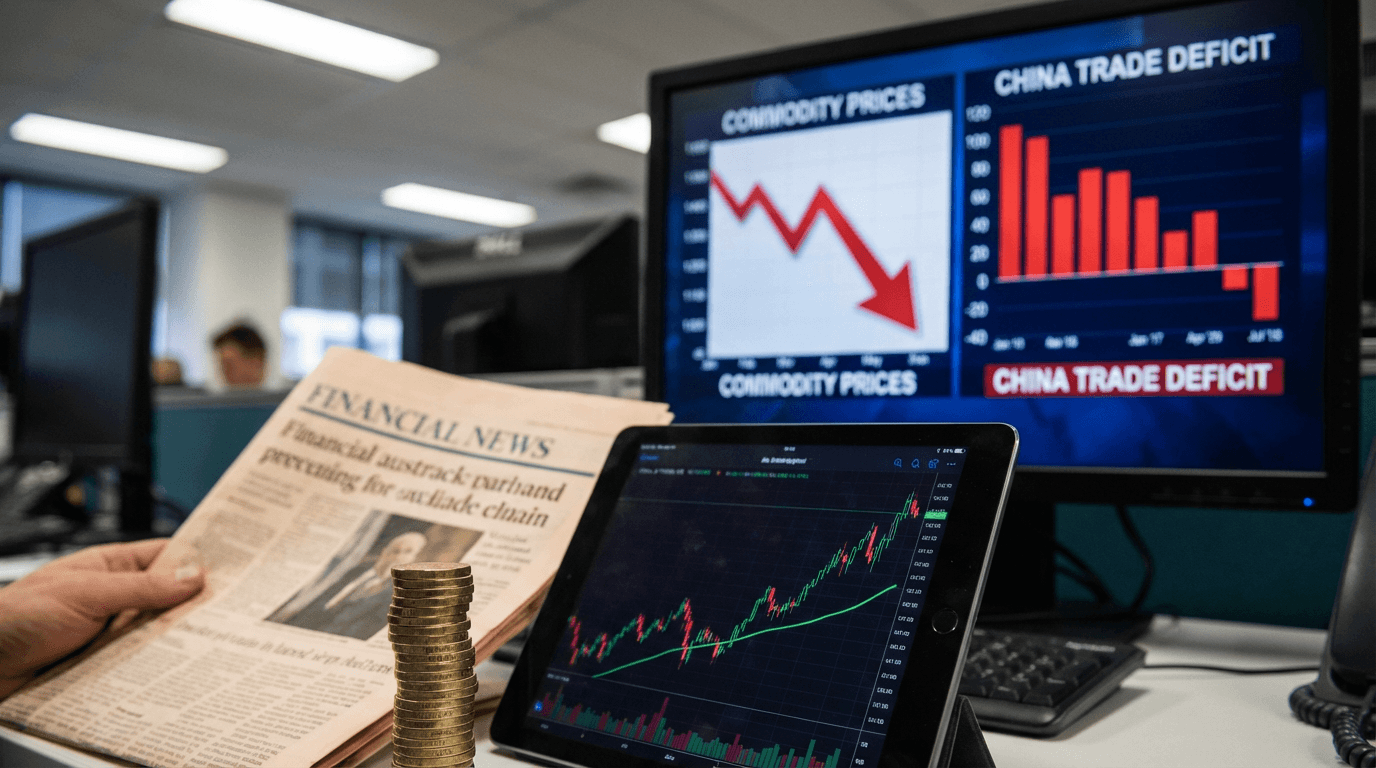
The Australian Dollar is navigating a complex landscape shaped by global commodity price pressures, China's trade dynamics, and uncertainty surrounding US tariff policies. While the AUD/USD exchange rate has recently strengthened to around 0.70-0.71 in late February 2026, the underlying fundamentals driving the currency remain volatile and multifaceted. Understanding these factors is essential for traders and investors seeking to position themselves in the foreign exchange market during this period of heightened uncertainty.
The Commodity Connection To Aud Performance
The Australian Dollar's value is inextricably linked to commodity prices, particularly iron ore, which represents one of Australia's most significant exports. As a resource-rich nation heavily dependent on commodity exports, Australia's currency tends to weaken when global commodity prices fall and strengthen when they rise. The current environment reflects mounting concerns about commodity weakness, which has put downward pressure on the AUD despite recent strength in the exchange rate itself. This disconnect illustrates the tension between short-term technical factors and longer-term macroeconomic headwinds that could challenge the currency's sustainability at higher levels.
China's economic health directly influences Australia's export prospects and, by extension, the demand for the Australian Dollar. As Australia's largest trading partner, China's purchasing power for raw materials drives much of the demand for AUD. A widening trade deficit in China signals reduced purchasing capacity and potentially slower economic growth, both of which diminish demand for Australian commodities and put pressure on the currency. Market participants are closely monitoring Chinese economic data and trade figures, as positive or negative surprises often have direct impacts on AUD pairs.
Tariff Uncertainty And Market Sentiment
The uncertainty surrounding US tariff policies adds another layer of complexity to AUD/USD dynamics. Trade tensions between the United States and China create ripple effects across global currency markets. With Washington currently engaged in negotiations with Beijing, market sentiment remains fragile. US Commerce Secretary Howard Lutnick's recent statements expressing confidence in reaching a trade deal provide some reassurance, but the path forward remains uncertain. Until clearer trade policies emerge, this uncertainty will continue to weigh on investor confidence and currency valuations across commodity-linked currencies like the AUD.
The broader market sentiment toward risk assets also influences AUD performance. When investors adopt a risk-on stance, demand for higher-yielding and commodity-linked currencies typically increases. Conversely, risk-off sentiment drives capital toward safe-haven assets and away from currencies like the Australian Dollar. The current period of geopolitical and trade uncertainty has created a volatile backdrop where sentiment shifts can produce sharp currency moves in either direction.
Technical Levels And Trading Dynamics
From a technical perspective, AUD/USD has broken through key resistance levels around 0.6400, which previously coincided with the 200-day exponential moving average. A bullish cross between the 20-day and 50-day moving averages suggests upward momentum, with the relative strength index climbing above 60. However, technical strength does not necessarily reflect fundamental stability. Traders should be aware of key resistance levels around 0.6500 and November 2025 highs near 0.6550, as well as support levels near 0.6287 and the psychological 0.6000 level.
The currency pair's movements have become more pronounced as traders react to conflicting signals between technical strength and fundamental weakness in commodity demand. This creates opportunities for range-bound trading but also heightened volatility that requires careful risk management.
Implications For Traders And Investors
For SimFi traders using platforms like E8 Markets, the AUD/USD pair presents both opportunities and risks. The fundamental weakness in commodities and China's trade deficit suggest caution regarding sustained strength in the Australian Dollar at elevated levels. However, technical momentum indicators and recent central bank policy divergence between Australia and the United States provide reasons for selective bullish positioning.
Key takeaways for market participants include: monitor Chinese economic data closely for signs of trade recovery, track commodity prices as leading indicators for AUD direction, stay informed on US-China trade negotiations for potential policy shifts, and use technical support and resistance levels to guide entry and exit decisions.
The Australian Dollar's near-term direction will likely be determined by which force prevails: technical momentum and the current favorable technical setup, or the fundamental headwinds from commodity weakness and China's trade challenges. Successful trading requires balancing both perspectives while maintaining disciplined risk management practices.