
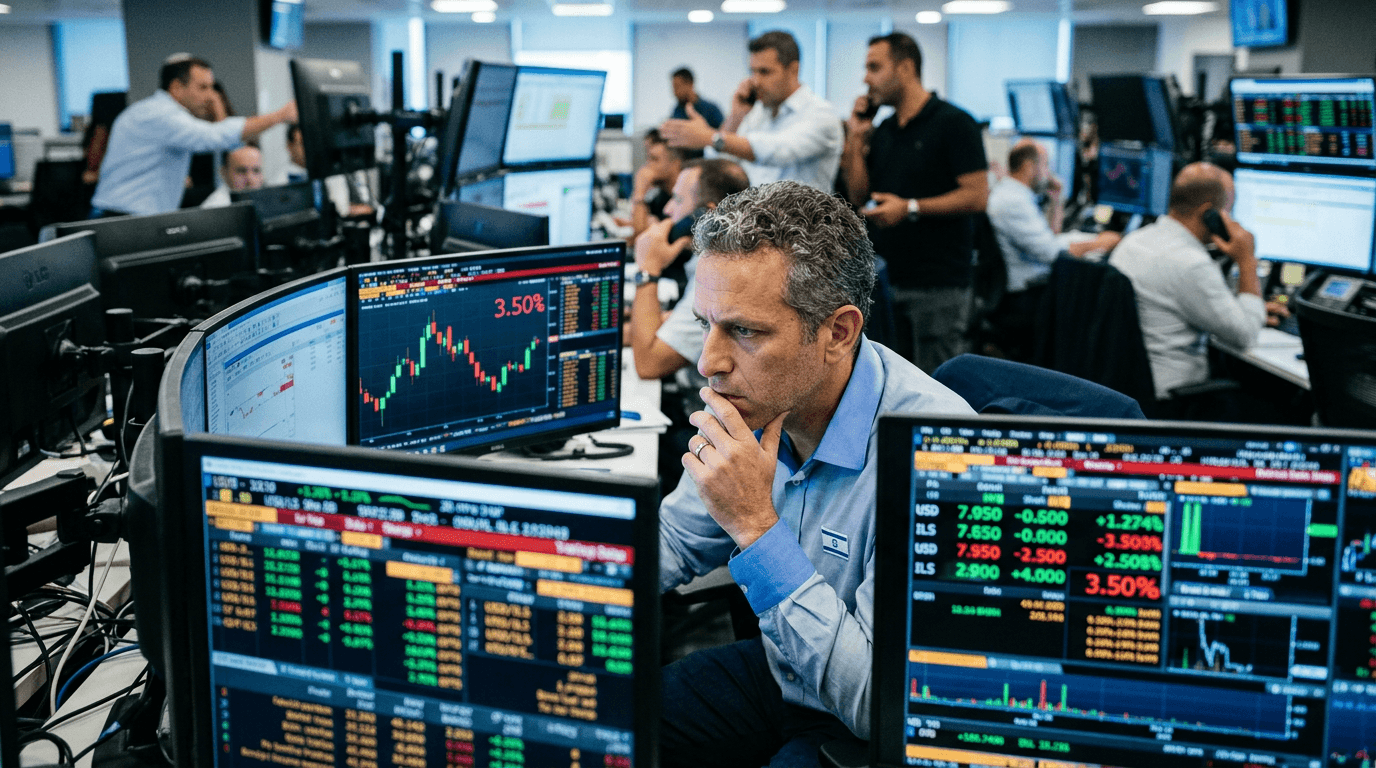
The Bank of Israel’s decision to cut its benchmark interest rate to 3.50% is more than a routine tweak to policy. It marks a deliberate shift toward supporting growth in the face of a very strong shekel, subdued inflation, and a still-fragile post‑conflict recovery. For traders, this move offers a clear window into how a small, open economy balances currency strength against domestic economic momentum—and how that calculus can drive FX, bond, and interest‑rate futures pricing in real time.
WHAT THE 3.50% CUT SIGNALS
At its July meeting, the Bank of Israel lowered the policy rate by 25 basis points, from 3.75% to 3.50%, the second consecutive cut and the lowest level since late 2022. The move extends an easing cycle that began after nearly two years of rates anchored around 4.5%, and constitutes the fourth cut since late 2025. The message is clear: the central bank has shifted from “inflation fight and stabilization” mode into a more growth‑supportive stance.
Importantly, the cut was widely anticipated by markets and aligned with prior forward guidance. That predictability matters. When rate moves are signaled ahead of time, the surprise factor is low, but the confirmation of the policy trajectory still drives repricing in local assets. In this case, traders had already begun to price a drift toward 3.50% through swaps and rate futures; the decision cemented that path.
At the same time, the magnitude of the cut—just 25 basis points—shows the Bank is easing cautiously rather than aggressively. Inflation is not collapsing; it is hovering near the midpoint of the 1–3% target range, giving the Bank room to cut, but not license for a deep, rapid easing cycle. That nuance is critical for rate‑sensitive strategies: the Bank is signaling a bias to ease, but with an eye on inflation expectations and external risks.
Why A Strong Shekel Worries The Bank
The central bank explicitly cited the strength of the shekel as a key factor behind the move to 3.50%. For an exporter‑heavy, import‑reliant economy like Israel’s, an overly strong currency is a double‑edged sword. On the positive side, it helps contain imported inflation, particularly in energy and traded goods. On the negative side, it erodes export competitiveness and can weigh on growth.
In recent months, the shekel has traded at multi‑year highs against the dollar and strengthened against a basket of trading‑partner currencies. That appreciation reflects easing geopolitical risk, lower energy prices following the U.S.–Iran memorandum of understanding, and investor confidence returning toward pre‑war levels. From a macro perspective, this is good news. From a policy perspective, it creates tension.
If the currency is too strong for too long, export margins are squeezed, and investment decisions in tradable sectors get delayed. The Bank of Israel is clearly worried about this growth drag. Cutting rates modestly reduces the interest‑rate differential versus other major currencies, which can temper further appreciation pressures. It does not reverse the shekel’s strength outright, but it signals that the central bank is willing to lean against excessive currency gains when they threaten the real economy.
For traders, this reinforces a key lesson: in small, open economies, FX dynamics can be as important as headline inflation in shaping the rate path. Reading central bank statements for references to the exchange rate, competitiveness, and trade balances is essential in understanding where policy is heading—and in positioning for both FX and rates.
Growth Risks In A Recovering Economy
Beyond the strong shekel, growth risks are central to the Bank’s thinking. Israel is still navigating the aftermath of intense regional conflict, including prior wars in Gaza and tensions with Iran. Activity has rebounded from the sharp downturn that followed those events, but the recovery is uneven across sectors, and geopolitical uncertainty lingers.
The Bank’s latest decision leans on several supportive data points: inflation around 1.9% near the target midpoint, a decline in energy prices linked to easing regional tensions, and a normalization of Israel’s risk premium back toward pre‑October 2023 levels. These conditions lower the cost of easing. If inflation is contained and external risk spreads are narrowing, the Bank can cut without destabilizing expectations.
However, the growth outlook remains vulnerable. Exporters have reportedly pressed for deeper cuts, signaling that profitability and orders are under pressure from the strong currency and softer global demand. Domestic demand is improving, but households and firms are still adjusting to post‑war realities, including changes in labor markets, investment plans, and fiscal policy.
For traders, this backdrop suggests a central bank that is willing to support growth but is constrained by the need to keep inflation anchored and maintain credibility. That typically translates into gradualism: small, data‑dependent cuts rather than a front‑loaded easing wave. Scenario analysis—asking “what happens if growth slows faster than expected?” versus “what if inflation re‑accelerates?”—is a valuable exercise when trading Israeli assets.
Market Reaction: Fx, Bonds, And Rate Futures
The rate cut and the Bank’s concern about the strong shekel quickly moved local markets. In FX, the shekel initially softened as the lower policy rate reduced some of its yield appeal, though the move was limited by the broader backdrop of still‑solid fundamentals and easing geopolitical risk. For short‑term traders, this created tactical opportunities around the announcement window and in the days that followed, as positioning adjusted.
In the bond market, yields across the curve shifted lower, with front‑end maturities reacting most to the confirmed policy path. The decision reinforced expectations for a shallow but extended easing cycle, compressing yields and supporting duration‑focused strategies. Longer‑dated bonds, more sensitive to growth and inflation expectations than to individual rate steps, moved more modestly but still benefited from a perception of contained inflation and reduced risk premium.
Interest‑rate futures and swaps repriced to reflect a slightly higher probability of additional cuts over the next few meetings, but with an embedded assumption that the Bank will move gradually. For traders, the interplay between official guidance, market pricing, and incoming data now becomes the key arena: surprises in inflation, FX, or geopolitical news can shift that curve quickly.
The move also fits into a broader global narrative. Even as some major economies still grapple with above‑target inflation, a number of central banks—particularly in smaller, open markets—have begun selective easing to support growth and adjust to currency dynamics. The Bank of Israel’s 3.50% cut is part of that trend, illustrating how local conditions can diverge from the global cycle and create relative value opportunities.
What Traders Should Watch Next
For both discretionary and systematic traders, the Bank of Israel’s move offers several practical takeaways:
First, central bank communication around FX is critical. When policymakers start explicitly referencing currency strength or weakness as a motivation for rate decisions, it signals that the exchange rate has entered the core of the reaction function. This should feed directly into FX, rates, and cross‑asset models.
Second, the balance between growth and inflation remains the main constraint on future cuts. If inflation stays around the midpoint of the target and growth indicators soften, markets will increasingly price further easing. But any upside surprise in inflation—or renewed geopolitical risk driving energy prices higher—could slow or pause the cycle.
Third, relative value trades between Israel and other central‑bank jurisdictions may become more attractive. A cautiously easing Bank of Israel versus a still‑hawkish or on‑hold major central bank can create spread opportunities in rates and FX.
Finally, for SimFi traders, this decision is a textbook case of how a single, well‑telegraphed central bank move can ripple across multiple asset classes. Using simulated environments to test macro‑driven strategies—such as shekel carry trades, curve steepeners, or policy‑sensitive equities—can help build a robust playbook for when similar decisions occur in larger markets.
The cut to a 3.50% benchmark rate crystallizes a new phase in Israel’s monetary policy: one where managing the implications of a strong currency and safeguarding growth are as central as traditional inflation targeting. For traders who can read that shift early and position accordingly, it is an opportunity as much as a risk.