
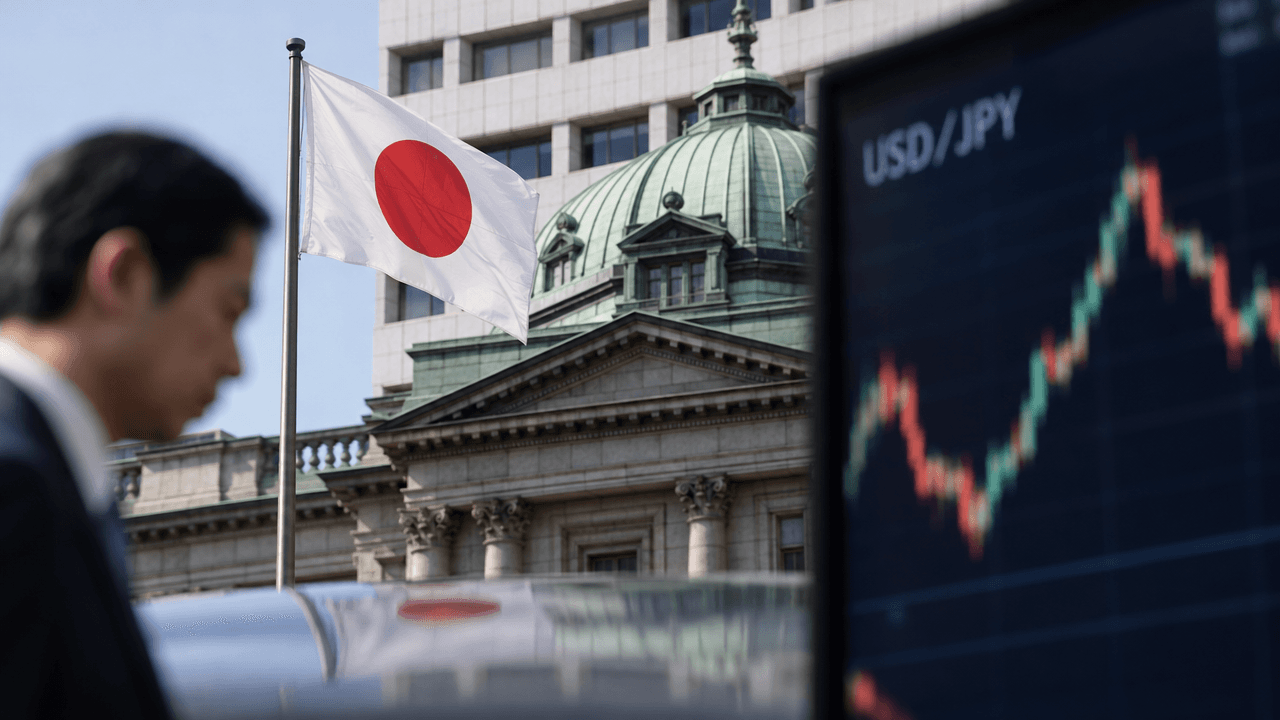
The Bank of Japan has kept its policy rate unchanged, but the decision was far from a signal that tightening is over. By holding the overnight call rate at 1.25% while acknowledging that underlying inflation is now broadly consistent with its 2% target, the central bank left the door open to another increase as soon as December. [1][5]
For traders, the message is best described as a hawkish hold: no immediate move, but stronger justification for future rate increases. The yen initially benefited modestly, while USD/JPY remained close to the 157.2–157.7 area as markets weighed the prospect of higher Japanese interest rates against continuing demand for the U.S. dollar. [7][11][14]
The Decision: A Hold With A Hawkish Bias
The BoJ’s decision to maintain rates at 1.25% was widely expected. The central bank has already raised borrowing costs this year, and policymakers appear willing to study the effects of earlier increases on lending, household spending, business investment, and financial conditions before acting again.
The vote itself, however, highlighted the debate inside the policy board. Eight members supported keeping rates unchanged, while one member, Hajime Takata, favored lifting the rate to 1.50%. [4][5] A dissent in favor of tighter policy is important because it shows that at least one policymaker believes inflation and economic conditions already warrant another move.
Governor Kazuo Ueda also emphasized that future decisions will be considered meeting by meeting, including at the December gathering. That approach avoids a formal commitment while keeping the market focused on the possibility of a near-term hike. [1]
The result is a policy stance that gives the BoJ flexibility without removing pressure from the market. If inflation remains firm and economic data continue to support normalization, December could become the next major turning point.
Inflation Has Changed The Policy Conversation
The most significant development was the BoJ’s assessment that underlying consumer inflation has reached a level generally consistent with its 2% price-stability target. The bank also indicated that inflation could remain around that level. [5][12]
This matters because the BoJ has spent years attempting to move Japan away from deflation and persistently weak price growth. For much of that period, policymakers were concerned that inflation was temporary, externally driven, or unsupported by domestic demand. The latest assessment suggests that the bank now sees a more durable inflation process.
A sustained 2% inflation environment gives the BoJ greater freedom to raise rates toward a more normal setting. It also reduces the risk that a rate increase would prematurely undermine the central bank’s long-running effort to establish stable price growth.
However, reaching the target does not automatically guarantee a December hike. Policymakers must still examine wage trends, consumption, economic growth, and the impact of earlier policy moves. Inflation driven mainly by imported goods or currency weakness would present a different policy challenge from inflation supported by rising wages and domestic demand.
Why December Matters For Markets
Market pricing has increasingly reflected the possibility of a December increase. Some reports placed the probability of a hike near 75% to 80% after the decision, although expectations can change quickly when new economic data or political developments emerge. [3][12]
A December move would likely involve a 25-basis-point increase to 1.50%. More important than the size of the move would be the guidance that follows. Traders will want to know whether the BoJ sees further hikes as part of a gradual normalization cycle or whether it intends to pause again after December.
A faster hiking path could support the yen by narrowing the interest-rate gap between Japan and other major economies. It could also encourage investors to reduce yen-funded carry trades, in which traders borrow cheaply in yen to purchase higher-yielding assets elsewhere. When Japanese rates rise or the yen strengthens rapidly, these positions can become less attractive and may be closed quickly.
For equity and bond markets, the consequences could extend beyond foreign exchange. Japanese government bond yields may rise, while global assets that have benefited from cheap yen funding could face additional volatility.
USD/JPY AND THE YEN’S NEXT MOVE
USD/JPY remained near 157.2–157.7, showing that the BoJ’s hawkish message was not enough to trigger a major currency reversal. The yen received some support from broader safe-haven demand, but the exchange rate remained close to the psychologically important 160 level. [11][12][14]
This reaction illustrates an important trading principle: central bank communication matters, but it is only one factor driving a currency. The relative outlook for U.S. interest rates, Treasury yields, risk sentiment, Japan’s economic data, and official concern about excessive yen weakness will also influence USD/JPY.
A sustained move lower in USD/JPY would likely require more than a single hawkish BoJ statement. Traders may need confirmation through stronger wage growth, resilient domestic demand, and clear evidence that the central bank is prepared to continue raising rates. Conversely, if Japanese growth weakens or inflation loses momentum, December hike expectations could fade and the yen could come under renewed pressure.
Practical Takeaways For Traders
First, treat the October decision as a signal about direction rather than an immediate change in policy. The rate stayed at 1.25%, but the inflation language and the dissenting vote strengthened the case for further tightening.
Second, monitor Japanese wage and inflation data before assuming a December hike is guaranteed. Stronger readings could increase expectations for a move, while weaker data could push investors back toward a more cautious outlook.
Third, watch USD/JPY around major technical and psychological levels, particularly the area near 160. Breakouts may become more volatile if markets begin pricing a faster BoJ tightening cycle.
Finally, remember that a hawkish BoJ does not guarantee a stronger yen every day. Currency markets respond to relative interest-rate expectations, risk appetite, and positioning. A modest initial yen reaction can still be followed by larger moves if investors begin unwinding carry trades.
The BoJ has not declared victory over inflation in the sense that all economic risks have disappeared. It has, however, acknowledged that the central condition required for sustained policy normalization is now largely in place. By holding rates while keeping December firmly in play, the bank has preserved flexibility and raised the stakes for the next meeting. For traders, the coming weeks will be defined by one question: whether Japan’s inflation progress is strong enough to turn a hawkish signal into another rate hike.