
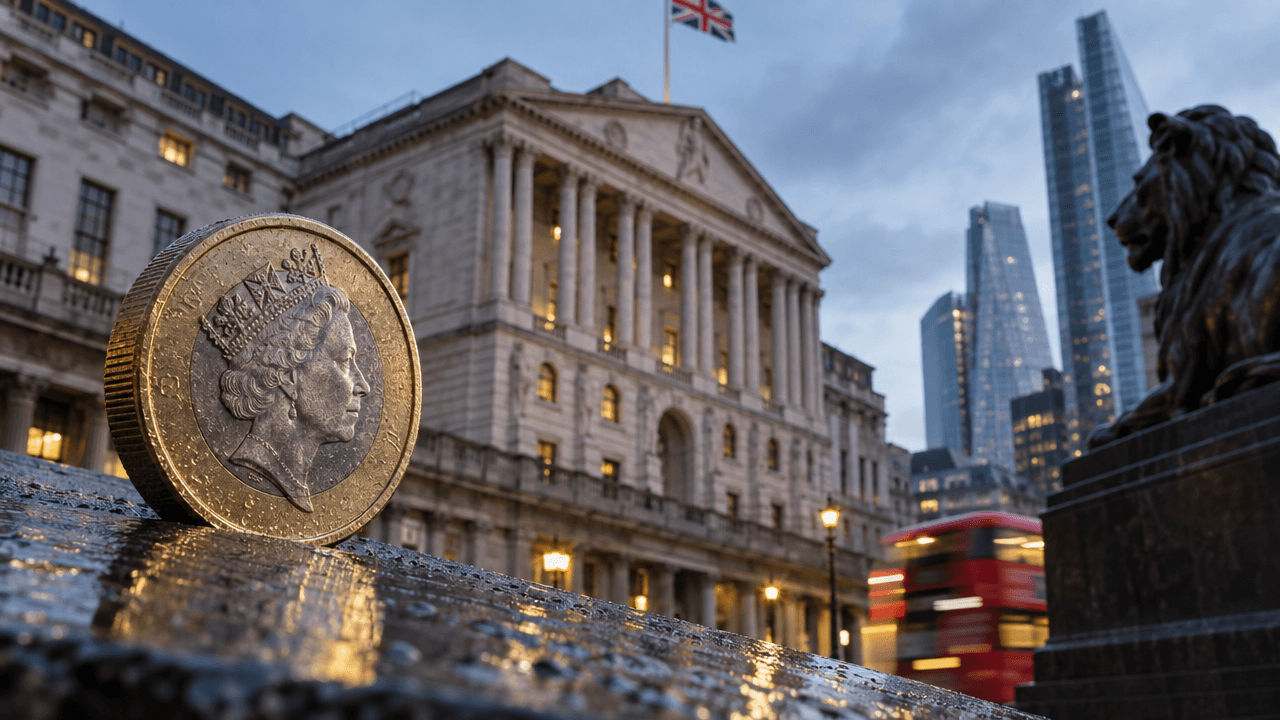
The Bank of England has raised Bank Rate from 3.75% to 4%, delivering its first increase in more than three years. The 25-basis-point move passed by an 8–1 vote, signalling that most policymakers believe renewed inflation pressure now presents a greater risk than the immediate threat of weaker economic growth. [1]
The decision highlights the difficult trade-off facing the U.K. economy. Higher interest rates can help prevent inflation from becoming entrenched, but they also increase borrowing costs for households, companies and investors. For financial markets, the move is supportive for sterling while raising fresh concerns about recession risks and the outlook for U.K. assets.
Why The Bank Of England Acted
Energy prices were the central factor behind the decision. Global energy prices have remained elevated and volatile, partly because conflict in the Middle East has disrupted the transportation and supply of energy. These pressures are feeding directly into household utility bills and motor fuel costs, while also raising expenses throughout business supply chains. [4]
U.K. consumer price inflation reached 3.5% in September, well above the Bank of England’s 2% target. Policymakers expect inflation to rise to approximately 5% by the middle of 2027 before gradually easing as the impact of higher energy prices fades and restrictive monetary policy weighs on demand. [2]
The Bank acknowledged that there is still limited evidence of widespread second-round effects. In other words, higher energy prices have not yet clearly triggered a broad acceleration in wages and prices across the economy. However, the Monetary Policy Committee judged that sufficient inflationary pressure was already building to justify acting before those effects became more persistent.
This is an important distinction. The Bank cannot directly lower the price of oil, gas or electricity through interest rates. Its objective is to prevent a temporary energy shock from turning into a longer-lasting inflation cycle.
WHAT THE 8–1 VOTE SIGNALS
The vote was decisive, but it was not completely uniform. Eight members supported a 25-basis-point increase, while one member preferred a larger 50-basis-point move that would have lifted Bank Rate to 4.25%. [12]
The absence of a vote to hold rates steady suggests that the committee is currently more concerned about inflation persistence than about the immediate economic slowdown. At the same time, the preference for a larger increase from one policymaker shows that the committee is not entirely aligned on how quickly it should respond to the energy shock.
Markets will therefore focus less on the rate decision itself and more on future guidance. The Bank has indicated that another increase could be needed if energy-driven inflation persists. Governor Andrew Bailey also pointed to the possibility of a further hike followed by a more conditional approach based on developments in energy prices and inflation. [10]
That does not guarantee another rate rise. Instead, it means incoming data will become especially important. Inflation expectations, wage growth, business pricing behaviour and household spending will all help determine whether the tightening cycle continues.
WHAT IT MEANS FOR STERLING AND U.K. ASSETS
A higher Bank Rate generally supports sterling because it can make pound-denominated assets more attractive to international investors. If markets expect U.K. interest rates to remain higher for longer, the pound may gain against currencies whose central banks are cutting rates or adopting a less restrictive stance.
The effect on U.K. shares is more complicated. Banks and financial companies may benefit from higher interest income, particularly if lending margins remain resilient. However, companies with high debt levels or weak pricing power may face greater pressure as financing costs rise.
Consumer-facing businesses could also struggle. More expensive mortgages and loans reduce disposable income, while higher energy bills leave households with less money for non-essential purchases. Retailers, leisure companies, housebuilders and other economically sensitive sectors may therefore face a more challenging environment.
Government bonds may also come under pressure if investors revise expectations for future interest rates upward. Higher yields can reduce the market value of existing bonds, although they may create more attractive entry points for investors seeking income over a longer time horizon.
The Growth And Recession Trade-off
The Bank of England is attempting to manage inflation without causing unnecessary damage to economic activity. That task becomes more difficult when inflation is driven by supply shocks rather than excessive demand.
Rate increases can weaken demand, but they cannot produce more energy or repair disrupted supply chains. If policymakers tighten too aggressively, the result could be slower growth, rising unemployment and reduced business investment. If they respond too cautiously, elevated inflation could become embedded in wage negotiations and corporate pricing decisions.
For traders, this creates the potential for sharp market reactions in both directions. Strong inflation data could strengthen expectations of another hike and support sterling, while weak employment or spending figures could revive concerns about a recession and limit future tightening.
Practical Takeaways For Traders
First, watch the difference between headline inflation and underlying inflation. Energy prices may push headline inflation higher, but persistent wage growth and services inflation would provide stronger evidence of broader price pressure.
Second, monitor Bank Rate expectations through short-term interest-rate markets. These expectations can move sterling, gilt yields and equity valuations before the Bank actually changes policy.
Third, avoid treating a stronger pound as an automatic signal that all U.K. assets will perform well. Currency strength may reflect higher interest rates, while those same rates can weigh on domestic companies and consumers.
Finally, manage risk around inflation releases, employment reports and future MPC meetings. Central-bank policy is likely to remain data-dependent, and energy-market developments can change expectations quickly.
The move to 4% is more than a routine quarter-point adjustment. It is a warning that the Bank of England is prepared to respond to persistent inflation even as growth risks increase. For SimFi traders, the key lesson is to follow the interaction between energy prices, inflation expectations and monetary-policy forecasts rather than focusing on the rate decision in isolation. In an uncertain environment, disciplined risk management and scenario planning matter as much as choosing a market direction.