
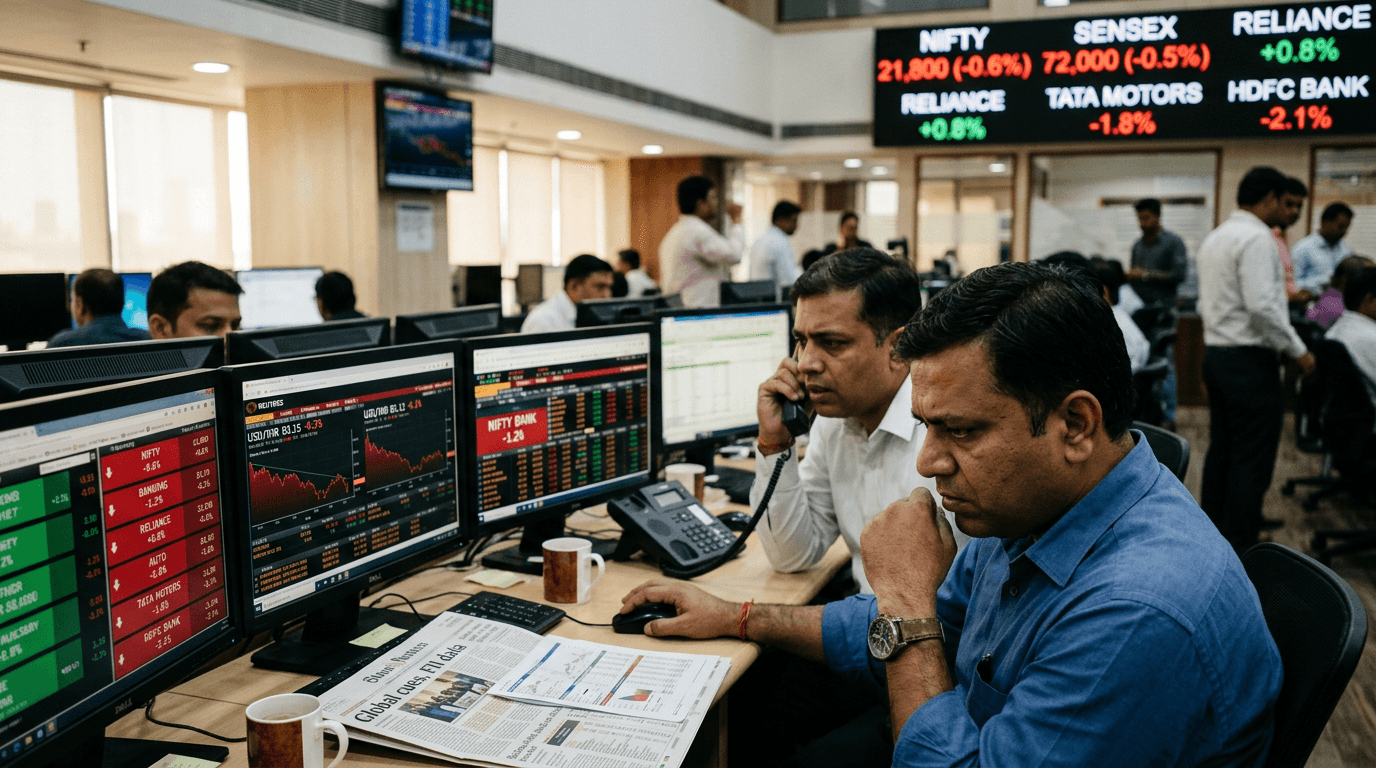
Indian equities eased in today’s session as the Sensex and Nifty slipped modestly, led by weakness in banking and auto stocks, while the USD/INR pair traded about 0.3% lower intraday, signalling a firmer rupee and cautious risk sentiment rather than outright panic selling[11][10][13]. For traders, the combination of sector-led equity softness and a stronger currency creates a nuanced environment where index futures, sector contracts, and INR-linked FX pairs all demand closer attention.
Market Snapshot
The major benchmark indices were marginally in the red, with the Sensex and Nifty both drifting lower as gains in defensives and select exporters failed to offset losses in rate‑sensitive and cyclical names[10][1]. Banking and auto stocks accounted for a significant share of the downside, pulling the indices off recent highs and reinforcing a near‑term consolidation phase after a strong multi‑month rally[10][4][13].
Market breadth reflected this cautious tone, with more decliners than advancers across the broader universe, even though the headline declines remained relatively shallow[10][8]. Rather than a capitulation move, the price action resembled profit‑taking and selective risk reduction, with traders trimming exposure to sectors that have led the market higher in recent weeks[2][5]. This kind of session often acts as a stress test for prevailing trends: leadership sectors are challenged, and the market reveals which areas still enjoy conviction buying and which are more vulnerable to rotation.
Banking And Auto Stocks Under Pressure
Banking heavyweights were among the top drags on the indices, with private financials and rate‑sensitive names seeing consistent selling through the session[10][3][13]. Moves in names such as HDFC Bank, Axis Bank, ICICI Bank and other major lenders have an outsized impact on both Sensex and Nifty because financials carry significant index weight and are closely tied to growth and rate expectations[2][10]. When these stocks soften together, index downside can materialise quickly even if other sectors are relatively stable.
There are several factors that can drive short‑term pressure in banking stocks. Profit‑taking after strong quarterly gains is common, especially around key macro events or policy meetings[4][6]. Concerns around credit quality, margin compression, or slower loan growth can also push traders to lighten exposure to lenders, particularly those with higher valuations. For intraday and short‑term index traders, understanding that bank stocks function as “beta amplifiers” is crucial: moves in Nifty Bank often foreshadow or exaggerate shifts in the broader Nifty 50.
Auto stocks also came under notable pressure, with names such as Mahindra & Mahindra, Bajaj Auto and Tata Motors experiencing downside as investors booked recent profits[1][4][13]. Autos are classic cyclical plays, sensitive to income trends, financing conditions and consumer confidence, and they tend to rally strongly during upswings. That strength makes them prime candidates for profit‑taking when sentiment turns more defensive[2][5]. For equity futures traders, the underperformance of Nifty Auto relative to the headline index is a signal to reassess sector‑specific long exposure and to consider relative value trades between autos and more resilient groups such as IT or FMCG.
USD/INR MOVES AND FX IMPLICATIONS
On the currency side, USD/INR was down around 0.3% intraday, a move that implies modest rupee strength against the US dollar despite the softer equity tape[11][10][13]. A stronger rupee in the face of risk‑off equity behaviour can reflect several cross‑currents: steady foreign inflows into certain segments, supportive carry dynamics, or expectations that domestic macro fundamentals remain sound relative to global peers[11][3]. It can also indicate that the equity pullback is more about sector rotation than broad capital flight.
For FX traders, a 0.3% intraday move is meaningful enough to impact short‑dated options, intraday positioning and carry strategies, but it does not yet represent a regime shift in the currency trend[11][13]. However, when combined with sector weakness in banks and autos, it can alter the behaviour of INR‑linked crosses and hedging strategies used by export‑ and import‑oriented firms[10][11]. Equity‑FX correlations may temporarily weaken, and that gives tactical traders scope to exploit divergence trades—going long or short INR separately from their equity view, rather than assuming they must move in lockstep.
Implications For Traders And Simulated Finance
For active traders and users of Simulated Finance platforms, this kind of day offers rich learning opportunities without the stress of extreme volatility. First, banking and auto sectors can be used as case studies in how index leadership changes: by running scenarios where Nifty Bank and Nifty Auto underperform versus the headline indices, traders can see how index futures respond and where portfolio risk is concentrated. Second, scenario testing around USD/INR—such as a continued 0.3–0.5% strengthening move versus a rapid reversal—helps traders understand how FX risk interacts with domestic equity exposure in multi‑asset strategies.
In a simulated environment, traders can experiment with three practical approaches. One is sector rotation: reducing simulated long exposure in banks and autos while increasing positions in more defensive or export‑oriented segments to see how drawdowns and volatility evolve. Another is hedged index trading: going long or short index futures while using sector futures or options to hedge sector‑specific risk, observing how different hedge ratios affect P&L in a modestly risk‑off market. A third is FX‑equity overlay: testing strategies that pair USD/INR positions with bank or auto exposure, such as using a stronger rupee to partially offset equity downside or to reinforce it, depending on the underlying thesis.
Conclusion
Today’s marginal slip in Sensex and Nifty, driven by banking and auto weakness alongside a 0.3% intraday drop in USD/INR, showcases a nuanced risk‑off environment where sector dynamics and currency moves matter as much as the headline index print[11][10][13]. For traders, the message is clear: pay attention to the sectors that carry index weight, respect the impact of even modest currency shifts, and use both real and simulated environments to refine playbooks for days when the market is not crashing, but quietly re‑pricing risk. Those incremental adjustments, made on routine but informative sessions like this, often set the stage for better decision‑making when truly high‑impact events arrive.