
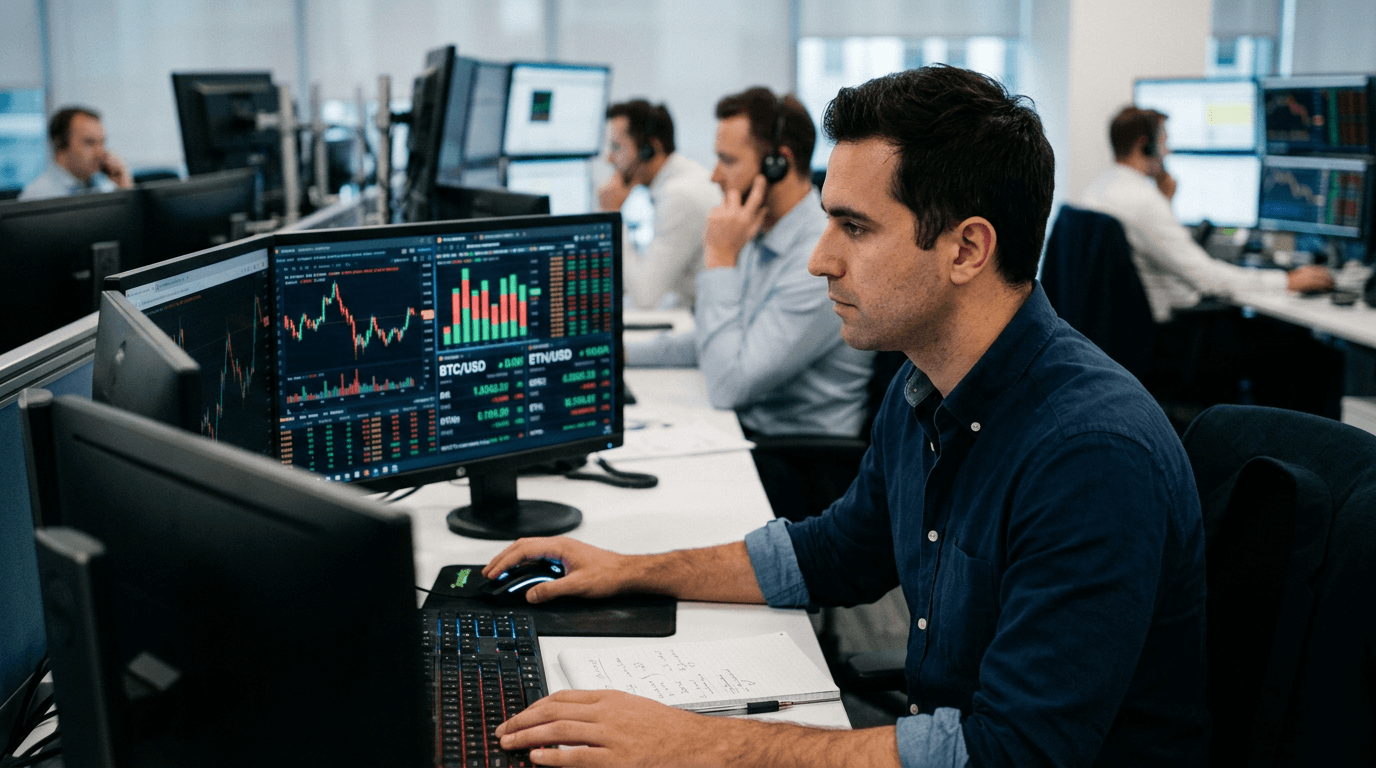
Bitcoin and Ethereum are edging higher in live trading sessions, but the move is modest rather than explosive, reflecting a market that is active yet still searching for a clear direction.[1][9][12] For traders, this kind of slow grind up can be more revealing than a dramatic spike, because it shows how participants are positioning when the market is not dominated by emotion or news shock.[9][14] Understanding these conditions is essential for building durable strategies in both live and simulated environments.
Markets Edge Higher, Not Overheating
Recent price snapshots show Bitcoin trading in the high-$70,000 range with intraday gains generally under 1%, a classic example of a “slightly up” session rather than a breakout rally.[1][10][12] Ethereum is likewise ticking higher in the mid-$2,400s, posting similar sub-1% moves as liquidity flows through the market without pushing prices into new territory.[1][5][12] This combination of incremental gains in the two largest crypto assets sends a subtle but important message: risk appetite is present, but not euphoric.[8][9]
Past sessions with similar behavior have seen Bitcoin open around 0.3% higher and Ethereum about 0.2% higher versus prior days, only to drift within a relatively tight intraday range.[9][11][13] This pattern places the current move in context: the market is willing to add exposure, yet still cautious enough to keep daily volatility under control.[9][11] In other words, what we are seeing is “constructive, but not aggressive” price action—an environment where professional traders often do their most meaningful positioning.
For active participants, that matters because the strongest edge often comes from trading these nuanced conditions rather than chasing obvious headlines. A slow upward bias tells you more about underlying conviction than a single, dramatic candle driven by a one-off news item.[4][9][14]
What Price Action Says About Sentiment
When Bitcoin and Ethereum grind higher together, it typically signals that broad crypto sentiment is tilting risk-on, even if the magnitude of the move is modest.[8][12][14] Buyers are stepping in, but sellers are not capitulating; instead, they are defending levels and taking profits, creating the choppy, directionally mixed tape many traders are now seeing.[2][11][13] That balance between demand and supply is a hallmark of a market that is digesting prior volatility rather than launching a fresh trend.
Altcoin behavior reinforces this view, with mixed performance across smaller tokens when the majors are only slightly higher.[2][8] Rather than a synchronized rally across the entire market, capital rotates opportunistically, rewarding specific themes—layer-2 scaling, smart contract platforms, or real-world asset protocols—while leaving other segments flat.[4][8] This dispersion supports the idea that traders are selective, not indiscriminately bullish.
For intraday traders, such sentiment typically translates into a playbook focused on mean reversion and range trading rather than momentum breakouts. Price has directional bias, but the path is noisy, so entries and exits must be precise. Stops that are too tight are easily whipsawed; stops that are too loose risk giving back too much of the small trend the market is offering.
Ripple Effect On Futures And Leveraged Flows
Even small spot moves in Bitcoin and Ethereum can have disproportionate impact on futures positioning.[1][10][12] A 0.3–0.7% rise may not look dramatic on a daily chart, but in leveraged futures, it changes margin balances, triggers risk checks, and shifts perceptions of whether the next move is likely to be higher or lower.[9][11][15] That, in turn, affects market-making behavior and the aggressiveness of directional traders.
When spot prices edge higher, funding rates on perpetual futures often creep up, reflecting a tilt toward long positioning.[12][14] The market may still be mixed, but longs start to dominate the open interest profile, while shorts become more tactical and shorter term. This is where modest spot gains can snowball into a meaningful change in positioning, especially if they follow a period of consolidation or mild downside.
For traders, monitoring this spillover is crucial. A market that is slightly higher in spot but meaningfully long in futures can be vulnerable to short-term shakeouts, as profit-taking or sudden news can force those leveraged longs to reduce exposure. Conversely, if spot is drifting up while futures remain balanced, the move can be more sustainable, giving swing traders more confidence to hold positions through minor pullbacks.
Practical Lessons For Active Traders
Sessions like these reward traders who are disciplined in their preparation and flexible in their execution. First, it pays to define clear scenarios before the trading day: what does a continuation of the gentle uptrend look like, and what would constitute a failed move where buyers lose control? Doing this work upfront helps avoid emotional decision-making when price action becomes noisy.
Second, position sizing should reflect the modest nature of the move. Small, controlled trends do not warrant outsized leverage; instead, they invite incremental risk-taking, tight risk limits, and frequent reassessment of trade thesis. This is especially true in crypto, where liquidity can vanish quickly and spreads can widen unexpectedly when sentiment flips.
Third, strategy choice matters. Range trading, VWAP-based entries, and fade-the-extremes approaches often work better than breakout strategies when the market is directionally mixed but leaning higher. Instead of waiting for a big, clean break of resistance, traders can aim to exploit intraday oscillations around key levels, respecting the slow upward bias while recognizing that mean reversion remains powerful.
How Simulated Finance Traders Can Capitalize
For SimFi traders, a day where Bitcoin and Ethereum edge higher is an ideal laboratory for testing robust trading plans. Because the moves are modest, simulated environments can replicate realistic noise, partial fills, and slippage, allowing traders to see how their strategies behave under conditions that are common but less exciting than major news days.
This is an opportunity to practice core skills: building and adjusting a daily bias, refining entries within a range, sizing positions dynamically as volatility changes, and managing trades when markets nudge in your favor but do not explode. By recording these sessions and reviewing them, traders can build a deeper understanding of how their decision-making responds to subtle changes in order flow and sentiment.
Crucially, simulated trading lets traders experiment with both spot-focused strategies and futures-oriented approaches that respond to changes in funding rates, basis, and open interest. While real capital is not at risk, the psychological discipline required to follow rules, respect stops, and avoid overtrading can be cultivated and stress-tested during these quieter, slightly bullish days.
Final Thoughts
Bitcoin and Ethereum grinding higher in live trading is not headline-grabbing action, but it is the kind of environment where serious traders refine their edge and institutions quietly adjust their risk.[1][9][12] Small, coordinated moves in the majors influence futures positioning, risk appetite, and the way capital rotates across the broader crypto complex, even when price changes look modest on the surface.[2][8][14] Whether trading live or in a simulated setting, the ability to read and trade these “directionally mixed but constructive” sessions is a key differentiator between reactive participation and strategic, professional-level execution.