
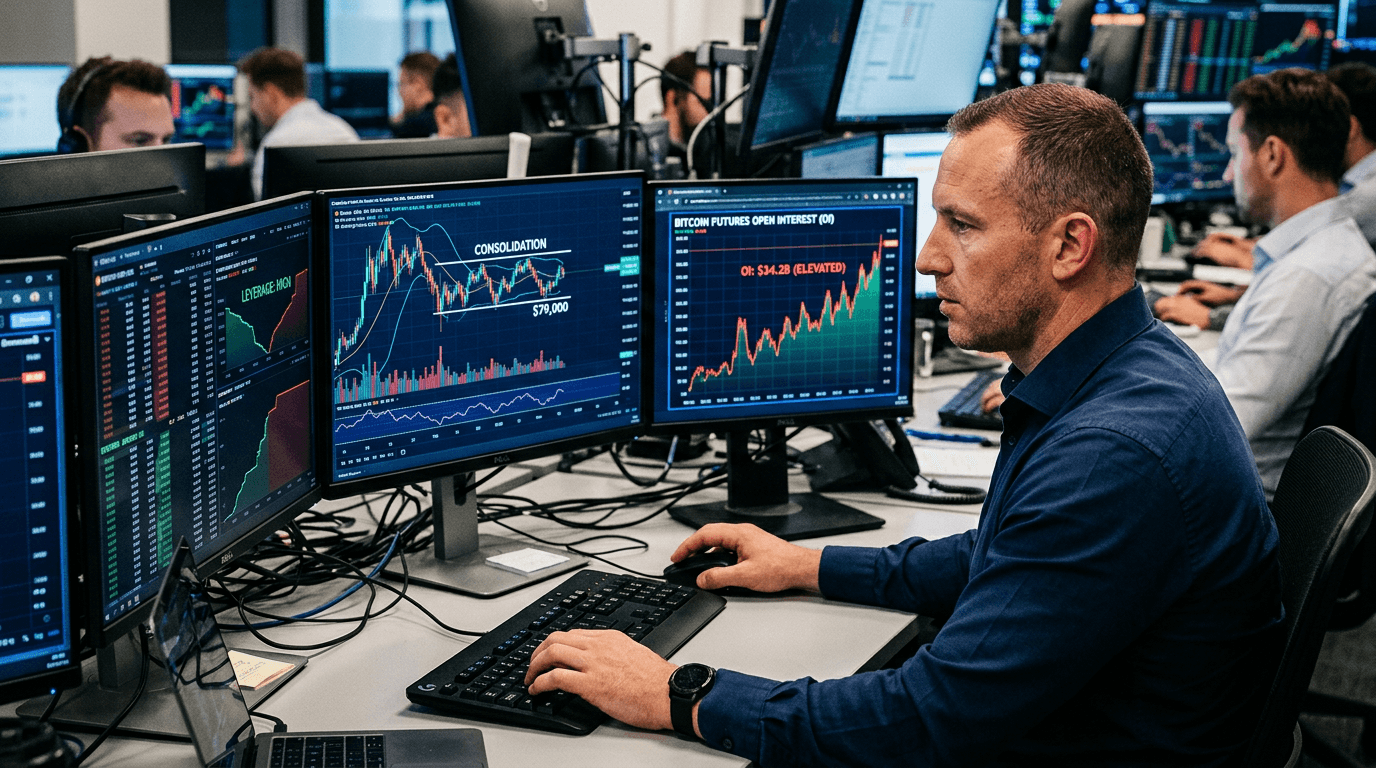
Bitcoin hovering around the $79,000 mark signals a market that is calm on the surface but highly charged underneath.[8][4] Price action has consolidated near recent highs after briefly testing above $80,000, suggesting traders are reluctant to take profits aggressively yet but are also cautious about chasing fresh breakouts.[8][4] For anyone trading Bitcoin on a SimFi platform, this is exactly the type of environment where understanding leverage, positioning, and scenario risk becomes more important than calling the next dollar of price.
Market Snapshot: Bitcoin Near Record Highs
Bitcoin is trading near $79,000, broadly flat over the last 24 hours but still close to its recent peak levels.[8] Despite the quiet daily change, the move over the past week has been strong, with gains in the mid‑teens percentage range, reflecting persistent buying interest rather than a one‑day spike.[8] Price has repeatedly approached the psychologically important $80,000 threshold, meeting resistance but not yet triggering a meaningful reversal.[4][8]
This kind of plateau at elevated levels often indicates a tug‑of‑war between short‑term traders locking in gains and longer‑term holders willing to sit through volatility.[4] Spot flows, including ETF demand, have cooled from their most aggressive phases, but remain supportive enough to prevent sharp downside breaks.[4][6] From a market structure perspective, Bitcoin is not in a euphoric vertical rally, nor in a clear distribution top—it is in a high‑altitude range where positioning matters as much as price.
Key takeaway: When price is flat near highs, the real story often lies in derivatives and positioning rather than the spot chart alone.
Leverage And Futures Positioning: Why Open Interest Matters
While spot price has been consolidating, Bitcoin futures open interest remains elevated, pointing to a heavily leveraged market.[14] Recent derivatives data show aggregate futures open interest in the tens of billions of dollars, with hundreds of thousands of BTC tied up in outstanding contracts that have not yet been closed.[14] In several recent episodes, traders added billions of dollars of fresh leveraged exposure within hours, underscoring how quickly sentiment can swing in the futures market.[3][13]
Open interest measures how many contracts are active, not whether they are long or short, but large and rising values typically mean more leverage embedded in the system.[11][14] When price is grinding sideways near a high while open interest stays lofty, it often implies that both bulls and bears are pressing their views with borrowed capital rather than cash.[14] The market becomes more sensitive to catalysts: a surprise macro headline, an ETF flow shock, or a large liquidation can trigger outsized moves as leveraged positions are forced to adjust.
For SimFi traders, elevated open interest is a signal that volatility can appear suddenly even if the chart looks quiet. It is also a reminder that risk is not just about direction, but about speed and magnitude of moves when leverage unwinds.
What This Environment Means For Traders
A flat price near $79,000 with high futures open interest creates a classic “coiled spring” setup, where the next directional move can be sharp relative to recent daily ranges.[8][14] If price breaks convincingly above $80,000, crowded short futures positions could be squeezed, leading to forced buying and an acceleration higher.[14] Conversely, a push below key short‑term support levels could trigger long liquidations and cascade selling as margin calls hit leveraged long positions.[3][13][14]
Because both scenarios involve forced flows from leveraged players rather than purely discretionary decisions, they tend to be fast and disorderly. This is exactly the kind of tape that can catch overconfident traders off guard, especially those relying on simple “trend up, buy dips” or “near highs, fade strength” playbooks without deeper context.
For SimFi participants, this environment offers a learning laboratory with three major lessons:
1. Direction and leverage interact. The same price move has very different impact when leverage is high than when the market is mostly spot. 2. Range trading is harder when liquidations can abruptly widen the band. 3. Risk management must be dynamic; static stop distances or position sizes can be inadequate.
PRACTICAL RISK MANAGEMENT IN A HIGH‑LEVERAGE MARKET
To navigate an elevated‑leverage environment around $79,000, traders can adopt several practical techniques within a SimFi framework.
First, right‑size positions using volatility, not just account size. When open interest is high and recent episodes show multi‑percentage‑point intraday swings, smaller position sizes can preserve flexibility and allow traders to survive unexpected liquidation cascades.[3][13][14] SimFi platforms are ideal for testing volatility‑based sizing rules—such as reducing exposure when realized volatility or leverage indicators spike—without risking real capital.
Second, use scenario planning rather than single‑point forecasts. Instead of asking “Will Bitcoin break $80,000?”, design playbooks for three paths: a breakout with follow‑through, a failed breakout and reversal, and an extended consolidation.[4][8] For each scenario, define entry criteria, risk limits, and exit rules. SimFi environments let traders run these playbooks repeatedly, collecting data on which rules perform best when leverage is high.
Third, pay attention to liquidation levels and funding dynamics. In the real market, clusters of leverage often form around obvious levels such as round numbers or recent swing highs and lows.[14] When price approaches these zones, the probability of forced liquidations grows. SimFi traders can simulate stress events—sharp moves through these levels—to see how different strategies behave under pressure and refine their approaches before deploying real capital.
Finally, emphasize risk‑first metrics like maximum drawdown, time underwater, and consistency over headline returns. In a heavily leveraged Bitcoin market, impressive gains are easy to generate with aggressive positioning; staying in the game through multiple cycles is harder. Using simulated environments to build resilient, repeatable processes is a competitive edge.
CONCLUSION: LEVERAGE IS THE REAL STORY AT $79,000
Bitcoin holding near $79,000 with elevated futures open interest tells a clear story: price is strong, but positioning is doing the heavy lifting.[8][14] The market is not complacent; it is highly geared and potentially fragile, with both upside squeezes and downside cascades on the table.[3][13][14] For traders—especially those honing their skills on SimFi platforms—the opportunity is not just to predict the next move, but to understand how leverage, open interest, and risk management interact in real time.
By focusing on position sizing, scenario planning, and liquidation dynamics, traders can turn a superficially “flat” market into a rich source of insight and practice. Whether Bitcoin’s next major move is above $80,000 or back into lower ranges, those who treat this environment as a training ground for disciplined, leverage‑aware trading will be better prepared for whatever comes next.