
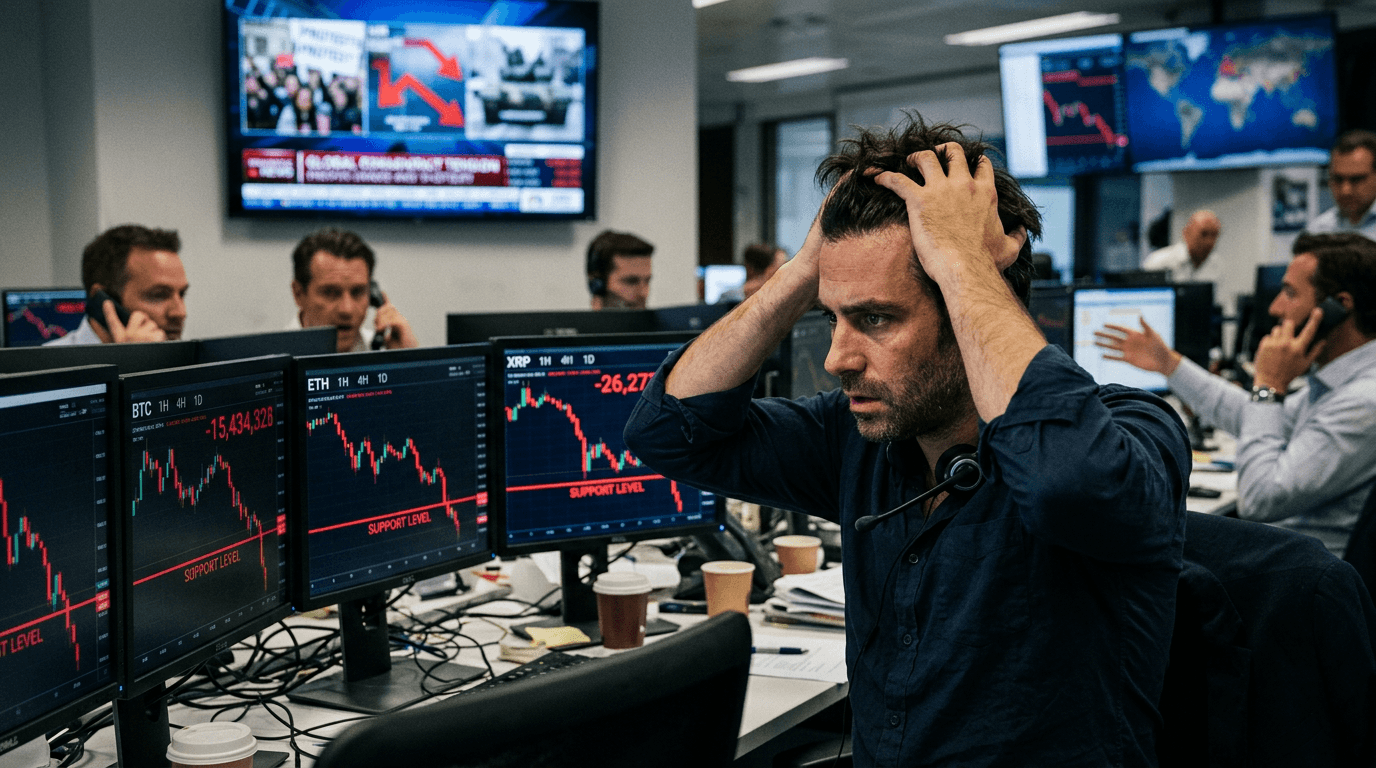
The cryptocurrency market continues to grapple with unprecedented volatility as the prolonged US-Iran conflict casts a shadow over Bitcoin, Ethereum, and Ripple valuations. In the wake of heightened geopolitical tensions, these three major cryptocurrencies have experienced significant downside pressure, with a recent 2% pullback underscoring how quickly external shocks can reshape market sentiment. Bitcoin struggles to maintain its footing above $71,000, Ethereum fights to hold its critical $2,000 support level, and Ripple consolidates near $1.33 amid an increasingly risk-averse investment climate. For traders navigating these turbulent waters, understanding the interconnected forces pressuring these major cryptocurrencies is essential for protecting capital and identifying potential recovery opportunities.
Crypto Markets As Risk-on Assets
The immediate market reaction to escalating US-Iran tensions underscores cryptocurrency's sensitivity to macroeconomic and geopolitical headlines. Despite cryptocurrency's positioning as a decentralized alternative to traditional markets, crypto assets continue to behave as risk-on assets, meaning they sell off sharply when investors flee to safety during periods of crisis. The February 28 military escalation demonstrated this vulnerability vividly: Bitcoin nosedived 6.4%, Ethereum tumbled 8%, and Ripple plunged 9%. These sharp declines show that when global uncertainty spikes, investors treat digital assets as expendable positions rather than safe havens.
What makes this situation particularly challenging for traders is the rapid reversal of sentiment based on diplomatic developments. When a ceasefire was announced in early April, crypto markets responded immediately and positively. Bitcoin surged nearly 5% over a 24-hour period, climbing above $72,000, while Ethereum gained 6% to reach $2,257. This volatile swing highlights how geopolitical announcements can trigger significant intraday moves and reshape market psychology within hours. For traders accustomed to crypto's traditional volatility, this geopolitical dimension adds a layer of unpredictability that technical tools alone cannot fully capture.
BITCOIN'S PRECARIOUS POSITION AT $71,000
Bitcoin is currently struggling to maintain its footing above the critical $71,000 support level, which represents both a technical and psychological barrier for investors. The magnitude of recent losses underscores how quickly geopolitical shocks can outweigh technical analysis and sentiment indicators that typically guide trading decisions. If Bitcoin breaks below $71,000, the next support zone sits around $66,601, which acted as a key consolidation point in recent sessions. A breakdown below this level could test even lower support zones, with some analysts warning that extended conflict could push Bitcoin toward $60,000 or potentially lower levels near $55,000.
The technical picture for Bitcoin remains mixed. While the cryptocurrency has demonstrated resilience by holding certain support levels, the lack of significant upside momentum suggests that bulls remain cautious. Trading volume remains compressed, indicating that both buyers and sellers are hesitant to commit significant capital while geopolitical uncertainty persists. This environment favors traders who maintain strict stop-loss discipline and avoid overleveraged positions.
ETHEREUM FACES CRITICAL TEST AT $2,000
Ethereum presents an even more concerning technical picture than Bitcoin. The second-largest cryptocurrency has retreated toward the $2,000 support zone after declining from its March peaks. The concerning factor is that the 50-day, 100-day, and 200-day exponential moving averages remain above $2,193, maintaining a persistent downtrend that suggests sellers continue to dominate longer-term price action.
A sustained movement below $2,000 would pave the way toward the $1,980 to $2,100 range, where prior congestion and dip-buying activity were previously observed. Most concerning is the possibility of a sustained break below $1,747, which would signal increased downside risk and potentially trigger further declines that test additional support zones. For Ethereum traders, these technical levels represent make-or-break points that will determine whether the cryptocurrency stabilizes or enters a more severe correction.
Ripple's Range-bound Struggle
Ripple presents a more compressed but equally challenging situation. Having dropped to $1.33, XRP has remained range-bound between $1.60 and $1.27 over the past several weeks since geopolitical tensions escalated. Unlike Bitcoin and Ethereum, which have experienced more dramatic swings, XRP's range-bound nature suggests that geopolitical risk continues overshadowing protocol fundamentals and adoption narratives in the broader cryptocurrency space.
Despite repeated bounce-backs that demonstrate underlying resilience, XRP has struggled to break free from its consolidation zone. This suggests that traders remain unconvinced about the cryptocurrency's strength until broader market sentiment improves or geopolitical tensions ease significantly.
Key Trading Considerations
For active traders, this environment demands heightened caution and disciplined risk management. Set clear stop-loss levels ahead of trading sessions. Monitor geopolitical news closely, as official statements or military developments can trigger sudden sharp moves. Avoid maintaining large overnight positions until tensions ease. Consider reducing position sizes during periods of elevated uncertainty.
The intersection of technical support levels and geopolitical uncertainty creates a precarious situation where traditional chart analysis becomes less reliable. Until US-Iran tensions show signs of meaningful de-escalation, expect crypto markets to remain volatile and sensitive to headline risks.