
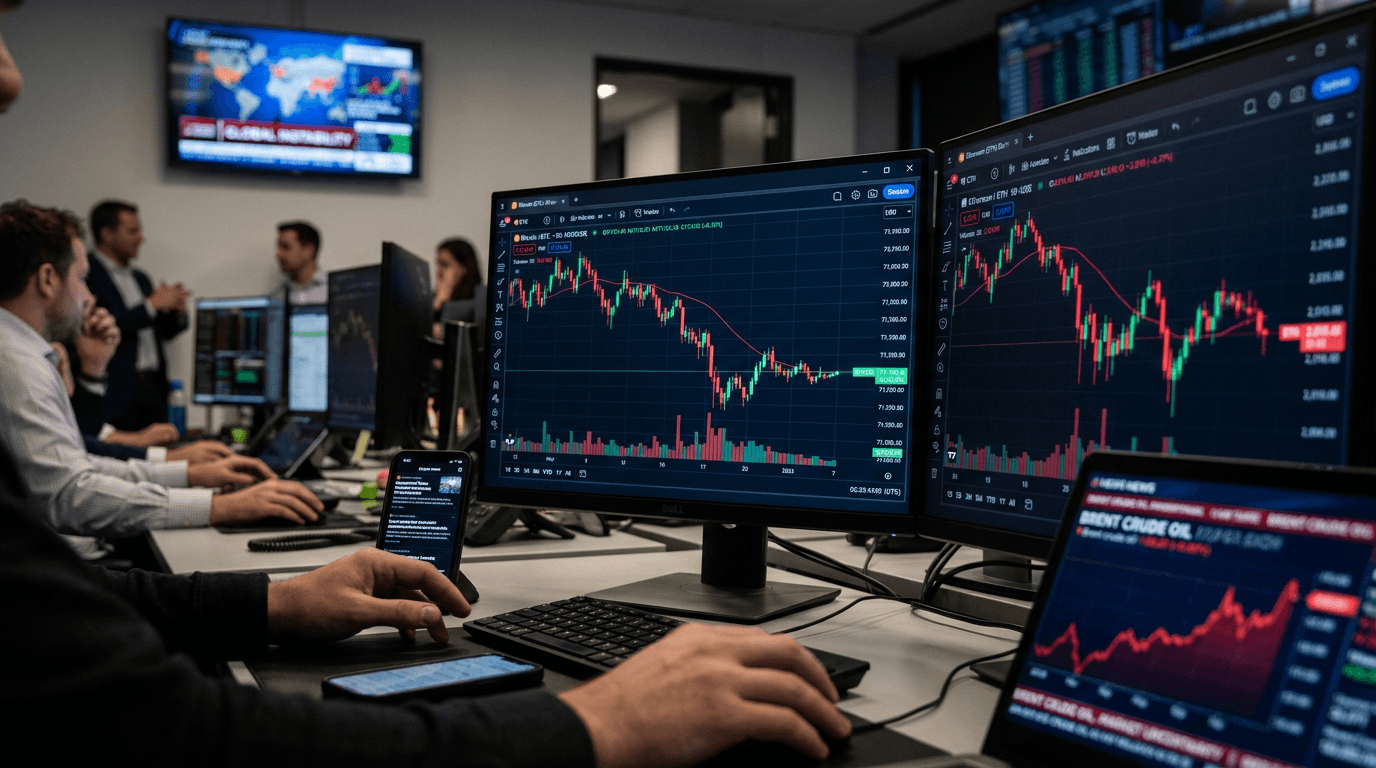
The cryptocurrency market is facing significant challenges as geopolitical tensions between the United States and Iran continue to create an uncertain environment for major digital assets. Bitcoin is struggling to maintain its position above $71,000, Ethereum is working to defend the critical $2,000 threshold, and Ripple is consolidating near $1.33. This broader uncertainty is affecting risk assets, making it crucial for traders and investors to understand how these geopolitical dynamics are impacting market pressure and how to navigate the resulting volatility to protect their capital.
Immediate Market Impact And Crypto Drawdowns
The heightened tensions between the US and Iran have led to swift and substantial declines in cryptocurrency valuations. Following US-Israeli military actions on February 28, Bitcoin saw a sharp 6.4% drop, Ethereum fell by 8%, and Ripple plunged by 9%. These declines highlight how quickly geopolitical risks can trigger sell-offs across the digital asset space. Recently, as peace talks stalled and uncertainty increased, Bitcoin dropped an additional 2% after briefly reaching above $79,000, resulting in nearly $278 million in liquidations across derivatives markets. These rapid movements underscore the fragility of investor sentiment in a market where headlines can quickly change directions.
The decline in cryptocurrency prices is part of a broader rotation out of risk assets, as investors seek safety amid ongoing conflict. Rising oil prices, a stronger U.S. dollar, and weakening institutional demand have all contributed to continued pressure on crypto valuations, creating a challenging environment for those holding positions in major cryptocurrencies. Disruptions in the energy market stemming from the conflict have also impacted prices in the airline industry, with the Strait of Hormuz remaining a critical focal point for traders and policymakers.
Technical Support Levels At Stake
From a technical perspective, major cryptocurrencies are hovering near critical support levels that have historically attracted buyers, yet they face persistent downward pressure. Bitcoin's immediate support is around $67,800, and a breakdown could lead to further declines toward the $65,800 to $65,000 range. If losses deepen beyond this, the mid-March base around $63,000 serves as the last major support before descending to levels seen in early 2025.
Ethereum is in a similar situation, having retreated from March peaks and fallen toward the $2,000 to $2,100 support zone. A decisive break below $2,000 could lead to the $1,930 to $1,980 range, where previous congestion and institutional buying provided support in prior cycles. These technical battlegrounds are critical decision points for traders to determine whether to accumulate for potential recovery or reduce exposure amid continued uncertainty.
Ripple has faced comparable pressure, dropping to $1.33, with all three major cryptocurrencies experiencing double-digit percentage declines recently. Despite broader geopolitical turmoil, XRP traders are pricing in minimal contagion from the conflict, maintaining XRP above the $0.90 level with steady conviction.
Geopolitical Catalyst Uncertainty
A ceasefire announced on April 7, brokered by Pakistan, temporarily reduced immediate military escalation risk. However, the ceasefire remains fragile. Trump extended negotiations on April 21 to allow more time for a comprehensive peace agreement, yet Iran blames the U.S. naval blockade for stalling progress toward a lasting deal. The Strait of Hormuz, a crucial waterway for oil supply, has not fully reopened despite the ceasefire agreement, with only bulk carriers carrying dry cargo passing through while oil tankers remain absent.
This incomplete reopening of shipping lanes has kept oil prices elevated, with WTI crude rising 2.5% to $95 and Brent crude climbing 2% toward $105. Analysts warn that if oil prices continue rising, the potential for a global recession increases, likely pushing investors toward further risk aversion and sustained pressure on cryptocurrencies.
Trading Strategy In Uncertain Times
In this turbulent environment, traders should adopt a defensive stance until clearer signals emerge regarding geopolitical resolution and broader macroeconomic conditions. Position sizes should reflect heightened volatility and limited visibility on recovery catalysts. However, maintaining vigilance for potential entry opportunities at critical support levels is essential, particularly if ceasefire announcements and diplomatic breakthroughs result in rotations back into risk assets.
Understanding that technical analysis operates within a broader geopolitical and macroeconomic context is vital for success in these conditions. If tensions ease and ceasefire agreements hold, analysts suggest that safe-haven flows could rotate back into traditional risk assets, eventually benefiting cryptocurrencies. Until then, patience and disciplined risk management are prudent approaches for protecting capital while positioning for eventual recovery.
The future for Bitcoin, Ethereum, and Ripple depends on resolving ongoing diplomatic efforts. Traders should stay alert to breaking developments while managing expectations about timing and potential rebound intensity.