
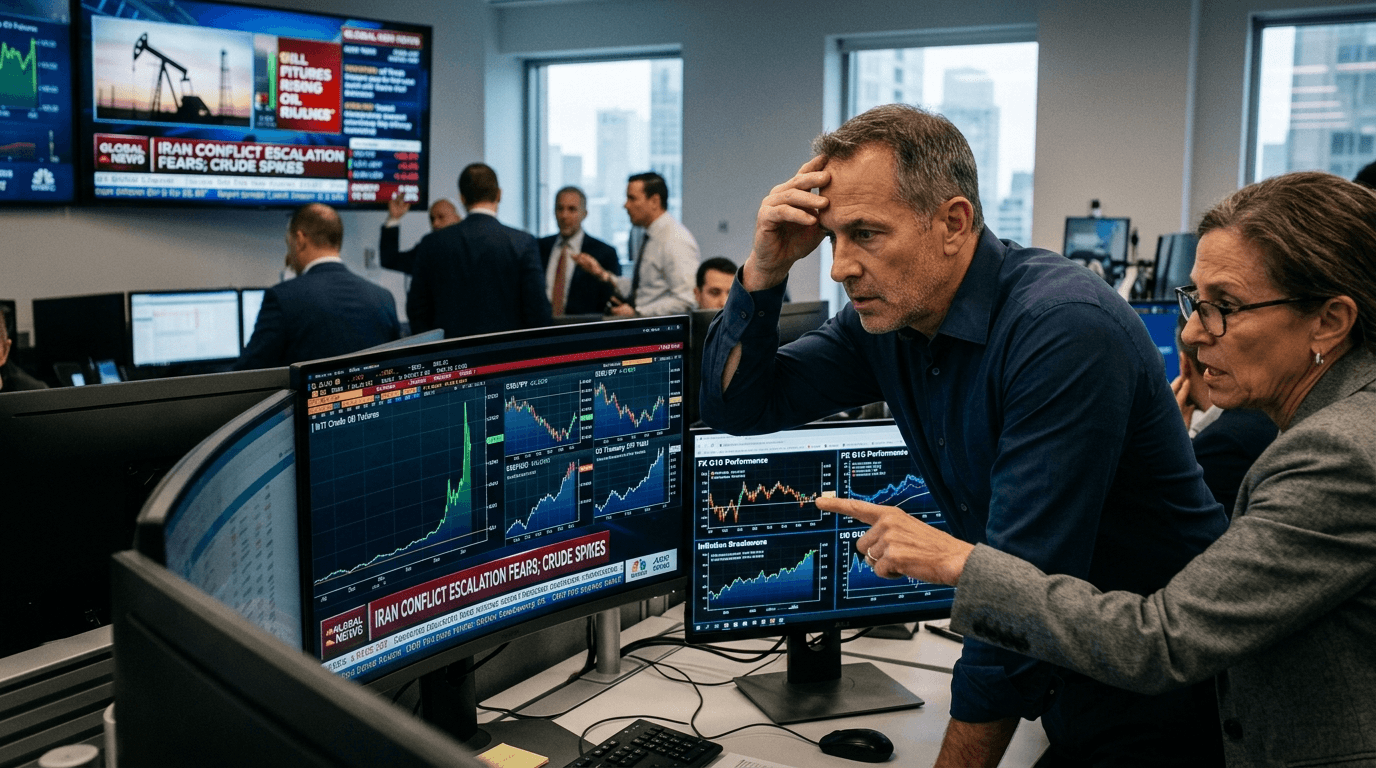
Oil’s latest surge has reminded traders how quickly geopolitics can rewrite the market script. On headlines of escalating war risk involving Iran, crude futures jumped roughly 9% in a matter of hours, lifting West Texas Intermediate above the 81-dollar mark and pushing Brent toward 86-dollar multi-month highs.[1] That move didn’t stay confined to the oil pit: safe-haven flows picked up, gold rallied, commodity-linked currencies caught a bid, and energy importers felt the squeeze.[1][4]
Oil Spikes And The Geopolitical Premium
When oil jumps this far, this fast, it usually isn’t about demand suddenly exploding. It is about a rapid repricing of the “geopolitical premium” embedded in crude.[1] Markets look ahead and ask: how much supply could realistically be disrupted, and for how long?
Iran matters because of its role in the broader Middle East energy ecosystem and its proximity to key shipping routes. Even when actual barrels are not yet offline, traders price the probability that flows could be interrupted, that shipping insurance costs rise, or that other regional producers may be dragged into the conflict.[4] That probability is what sends futures and options markets into overdrive.
In this latest spike, oil volatility jumped alongside price, with futures volumes surging as hedgers and speculators alike rushed to adjust positions.[1] Higher implied volatility means markets are willing to pay more for protection against large future price swings—a clear signal that uncertainty, not just spot demand, is in the driver’s seat.
SAFE-HAVEN FLOWS: GOLD, CHF, AND THE “GEOPOLITICAL HEDGE”
As oil ripped higher, classic safe-haven assets found steady buyers. Gold, already supported by an ongoing “debasement trade” narrative, benefited from a dual role: hedge against both geopolitical shock and the inflation that may follow a sustained energy rally.[1][4] When traders worry that wars and fiscal deficits could erode the real value of paper assets, they tend to rotate into tangible stores of value like precious metals.[4]
Currencies also reflected a shift toward safety. The US dollar often maintains its safe-haven status in global risk-off episodes, even when the underlying stress is tied to US policy or geopolitical involvement.[1] The Swiss franc, another recognized safe haven, typically appreciates as investors unwind riskier positions and park capital in perceived “quality” assets.
Meanwhile, emerging market FX and higher-beta currencies generally faced pressure, especially in countries heavily dependent on imported energy.[1][3] Rising oil prices widen trade deficits and intensify inflation risks for these economies, forcing investors to re-evaluate credit profiles and growth prospects. In practice, that often means weaker EM FX and a pullback in local bond markets as global funds cut exposure.
Commodity Fx: Why Aud, Cad, And Others Move
Not all risk-sensitive currencies suffer when oil spikes. The latest move saw commodity-linked FX—notably the Canadian dollar and, to a lesser degree, the Australian dollar—catch a tailwind.[1][4] For producers and resource-heavy economies, higher commodity prices improve terms of trade and can bolster fiscal revenues, at least in the short run.
Canada, as a major oil exporter, often trades like a leveraged play on crude. When WTI barrels rise, markets anticipate better cash flows for Canadian producers, stronger investment in the energy sector, and potentially improved current account dynamics. That tends to support CAD, especially against currencies of large oil importers.
Australia is less directly linked to oil but is heavily tied to the broader commodity complex. If an Iran-related shock boosts not only oil but general risk premia in raw materials, AUD can benefit as investors bid up commodity currencies more broadly.[4] At the same time, markets differentiate: exporters with strong external balances and credible policy frameworks generally outperform, while importers with fragile balances face the opposite dynamic.
The winners-versus-losers lens matters. History shows that during major geopolitical energy shocks, markets quickly reprice currencies and equities based on their net commodity exposure.[4] Exporters tend to see stronger currencies and equity inflows; importers often experience currency weakness, tighter financial conditions, and slower growth expectations.
What This Means For Growth, Inflation, And Policy
A fast 9% jump in oil doesn’t just change trading P&L—it reshapes macro expectations. Higher energy prices act like a tax on consumers and businesses in importing countries, forcing households to allocate more to fuel and heating and less to discretionary spending.[3] For corporates, higher input costs squeeze margins unless they can pass them on, which may weigh on earnings and capex.
Central banks also get pulled into the story. A sustained oil rally complicates the inflation outlook, especially if it arrives just as policymakers were considering rate cuts. Markets may start pricing a slower easing path or even a temporary hawkish tilt if inflation expectations threaten to drift higher. That feedback loop—oil to inflation to policy to growth—is a key channel through which geopolitical shocks can ripple far beyond the energy complex.
Risk assets respond accordingly. Equity futures often come under pressure on such headlines, as investors mark down growth expectations and demand a higher risk premium.[1] Sector rotation tends to favor energy producers and defensives over cyclicals and rate-sensitive segments like tech or small caps.
Building A Trading Playbook In A Simulated Environment
For active traders, episodes like this are as much a test of risk management as they are of macro insight. When intraday ranges widen across crude, FX, and equity indices, position sizing needs to adjust to volatility, not just conviction.[1] That can mean scaling down leverage, widening stops strategically, and avoiding the temptation to “double down” simply because a narrative feels compelling.
Headline-driven markets also tend to overshoot. A single geopolitical update can trigger a sharp spike followed by rapid mean reversion once the initial fear fades.[1] Developing a framework to differentiate between short-lived shocks and regime-changing events is critical. Tools like multi-day closes, cross-asset confirmation (oil, gold, volatility indices, safe-haven FX moving together), and options skew can help.
This is where simulated finance platforms become particularly valuable. In a SimFi environment, traders can:
- Back-test strategies on past geopolitical shocks, such as prior Middle East flare-ups or the 2022 Ukraine invasion, to see how systems handle gap risk and volatility clusters.[1]
- Forward-test adjustments—like volatility-based sizing rules or time-of-day filters—to understand how they would have performed during historical oil spikes, without risking real capital.
- Run “what-if” scenarios: for example, simulate a further 10–15% jump in oil and map potential moves in energy-sensitive FX pairs, gold, equity indices, and bond yields, then build contingency plans around those outcomes.[1]
Instead of improvising when the next Iran headline hits the tape, traders can lean on a pre-defined playbook tested across multiple stress scenarios.
Key Takeaways For Traders
Several practical lessons emerge from the latest oil spike:
- Oil is a cross-asset driver, not a siloed commodity. Moves of this magnitude can reshape FX, equities, rates, and metals in hours, not weeks.
- Safe-haven flows and commodity FX reactions offer real-time clues about how deep the risk-off sentiment runs.
- Differentiating exporters from importers—in FX, equities, and credit—is essential to spotting relative winners and losers.
- Volatility is the variable to manage; conviction should never override risk limits.
- Simulated environments provide a crucial laboratory to rehearse responses before real capital is on the line.
In a world where a single geopolitical headline can jolt multiple asset classes at once, preparation and disciplined risk control are more valuable than ever. Oil may be the catalyst, but your process is what determines whether these shocks become opportunity or avoidable damage.