
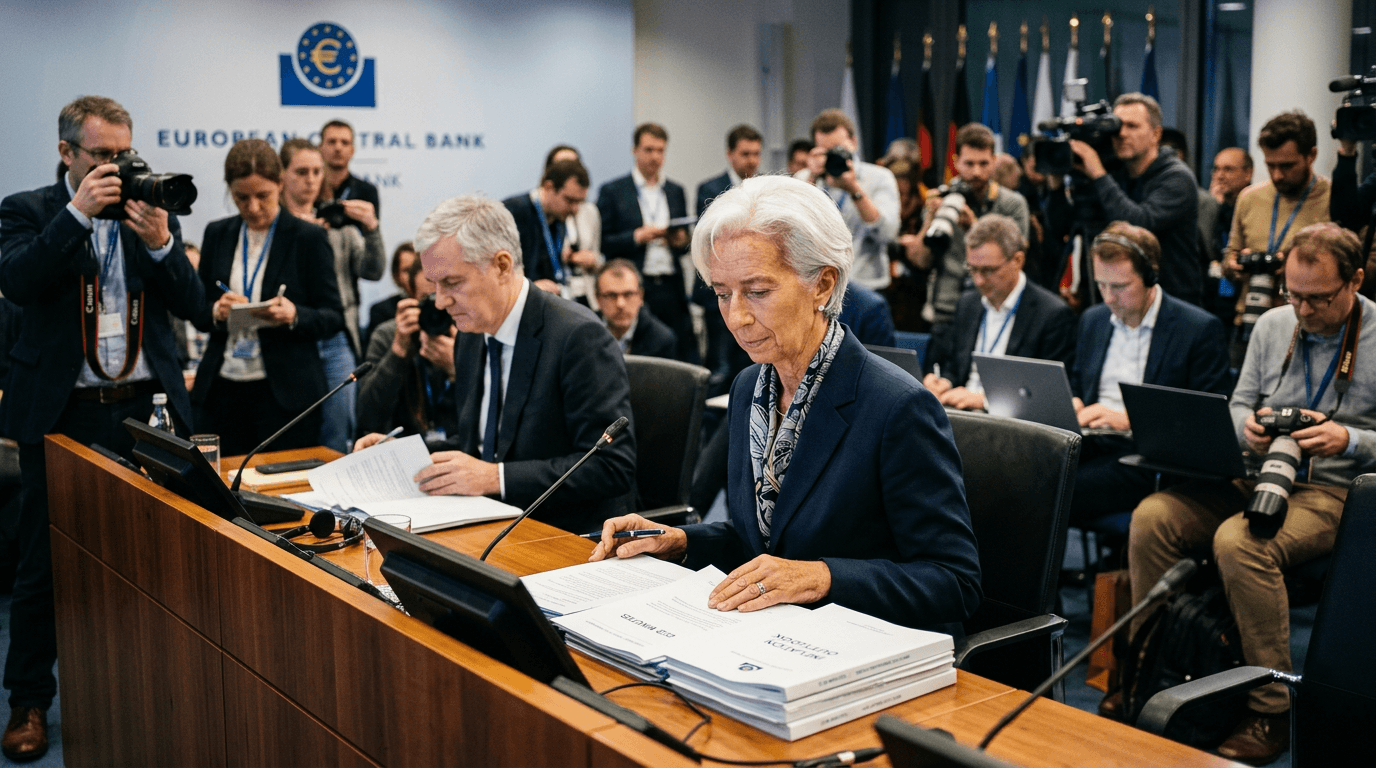
When the European Central Bank (ECB) publishes its meeting minutes, markets pay close attention—and the latest release has put inflation and interest-rate expectations firmly back in the spotlight. The accounts show policymakers were presented with projections of inflation staying above the ECB’s 2% target into next year, a reminder that the fight against price pressures is not fully over and that European rates may need to stay higher for longer.[3][5] For traders, that combination is fertile ground for renewed volatility in euro-denominated assets.
Why Ecb Minutes Matter
ECB minutes (or “accounts”) are detailed records of the Governing Council’s monetary policy discussions, released with a lag after each meeting. They complement the policy statement and press conference by revealing the range of views inside the Council, the data they considered, and the risks they are most worried about.[3][4]
Unlike the headline rate decision, which is binary, the minutes give nuance: how confident policymakers are about the inflation outlook, how they judge financial conditions, and how willing they are to surprise markets in the future. For rate-sensitive instruments—from government bonds and overnight index swaps to FX and equity sectors—this nuance can shift pricing even when the policy stance is formally unchanged.[3][12]
Recent accounts have shown that officials generally see current rates as “broadly appropriate” and are in no rush to change course as long as inflation remains close to target.[3][4] That steady tone anchors expectations, but it also means any hint of concern about inflation persistence or upside risks can have an outsized impact on how traders project the path of rates.
Inflation Still Above Target: What The Minutes Say
The ECB’s mandate is to keep inflation at 2% over the medium term, and the latest projections presented to the Governing Council show price growth staying above that level in the near term. In its March staff forecasts, headline inflation was seen averaging 2.6% in 2026, before easing to 2.0% in 2027 and 2.1% in 2028.[5] That profile suggests a gradual normalization, but not an immediate return to a comfortable zone.
Core inflation—excluding energy and food—was also projected to run above 2% in 2026 and 2027, reinforcing the idea that underlying price pressures remain somewhat elevated.[5] At the same time, indicators of “underlying inflation” that strip out temporary factors were described as broadly consistent with the 2% target, showing that the ECB still believes its medium-term anchor is intact.[5][10]
Survey data tell a similar story. The ECB’s Consumer Expectations Survey showed perceived inflation over the previous 12 months rising to 3.5% in March from 3.0% in February, while median expectations for the next 12 months have eased but remain above pre-2023 levels.[7][9] Professional forecasters and market-based inflation compensation measures, however, still cluster around 2% over the medium term, suggesting that longer-term expectations are well anchored.[3][10]
For policymakers, this mix—near-term inflation somewhat above target, but longer-term expectations stable—supports a cautious stance. Minutes highlighting inflation above target into next year signal that the ECB cannot credibly commit to rapid easing and must remain data-dependent.
Rate Expectations And Market Pricing
Following a sequence of rate reductions from their 2024 peak, the ECB has held its key rates steady for several meetings, with the deposit facility at 2.00%, the main refinancing rate at 2.15%, and the marginal lending facility at 2.40%.[12] This plateau reflects a view that policy has moved from restrictive towards a more neutral stance, but without declaring victory over inflation.
Market pricing has increasingly converged on a scenario of stable rates through most of 2026, with limited expectations for additional cuts from current levels and only modest scope for hikes further out.[3][12] Some medium-term projections even allow for a slight drift higher towards around 2.25% by 2030, assuming inflation stays near target and growth stabilizes.[12]
The minutes reinforce this picture. Accounts from recent meetings show policymakers broadly comfortable with market expectations for a prolonged hold, indicating that any easing would require a clear deterioration in the data.[3][4][6] They also highlight that financial conditions have tightened marginally but remain closely aligned with the policy stance, which the ECB sees as evidence of effective monetary transmission.[3]
For traders, the key takeaway is that rate expectations are now less about “how many cuts” and more about “how long the plateau lasts.” Surprises in inflation data or in minutes language—especially around wage dynamics, energy prices, or global shocks—can shift the perceived length of that plateau and therefore move the entire yield curve.
Impact On The Euro And Volatility
Currency markets are highly sensitive to relative interest-rate expectations. If the ECB is seen as keeping rates higher for longer because inflation remains above target, that can support the euro against currencies whose central banks are closer to cutting.[3][12] Conversely, any sign that the ECB is opening the door to earlier easing can weigh on the euro.
The latest minutes highlight that expectations of further rate cuts in 2026 have largely been priced out, and that markets now anticipate an extended period of stable policy rates with a possible rate hike only beyond 2027.[3] Longer-term risk-free rates have already risen, with the 10-year nominal overnight index swap (OIS) rate up by about 26 basis points, driven mainly by higher real rates rather than inflation compensation.[3]
Higher real rates tend to attract capital inflows and can support the currency, but the process of repricing can be volatile. On minutes days, traders often see sharp intraday moves in the euro and European bond yields as algorithms and discretionary desks react to nuances in the language—references to “upside risks,” “persistence,” or “second-round effects” in wages.
For options traders, this environment reinforces demand for euro volatility. As long as inflation is hovering above target and the ECB remains firmly data-dependent, each major release—minutes, CPI prints, wage data—can trigger repricing across FX, rates, and equity sectors tied to financials and interest-rate sensitivity.
Practical Takeaways For Simulated And Real Traders
For traders using both live and simulated environments, the ECB minutes offer a structured way to think about macro risk and strategy:
First, anchor your rate view in the ECB’s own projections. If staff forecasts show inflation above 2% next year and only slowly converging to target, it is reasonable to assume the ECB will resist aggressive easing and maintain a “higher for longer” stance.[3][5][12]
Second, track how markets respond to each minutes release. Compare the pre- and post-minutes pricing of the OIS curve and government bond yields to see whether traders are extending or shortening the expected plateau in rates.[3] This helps you understand consensus and where potential mispricings may lie.
Third, link rate expectations to FX strategies. A more hawkish read of the minutes—emphasis on inflation persistence or upside risks—tends to support the euro, particularly against currencies whose central banks are clearly leaning towards cuts. A more dovish tone, stressing downside growth risks or openness to future easing, can have the opposite effect.[3][4][6]
Fourth, use simulated trading to stress-test scenarios. For example, build strategies around: (a) a base case of stable ECB rates through 2026, (b) an upside inflation shock that forces a renewed tightening discussion, and (c) a downside growth surprise that reopens the debate on cuts. Assess how euro pairs, European equity indices, and rates products perform under each scenario.
Finally, pay close attention to how the ECB describes “data dependence.” When minutes highlight specific indicators—wage growth, negotiated pay, energy prices, or survey-based inflation expectations—that is a signal about what will matter most for the next decision.[3][5][9] Align your calendar and risk management with those data points.
Conclusion
The latest ECB minutes underscore that, even after substantial progress in bringing inflation down from its peak, price growth is expected to stay above target into next year. That keeps interest-rate expectations—and the euro—squarely in focus for global markets.[3][5] With policy rates now on a plateau and further cuts largely priced out for 2026, traders must shift from timing individual moves to assessing how long this stance will last and how sensitive it is to incoming data.[3][12]
For both educational and practical purposes, understanding the narrative inside the minutes—how policymakers balance inflation risks, growth prospects, and financial conditions—is essential. It is that narrative, more than the headline rate decision alone, that will drive the next wave of volatility in European rates and FX.