
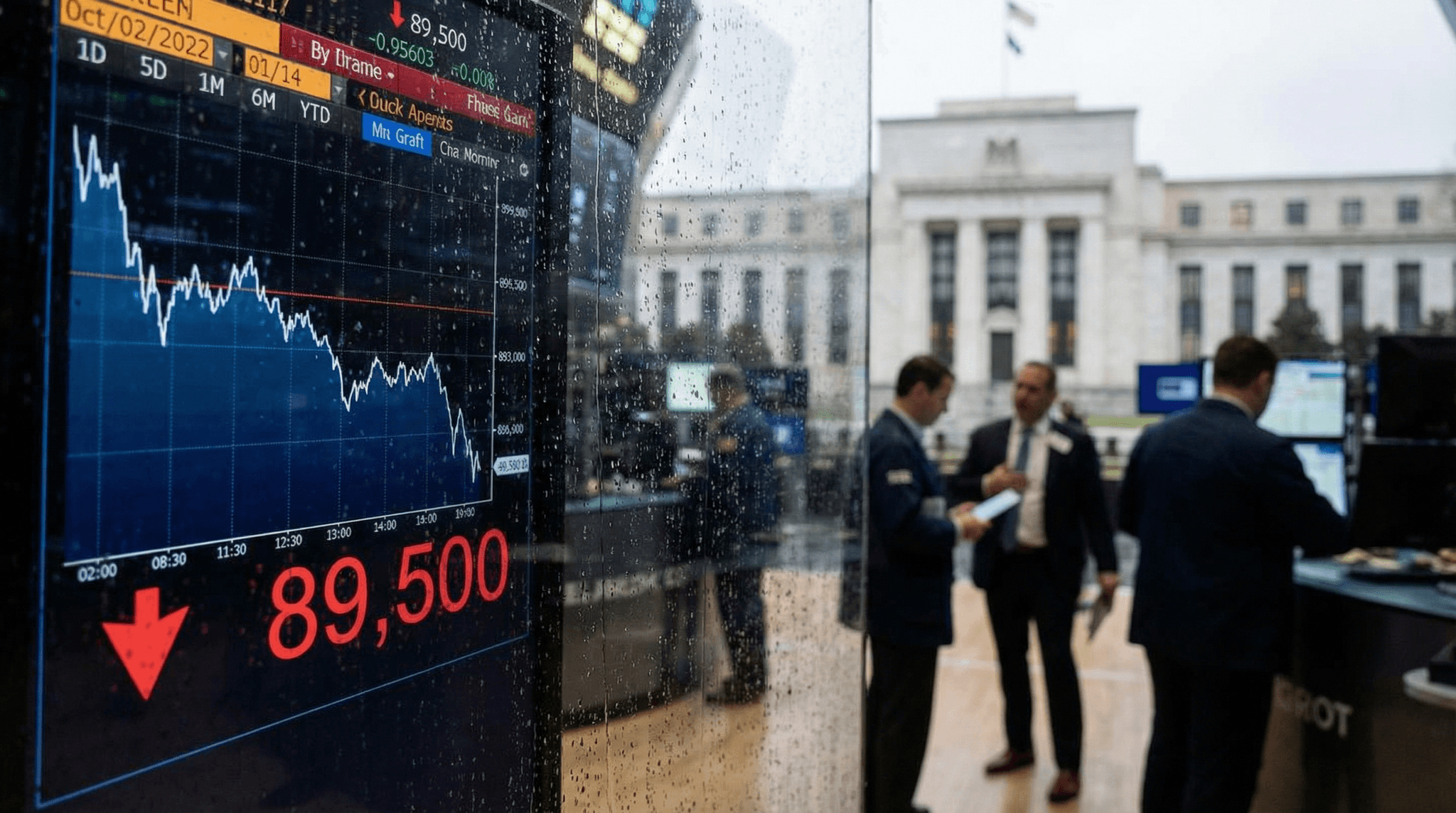
Bitcoin markets faced a critical juncture on January 28-29, 2026, as the Federal Reserve announced its decision to hold interest rates steady, leaving traders navigating the tension between policy certainty and persistent macroeconomic uncertainty. The cryptocurrency, which had surged toward $90,000 in anticipation of the announcement, ultimately settled below this key psychological level, illustrating the delicate balance between bullish momentum and bearish headwinds that continue to define the crypto market's relationship with monetary policy shifts.
The Fed's Hold: Expected But Consequential
The Federal Reserve's decision to keep interest rates unchanged at 3.5%-3.75% arrived exactly as markets had predicted, with little surprise in the headline announcement itself.[1] What traders truly monitored, however, was Federal Reserve Chair Jerome Powell's commentary during the press conference and whether he would signal any shift in the Fed's stance toward future rate cuts. Powell remained tight-lipped on several fronts, including declining to comment on a Justice Department investigation into his conduct. This restraint, while maintaining Fed credibility on independence, left market participants parsing every word for hints about the monetary policy trajectory ahead.
The decision to hold rates came as the U.S. economy continues to display resilience, with unemployment at 4.4% and gross domestic product growth remaining surprisingly robust.[4] For crypto markets specifically, this creates a paradox: while a paused Fed supports softer financial conditions over the long term, the near-term implications remain unclear. Following the announcement, market odds that rates will remain unchanged at the March meeting actually rose to 86%, according to the CME's FedWatch tool, suggesting the Fed intends to maintain its current stance for some time.[1]
Bitcoin's Price Action: Volatility And Resilience
Bitcoin's movement around the $90,000 level tells a nuanced story of market dynamics. In the days leading up to the announcement, Bitcoin surged, climbing to highs of $90,361 as traders positioned for potential volatility.[4] However, after the Fed's decision, Bitcoin struggled to maintain these gains, ultimately settling in the $89,000-$90,000 range. Over the seven days preceding the announcement, Bitcoin was actually down over 1%, suggesting that the broader trend remains under pressure despite short-term rallies.[1]
This volatility reflects a fundamental challenge facing crypto investors: Bitcoin's price action remains highly sensitive to Federal Reserve communications, even as the announcements themselves deliver little material surprise. When Powell's press conference failed to open the door to imminent rate cuts or signal major policy shifts, Bitcoin's momentum stalled. The cryptocurrency had experienced its worst annual performance since 2017 heading into 2026, and current price action suggests recovery remains fragile and dependent on external factors.[2]
Macro Headwinds And The Dollar's Role
One of the most significant but often overlooked factors influencing Bitcoin's performance is the U.S. dollar's direction. The dollar has been under considerable pressure, posting its worst annual performance since 2017, and this weakness heading into the Fed announcement actually created favorable conditions for risk assets including cryptocurrencies.[2][3] A weaker dollar can loosen financial conditions even without explicit Fed rate cuts, making assets denominated in dollars more attractive to international investors.
However, the Fed's hawkish hold on rates has provided some support to the dollar, potentially limiting the downside benefit to Bitcoin that typically accompanies dollar weakness. This creates a constrained environment where Bitcoin cannot fully capitalize on depreciating currency dynamics because the Fed's stance simultaneously supports dollar strength. Analysts note that the path forward for financial conditions may emerge indirectly through factors beyond traditional rate cuts, including future policy shifts when Powell's successor takes office.[1][2]
Political Uncertainty And Forward Catalysts
A critical development emerging from this period is the looming transition in Fed leadership. Powell's term as chair expires in May 2026, and President Trump is expected to nominate a successor within the coming week.[1] This potential shift represents one of the most significant political variables affecting crypto markets in the near term. Any announcement regarding a new Fed chair could dramatically reshape market expectations around future rate cuts and monetary accommodation.
According to research from CF Benchmarks, "near-term bullish catalysts for Bitcoin remain intact but are increasingly political rather than monetary."[1] A nominee perceived as more dovish than Powell could reverse current market pessimism, while a hawkish choice might extend the current consolidation. Markets will watch this development closely, as it could shift expectations for rate cuts far more dramatically than any single FOMC statement.
Key Takeaways For Investors
Bitcoin's hold beneath $90,000 represents neither a definitive breakdown nor a sustained rally, but rather a market in transition. The Fed's decision to pause rate cuts was widely anticipated and largely priced in, leaving Bitcoin vulnerable to disappointment. However, the cryptocurrency maintains support from a weakening dollar and growing regulatory clarity in the United States, particularly around proposed crypto legislation.[4]
For investors, the current environment demands patience and precision. The next major catalyst will likely be the announcement of Powell's successor, not the next FOMC meeting. Until then, expect continued range-bound trading as Bitcoin consolidates gains from its December recovery, hovering around key technical levels including support at $87,000 and resistance near $92,000.[2]