
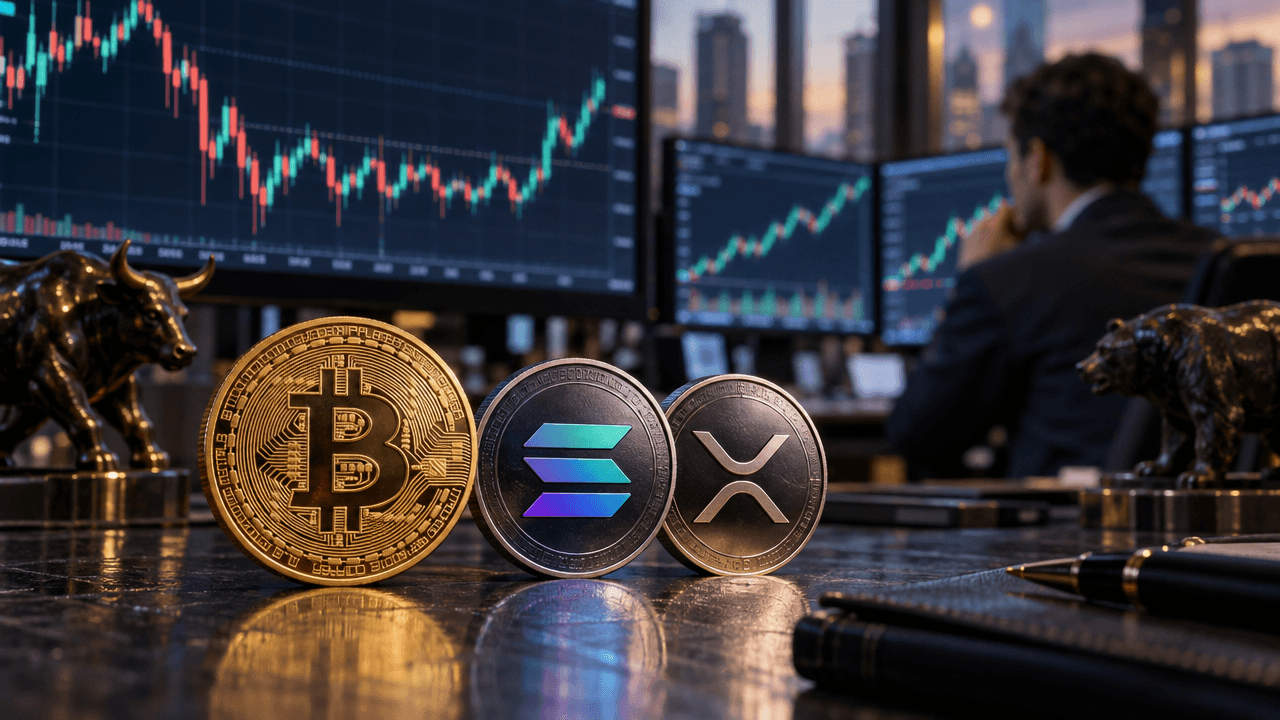
Bitcoin is holding close to $84,000 after a strong rally that briefly pushed prices above $87,000 earlier in the week, leaving the market in a period of consolidation rather than trend expansion.[3][10][11][14][15] While the benchmark crypto trades broadly sideways, Solana has climbed roughly 4% to around $122 and XRP has added a couple of percent, highlighting a clear rotation into selected large‑cap altcoins as traders search for relative strength.[4][8][9] For active and simulated traders alike, this kind of environment blends range‑bound price action in Bitcoin with momentum opportunities in higher‑beta names.
Market Snapshot: Bitcoin Steadies, Altcoins Move
Recent sessions have seen Bitcoin oscillate within a relatively tight band between roughly $83,000 and $85,000, with intraday dips toward the low $83,000s followed by recoveries back near $84,000.[1][2][3][11][14][15] Day‑to‑day moves have been modest—around 0.4% to 0.7% to the downside—signaling consolidation rather than a decisive change in trend.[1][14] At the same time, large‑cap altcoins such as Solana and XRP have attracted fresh flows, with Solana’s price near $122 and up about 4% over 24 hours, and XRP gaining around 2%.[4][8][9] This divergence between a range‑bound Bitcoin and outperforming altcoins is a classic sign of rotation, where capital shifts from the leader into assets with more upside torque.
For traders on simulated platforms, this snapshot underscores a key tactical point: the headline index (Bitcoin) can be relatively quiet even while opportunities emerge in its periphery. A flat Bitcoin often reduces overall market stress, allowing participants to reprice altcoin narratives and test new positions in names that have underperformed or carry higher innovation stories, such as high‑throughput chains and DeFi platforms.
WHY BITCOIN IS STUCK AROUND $84,000
Bitcoin’s inability to break cleanly above the $87,000 area and hold those levels has created a clear technical structure of resistance overhead and support around the mid‑$80,000s.[3][7][11][12][15] Several analyses highlight the $84,000–$85,000 zone as an important region where previous buyers are now defending their positions after the pullback from recent highs.[1][2][15] Under the surface, on‑chain data and ETF flows remain constructive, with U.S. spot Bitcoin ETFs posting multiple days of net inflows and mid‑sized wallets (100–1,000 BTC) accumulating coins even as price chops sideways.[3][11] This confirms that the consolidation is driven less by a collapse in demand and more by external macro and positioning factors.
One of those macro forces is the surge in U.S. Treasury yields, with the 10‑year note trading above 5%, its highest level in nearly two decades, which tightens financial conditions and weighs on risk assets, including crypto.[2][10] As yields rise, some capital rotates toward fixed‑income instruments, and leverage becomes more expensive, dampening the appetite for aggressive upside bets in Bitcoin. The result is a tug‑of‑war: structural bullish drivers such as ETF inflows and whale accumulation versus near‑term headwinds from higher rates and a stronger dollar.[3][10][11]
For simulated traders, this environment is ideal for practicing range‑trading and volatility management. When price respects well‑defined support and resistance zones, strategies such as mean‑reversion, grid trading, and options selling can be tested without the stress of runaway trends. The key is to define scenarios—“range holds,” “support fails,” “resistance breaks”—and build playbooks around each, then observe how those playbooks would have performed as the real market evolves.
SOLANA’S OUTPERFORMANCE: READING THE SIGNAL
While Bitcoin digests its prior gains, Solana has emerged as one of the strongest large‑cap performers, trading around $122 with roughly 4% gains over 24 hours and robust trading volume.[6][8][9] The move pushes Solana toward levels last seen earlier in the year, reinforcing its status as a high‑beta proxy for risk appetite in the altcoin space.[9][13] Historically, Solana’s rallies have coincided with renewed interest in high‑performance smart‑contract platforms, as traders position for growth in DeFi, NFT activity, and new application launches.
From a market‑structure perspective, Solana’s outperformance suggests that traders are willing to move further out the risk curve when Bitcoin volatility compresses. Instead of betting on an immediate BTC breakout, they look for assets with clearer momentum, stronger short‑term narratives, or technical setups that show clean breakouts from consolidation ranges.[4][9][13] This can precede broader altcoin seasons, but it can also be short‑lived bursts of relative strength that fade if Bitcoin resumes aggressive trending or if macro conditions deteriorate.
For simulated trading, Solana’s behavior is an opportunity to test trend‑following and momentum strategies. Traders can design rules for entering on breakout candles, setting dynamic stops based on average true range, and scaling out of positions as price extends away from moving averages. Because Solana is more volatile than Bitcoin, it also helps stress‑test position sizing and risk limits—skills that are critical before deploying capital in live markets.
ALTCOIN ROTATION AND XRP’S ROLE
XRP’s roughly 2% gain alongside Solana’s stronger rally points to selective altcoin rotation rather than a broad, indiscriminate melt‑up.[4][9] Large‑cap names with established liquidity and recognizable narratives often lead such phases, as they can absorb institutional and retail flows without excessive slippage. This rotation typically reflects traders seeking relative value: assets that have lagged Bitcoin’s recent run, yet have catalysts such as regulatory clarity, ecosystem developments, or technical setups indicating room to catch up.
However, rotation also concentrates risk. If Bitcoin were to break below its current support band around $83,000–$84,000, these outperforming altcoins could see amplified downside as traders unwind leveraged positions and retreat to stablecoins or cash.[1][11][12][15] Understanding this linkage is crucial for risk management: strong altcoin days are often conditional on Bitcoin remaining stable rather than collapsing.
In a simulated environment, traders can explore pairs strategies that express this rotation theme, such as long Solana and short Bitcoin, or baskets of large‑cap altcoins versus BTC. Tracking the performance of these relative‑value trades through different volatility regimes builds intuition about when rotation is sustainable and when it is vulnerable to sharp reversals.
Practical Takeaways For Simfi Traders
Today’s mix of a range‑bound Bitcoin and outperforming altcoins offers several actionable lessons for traders practicing on SimFi platforms:
1) Treat Bitcoin’s $83,000–$85,000 band as a case study in support‑resistance dynamics, mapping how price reacts near these levels and how volume shifts as the range persists.[1][2][11][14][15]
2) Use Solana’s breakout to test momentum and breakout strategies, focusing on entries, exits, and how quickly to adjust stops when volatility expands.[6][8][9][13]
3) Model scenarios where a macro shock—such as another spike in bond yields—forces Bitcoin out of its range, and track how that would propagate to altcoins and portfolios.[2][10][11]
4) Practice portfolio rotation: gradually shifting simulated exposure from Bitcoin into a diversified basket of large‑cap altcoins, then measuring risk and drawdowns under different assumptions.
By iterating through these exercises in a simulated environment, traders can refine their frameworks without capital at risk, gaining the discipline and pattern recognition that become invaluable when markets move quickly.
Conclusion
Bitcoin’s pause near $84,000 is not a sign of market fatigue so much as a consolidation phase where macro pressure and prior gains are being digested.[2][3][10][11][14][15] Beneath that calm surface, Solana’s roughly 4% rise and XRP’s more modest gains show that risk appetite is alive and rotating into selected large‑cap altcoins.[4][8][9] For traders, especially those honing their skills on SimFi platforms, this environment is rich with lessons in range‑trading, momentum, rotation, and macro sensitivity. The challenge is not predicting the next big move, but building and testing robust strategies that can adapt whether Bitcoin breaks out, breaks down, or continues to drift sideways while altcoins take turns in the spotlight.