
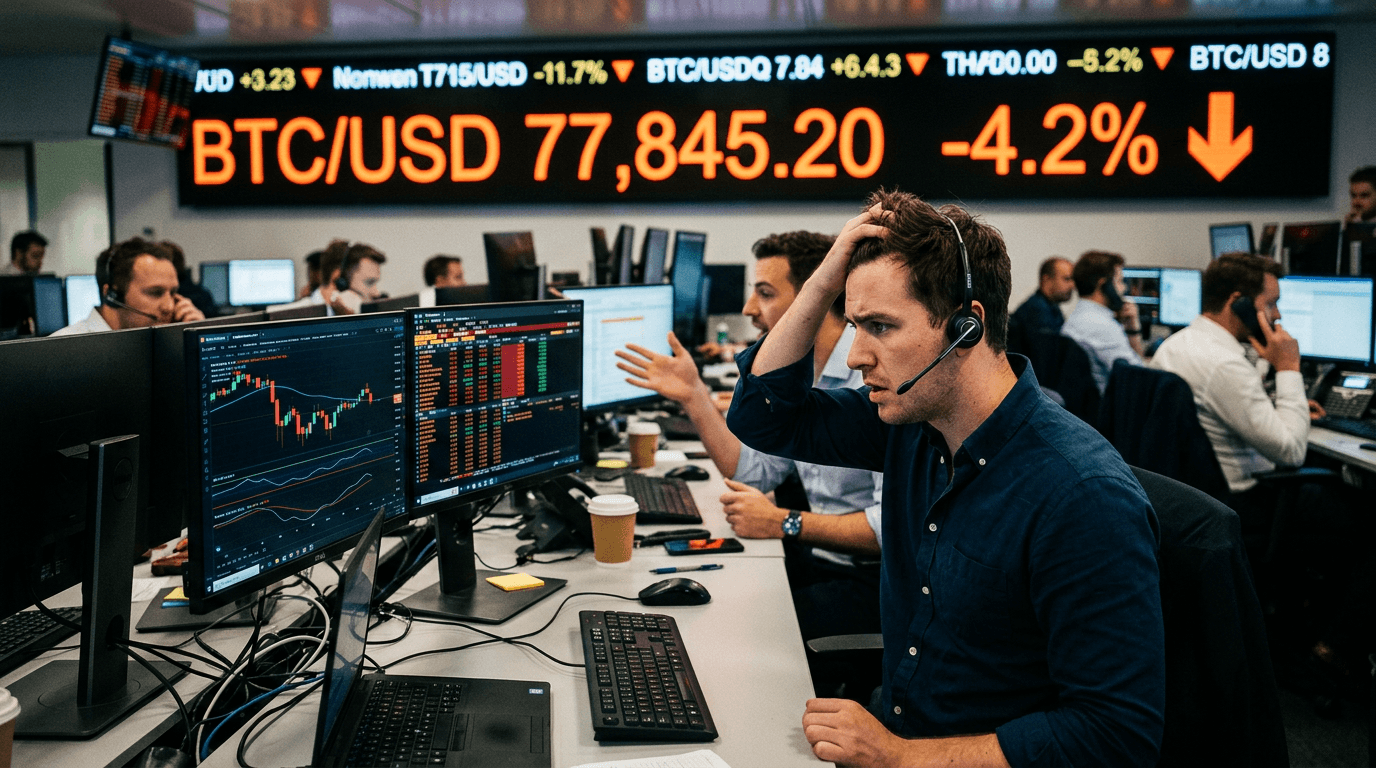
Bitcoin’s slide below the $78,000 mark has jolted a market that was already on edge, reminding traders that crypto still behaves like a high‑beta risk asset when geopolitics flare up. An escalation in the US‑Iran conflict has triggered a sharp risk‑off move across digital assets, with major altcoins down and leveraged positions feeling the full force of the correction.
WHAT JUST HAPPENED?
The latest shock came as tensions between the US and Iran escalated, prompting a broad de‑risking across global markets. In crypto, that translated into Bitcoin breaking below the $78,000 level, a psychological and technical area that had attracted significant spot and derivatives interest.
Ethereum, XRP, Solana, and BNB have all dropped in the low single digits, roughly in the 2–4% range, as traders cut exposure to anything perceived as volatile or speculative. This move may look modest compared with previous crypto crashes, but in a market that had recently stretched higher, it is enough to trigger a chain reaction in futures and highly leveraged positions.
This is not the first time geopolitical stress between the US and Iran has hit crypto. Earlier phases of the conflict saw Bitcoin plunge more than 7% on news of US strikes, as investors rotated into perceived safe havens like bonds and the US dollar[6]. In another episode, total crypto market capitalization shed around tens of billions of dollars within days as fresh military strikes intensified tensions[11].
The current drop is part of that same pattern: when geopolitical risk spikes, traders aggressively reduce the riskiest positions first, and digital assets sit near the top of that list[7].
Why Geopolitics Hit Crypto So Hard
Crypto markets are deeply sensitive to macro shocks for three main reasons: liquidity, positioning, and narrative.
Liquidity thins out quickly when headlines turn hostile. Traditional risk‑off flows push capital into cash and government bonds, leaving fewer buyers in crypto order books. Even modest sell orders can move prices more than usual when market makers widen spreads or temporarily step back.
Positioning also matters. After a strong run‑up, derivatives markets often show elevated funding rates and a high share of leveraged longs. When price reverses, these positions can be forced out rapidly. Recent episodes have seen hundreds of millions of dollars in long liquidations as Bitcoin slipped through key levels in the high‑$70,000 range[13]. During earlier US‑Iran flare‑ups, crypto liquidations reached the hundreds of millions as Bitcoin dropped into the low‑$60,000s[10].
Finally, narratives shift. In calmer periods, Bitcoin’s “digital gold” story tends to dominate, with some evidence that it can behave like a hedge during certain macro or inflation shocks. But when geopolitical risk escalates suddenly and forcefully, markets often treat Bitcoin not as a hedge but as a high‑volatility tech‑like asset, selling it alongside equities and other growth plays[6][7]. That tension between “digital gold” and “risk asset” is exactly what traders must navigate during episodes like this.
How Leveraged And Simulated Traders Feel The Impact
Leverage is where a seemingly modest move in spot prices becomes a significant event.
A 1–1.5% drop in total crypto market capitalization might sound manageable, but for traders running 10x or 20x leverage on Bitcoin or major altcoins, that move can be the difference between a small drawdown and a full liquidation. Prior episodes of US‑Iran escalation triggered large waves of forced selling in futures markets, amplifying the impact on prices and volatility[10][12].
This dynamic matters not just for professional derivatives desks but also for retail traders and prop‑style strategies. High leverage compresses reaction time. When markets move on geopolitical headlines, there is often no chance to “wait and see” before margin calls hit. Orders are executed automatically, sometimes at unfavorable prices, and slippage compounds losses.
Simulated finance (SimFi) environments, like those offered by platforms such as E8 Markets, are designed to help traders experience exactly this kind of stress scenario without real capital at risk. In a simulated setting, traders can:
– See how their strategies behave when Bitcoin gaps below a key level. – Understand how quickly margin can be exhausted under different leverage settings. – Test how stop‑loss placement and position sizing affect survival during a volatility spike. – Practice decision‑making when news is evolving minute‑by‑minute rather than over days.
For many traders, events like today’s slump highlight weaknesses in their approach to risk and leverage that only become obvious when markets move sharply.
Lessons For Risk Management And Strategy
Geopolitical shocks are, by definition, hard to predict. But their impact on a portfolio can be managed proactively. This episode offers several practical lessons:
1. Position size and leverage first, market view second Most traders think in terms of direction (“bullish” or “bearish”), but in risk‑off shocks, sizing and leverage are usually more important than the direction of the bet. Running smaller positions with modest leverage gives you time to react when volatility jumps unexpectedly.
2. Respect psychological and technical levels Round numbers and well‑watched levels like $78,000 in Bitcoin often act as magnets for stop orders and liquidations. When price breaks through them, order flow can become one‑sided, intensifying short‑term moves. Planning trades around these areas—rather than ignoring them—helps reduce surprise.
3. Diversification within crypto is not enough When macro or geopolitical risk dominates, major altcoins like Ether, Solana, XRP, and BNB tend to move broadly in the same direction as Bitcoin, albeit with different magnitudes[11][15]. On days like this, crypto‑only diversification does little to cushion drawdowns. True risk management requires thinking across asset classes and time horizons.
4. Newsflow and time‑of‑day matter Geopolitical headlines often hit during off‑hours for your local timezone. If trades require constant supervision, consider whether you can realistically monitor them when key risk events are likely. For strategies that can’t be watched around the clock, wider stops and lower leverage may be more appropriate.
SimFi platforms allow traders to rehearse these risk management choices in realistic but consequence‑free conditions, building habits that can be deployed when real capital is at stake.
Scenarios Ahead And Key Takeaways
From here, markets will focus on three things: the trajectory of US‑Iran tensions, broader risk sentiment, and how quickly leverage resets.
If diplomatic signals improve or tensions stabilize, crypto markets could stage a relief rally, especially if positioning has already been cleaned out. Past episodes show that Bitcoin can rebound strongly once forced selling abates and headlines soften[6][11]. Conversely, any escalation or spillover into energy markets could keep risk assets under pressure, with crypto at the sharp end of that trade[7][12].
For traders, the key takeaway is not to predict every geopolitical twist, but to build strategies that can survive them. That means:
– Keeping leverage at levels that allow for sudden, multi‑percent intraday moves. – Using clearly defined risk limits and respecting them, even when markets feel calm. – Stress‑testing strategies in simulated environments where extreme but plausible scenarios can be explored safely. – Treating events like this not just as market shocks, but as live drills for your trading process.
The drop below $78,000 is another reminder that crypto’s growth story coexists with its vulnerability to global shocks. Traders who treat this environment as an opportunity to refine their risk frameworks—whether in live or simulated markets—will be better positioned for the next wave of volatility, whatever its trigger.