
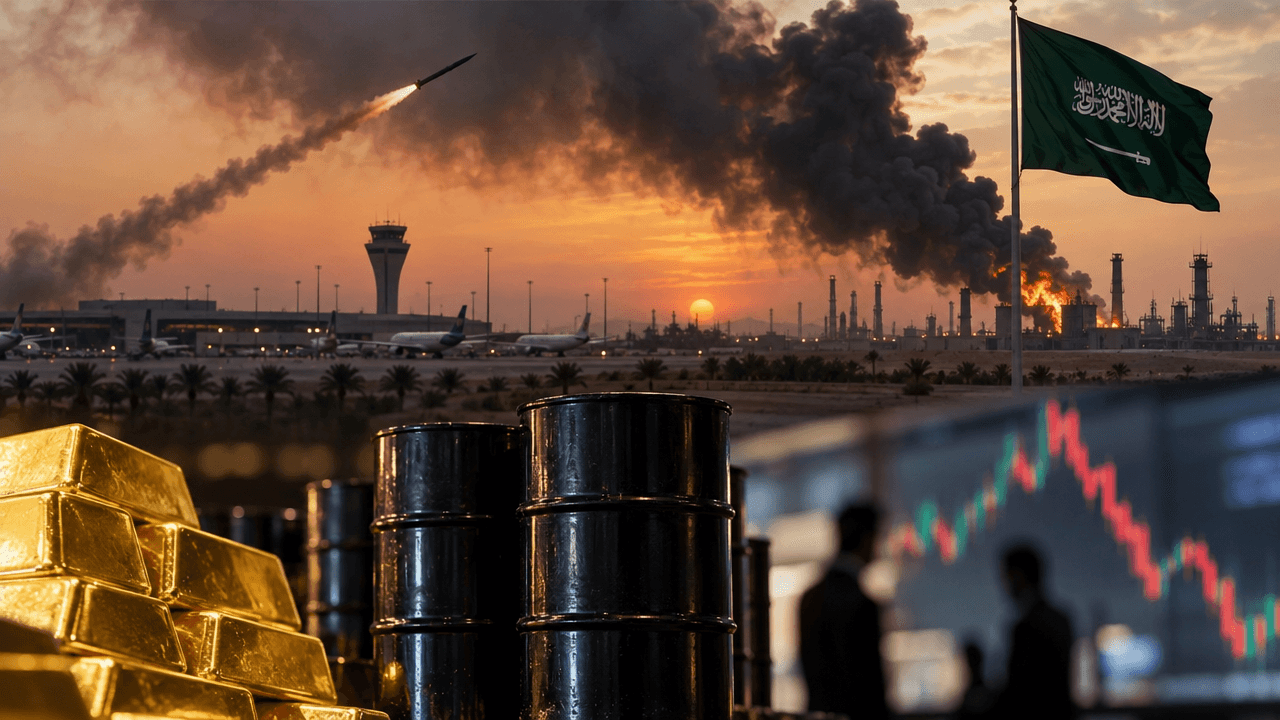
A fresh wave of Houthi attacks on Saudi Arabian airports and energy infrastructure has reminded markets how quickly a regional security incident can become a global pricing event. Investors are balancing fears of disrupted oil supplies against evidence that crude exports remain resilient, while gold is benefiting from renewed demand for protection. The result is a market defined less by a clear direction than by sharp, headline-driven swings.
The latest attacks reportedly targeted Riyadh’s King Khalid International Airport and other Saudi sites, while Houthi statements also claimed strikes against Aramco facilities and energy infrastructure. Saudi authorities reported deaths and hundreds of injuries following attacks on the Riyadh airport, and operations were disrupted. [1][2] The developments have increased concern that the conflict could spread beyond military targets to transport networks, energy facilities and commercial aviation.
Why The Market Reaction Is So Volatile
Oil markets respond to two competing forces during geopolitical crises. The first is the risk premium: traders price in the possibility that production, exports, pipelines, refineries or shipping routes could be disrupted. The second is the physical supply picture. If barrels continue to reach consumers, the immediate justification for higher prices becomes weaker.
That tension is visible in current trading. Brent crude recently slipped toward $103 a barrel, while West Texas Intermediate traded below $91, despite renewed attacks in the Gulf. On October 12, Brent was reported at approximately $103.35 and WTI at $90.55, with both benchmarks lower on expectations of additional supply and energy-market developments elsewhere. [15][28]
A modest decline in oil does not mean geopolitical risk has disappeared. It may indicate that traders believe Saudi production and exports remain operational for now, or that other supply expectations are offsetting the security premium. Oil can therefore fall on one headline and surge on the next if an attack damages a major facility, threatens shipping or prompts military retaliation.
For traders, the key lesson is that geopolitical risk and immediate supply loss are not identical. Markets may initially react to fear, then reverse when infrastructure damage appears limited. That creates conditions in which stop-losses, leverage and overnight exposure become especially important.
GOLD’S SAFE-HAVEN ROLE IS MORE COMPLEX THAN IT LOOKS
Gold has moved back above $4,200 an ounce as investors seek protection from geopolitical uncertainty. Reports on October 12 described bullion trading above that level, supported by risk aversion, softer oil prices and lower bond yields. [16][17]
Gold is often described as a straightforward safe-haven asset, but its price is influenced by several forces at once. Escalating conflict can increase demand for bullion. At the same time, higher oil prices can intensify inflation concerns, potentially encouraging expectations for higher interest rates. Rising yields generally make non-yielding gold less attractive.
This helps explain why gold and oil do not always rise together. If crude jumps sharply and markets expect central banks to keep policy restrictive, gold can struggle despite geopolitical fear. If oil eases, yields decline and investors still want protection, bullion can gain momentum. The current move above $4,200 reflects that combination rather than a single-factor reaction.
Currency movements also matter. A weaker dollar tends to support gold because bullion becomes less expensive for holders of other currencies. Conversely, a broad flight into the US dollar can temporarily limit gold’s upside, even when global risk sentiment deteriorates.
The Broader Impact On Risk Sentiment
The attacks are affecting more than commodities. Aviation disruptions can damage business confidence, delay travel and increase insurance and logistics costs. If energy infrastructure becomes a sustained target, companies may face higher operating expenses and governments may need to expand security or emergency supply measures.
Equity markets typically respond through sector rotation. Defense and energy companies may attract interest, while airlines, travel businesses, regional banks and firms dependent on Gulf logistics can come under pressure. Emerging-market currencies may also weaken if investors move toward the dollar, Swiss franc or other perceived defensive assets.
However, not every risk-off move becomes a prolonged market selloff. Investors will monitor whether the attacks remain localized, whether Saudi facilities continue operating and whether outside governments become directly involved. A wider military response would likely increase the risk premium across oil, shipping and regional assets. Diplomatic progress, additional stock releases or evidence of stable exports could reduce it.
What Traders Should Watch Next
The first indicator is physical energy infrastructure. Headlines involving refineries, gas plants, export terminals and pipelines are usually more consequential for oil than attacks on locations with limited production capacity. Traders should distinguish confirmed damage from unverified claims, particularly during fast-moving conflicts.
The second is shipping activity. Any threat to vessels or key maritime routes could affect freight rates, delivery schedules and crude differentials even if production remains intact. A disruption near a major chokepoint would carry a substantially larger market impact than a contained incident inland.
The third is official policy. Military retaliation, sanctions, emergency stockpile releases and statements from major oil-consuming nations can quickly change the balance between supply fears and actual availability. Central-bank commentary is also important because energy-driven inflation could alter interest-rate expectations and influence gold.
Finally, traders should track market structure rather than relying only on headline prices. Expanding futures spreads, rising options volatility and widening regional crude differentials can reveal stress before it becomes obvious in spot prices.
Practical Takeaways For Simfi Traders
Reduce position size when headline risk is elevated. A normal technical setup can fail instantly when a new attack, retaliation threat or supply announcement reaches the market.
Use defined risk on every trade. Wider stops alone are not a risk-management plan; they can increase losses if the position size is unchanged. Consider smaller exposure, clear invalidation levels and limits on correlated trades.
Avoid assuming that oil and gold will move in opposite directions every time. Their relationship depends on inflation expectations, bond yields, the dollar and the scale of the supply threat.
The Middle East escalation has created a market where volatility itself is the central theme. Oil is being pulled between supply anxiety and resilient exports, while gold is responding to the search for safety and changing rate expectations. For traders, patience, verification and disciplined risk controls are more valuable than trying to predict every headline.