
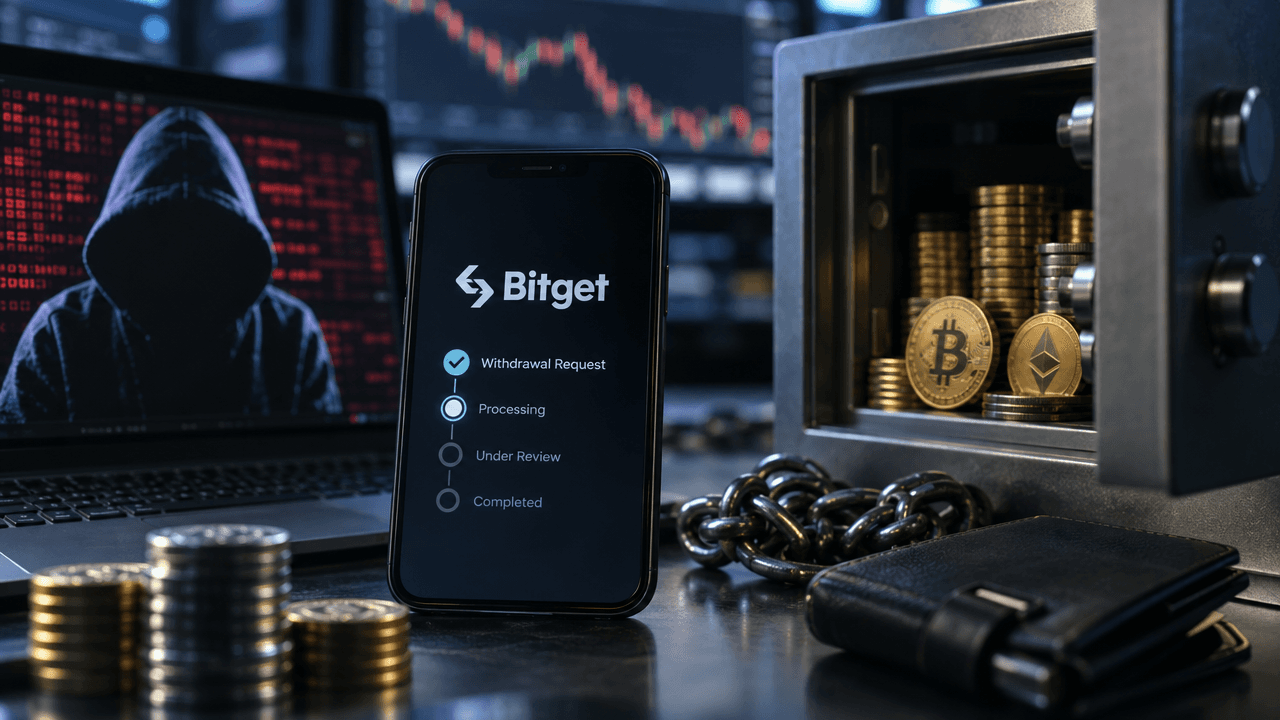
Bitget’s decision to resume withdrawals in phases after a reported $388 million hot-wallet hack is more than a single-exchange story; it is a live stress test of how the crypto market handles counterparty risk, infrastructure failures, and user trust in real time[1][8][9][10]. The incident highlights how quickly exchange risk can escalate and why traders need robust frameworks for assessing and managing that risk alongside price volatility[11][14][15].
What Happened At Bitget
On September 24, 2026, Bitget’s security systems flagged unauthorized transfers from a portion of its hot wallets, forcing the exchange to freeze withdrawals and trigger emergency protocols[1][5][13][15]. Initial estimates put the affected funds at about $351.6 million, later revised to roughly $387–388 million after including additional networks such as TRON and Zcash[1][8][9][12]. The breach touched parts of Bitget’s hot and warm wallet layers but left cold wallets—offline and more secure—unaffected[1][4][13][15].
Bitget operates a three-tier wallet architecture, and the exchange has emphasized that user balances remain accurate and that the losses fall within the coverage of its User Protection Fund, which holds over $464 million[1][5][10][13]. That fund is designed to act as an internal insurance pool, allowing Bitget to absorb the financial impact while keeping trading and deposits functional[1][5][10]. However, the sheer size of the hack—one of the largest reported in recent years—inevitably raises questions around operational security, vendor risk, and governance practices across centralized exchanges[9][11][14].
The Mechanics Of The Attack And Phased Withdrawals
In post-incident disclosures, Bitget’s leadership has indicated that the attackers did not steal private keys but instead compromised a critical backend system within the wallet infrastructure[3][10][11][12]. By spoofing transaction data and triggering internal authorization flows, the attackers effectively tricked Bitget into approving transfers of its own assets, a method likened to forging deposit slips rather than cracking the vault itself[3][10][12]. This nuance matters because it shifts attention from key management to application security, access control, and monitoring of internal systems[3][11][12].
Following containment of the breach, Bitget moved from a full withdrawal freeze to a phased resumption schedule designed to balance user access with continued risk management[2][5][8]. According to the exchange’s public timeline, BTC withdrawals were prioritized, followed by ETH and related networks, then major stablecoins such as USDT, and finally other tokens, fiat channels, and P2P services[2][8]. This phased approach allows the team to validate systems network by network, monitor flows for anomalies, and manage liquidity more predictably during a period of heightened uncertainty[2][5][8]. For users, the ability to withdraw—starting with core assets—provides partial relief, but the episode underscores the importance of planning for temporary inaccessibility even at otherwise reputable venues[9][14].
Why This Matters For Exchange Counterparty Risk
From a market-structure perspective, the Bitget hack is a textbook example of exchange counterparty risk: the possibility that an intermediary holding users’ assets becomes unable to honor withdrawals or suffers losses that challenge its solvency or operational integrity[9][11][14][15]. Even when an exchange pledges to make users whole, the period of frozen withdrawals introduces liquidity and timing risk, especially for traders running leveraged or high-frequency strategies that depend on rapid capital mobility[8][9].
The fact that the loss appears to be fully covered by Bitget’s User Protection Fund is a mitigating factor, but it does not erase the psychological impact on market confidence and perceived safety of hot wallets and centralized custodial models[1][5][10]. Historically, large exchange breaches have had ripple effects far beyond the directly affected platform, influencing regulatory scrutiny, insurance demand, and user migration toward other venues or self-custody solutions[11][14]. In this case, the scale of the theft and the involvement of sophisticated attackers—reporting has suggested state-linked actors may be “very likely” behind the breach—reinforces the idea that major exchanges are high-value targets requiring continuous security reinvestment[11][13][14].
Practical Lessons For Traders And Simfi Participants
For active traders and participants in simulated finance environments, the Bitget incident offers several practical takeaways about risk management and system design. First, hot-wallet exposure is an inherent trade-off between usability and security: assets kept online for immediate withdrawals and internal transfers will always carry more attack surface than those held in cold storage[1][4][13][15]. Understanding what percentage of an exchange’s funds are held in hot, warm, and cold wallets—and how large the protection reserves are—should be part of any serious counterparty due diligence process[1][5][10][13].
Second, traders should treat withdrawal freezes as a scenario to plan for, not an unthinkable exception. That means avoiding overconcentration of capital at a single venue, using multiple exchanges and custody solutions, and maintaining contingency liquidity elsewhere for margin calls or time-sensitive obligations. The Bitget case shows that even with losses covered, users can face days of restricted access as technical and forensic reviews unfold[2][5][8][14].
Third, simulated finance platforms and risk-training environments can incorporate exchange-hack scenarios into their models, allowing participants to practice reallocating capital, adjusting position sizing, and managing liquidity when a major venue suddenly becomes unavailable. By modeling hot-wallet breaches, phased withdrawal resumptions, and shifts in market sentiment, SimFi users can learn to respond systematically rather than emotionally when real-world events disrupt normal market functioning.
Looking Ahead: Security, Transparency, And Market Trust
In the aftermath of the Bitget hack, the industry conversation is likely to focus on deeper security audits, stronger segregation of duties in backend systems, and enhanced real-time monitoring for anomalous transaction patterns[3][11][12][14]. Exchanges that can demonstrate clear wallet architecture, robust protection funds, and transparent incident-handling procedures may be better positioned to retain and regain user trust when events like this occur[1][5][10][15].
At the same time, regulators, institutional participants, and sophisticated retail traders are increasingly viewing operational resilience as a core part of market infrastructure, not a secondary concern. Large-scale breaches and temporary withdrawal suspensions feed into broader debates about custodial risk, proof-of-reserves methodologies, and the role of insurance-like mechanisms in crypto markets[9][11][14].
For traders, the key is not to assume that any single platform is risk-free, but to build strategies and operational setups that remain functional even when a major exchange experiences a shock. The Bitget incident, and its gradual move from freeze to phased withdrawals, is a reminder that in modern markets, risk is multidimensional: price, liquidity, technology, and counterparty all matter—and all can change suddenly.