
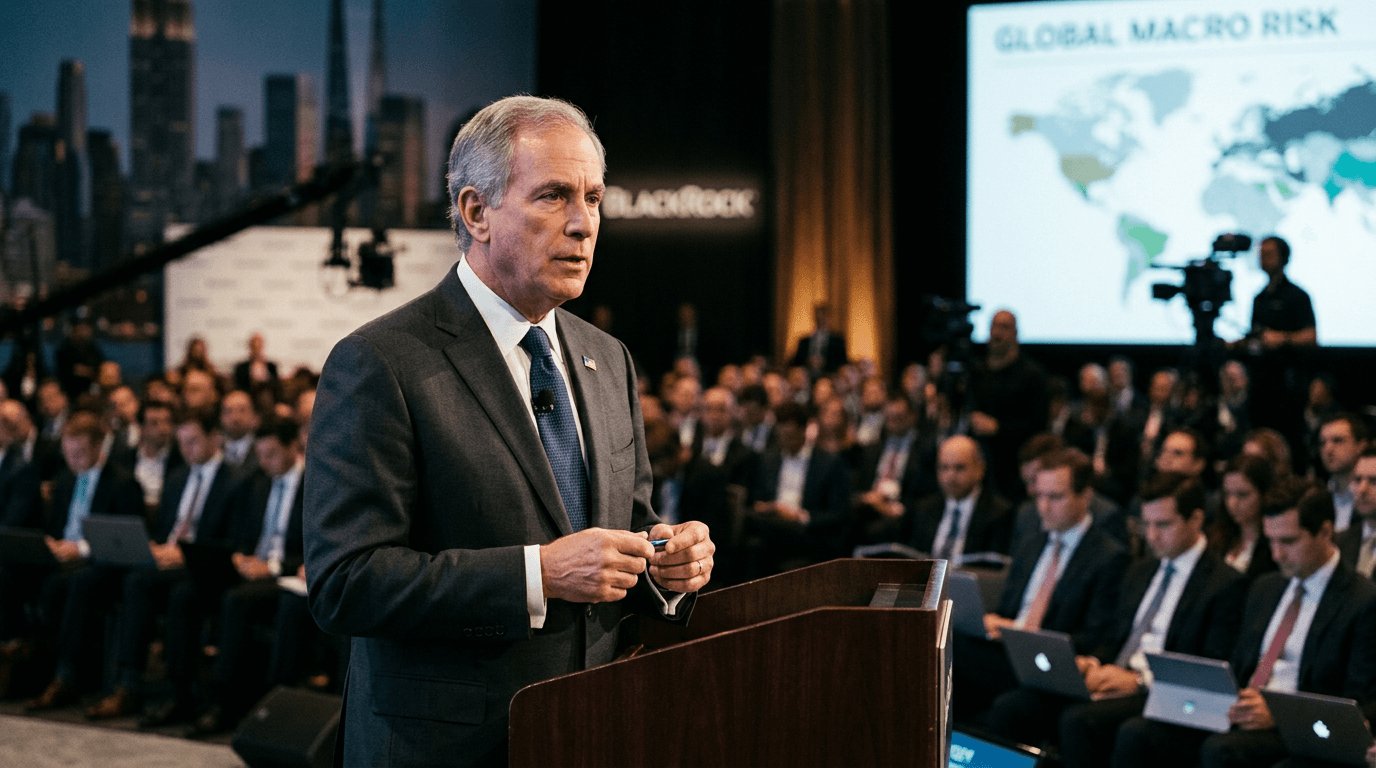
Larry Fink, the CEO of BlackRock, has warned that the US economy is very close to, if not already in, recession, echoing what he says he is hearing from many corporate leaders.[1][2][5] His comments, delivered in a high‑profile interview, landed in a market already uneasy about softer US data, immediately weighing on equity futures, supporting safe‑haven demand for Treasuries and select currencies, and tempering the US dollar’s recent strength as traders ramped up expectations for future Federal Reserve easing.[1][2]
WHAT FINK IS SIGNALING – AND WHY IT MATTERS
When the head of the world’s largest asset manager says “most CEOs I talk to say we’re probably in a recession right now,” markets listen.[1][2] Fink’s perspective is not based on a single data point; it is drawn from conversations with leaders across sectors, including industries that tend to feel turning points early, such as airlines and consumer‑facing businesses.[2]
Officially, a recession is typically defined as a broad and persistent decline in economic activity, often captured by falling output, softer labor markets, and weaker consumption. Fink’s message is that beneath still‑reasonable headline indicators, the engine of the US economy—consumer spending and business investment—is losing momentum.[1][2] CEOs are reporting slower demand, tighter access to capital, and greater caution on hiring and capital expenditure, all of which are consistent with late‑cycle dynamics.
What makes this warning more potent is timing. Markets had been debating a “soft landing” scenario, where inflation falls without a major downturn. Fink’s remarks tilt that debate toward a harder landing: an environment where tighter financial conditions and past rate hikes are finally biting, putting growth at risk even as inflation moderates.[1][2] For traders, this shifts the focus from “if” a slowdown comes to “how deep and how long” it might be.
Market Reaction: Risk Assets, Treasuries, And The Dollar
The immediate reaction to Fink’s comments reflected a classic risk‑off pattern: equity futures slipped as investors reduced exposure to cyclical risk assets, while demand for US Treasuries increased, pushing yields lower.[1] Lower yields, in turn, signal both a flight to safety and a repricing of the Fed path as markets increase the odds of rate cuts to counter a potential downturn.
In foreign exchange, the picture is more nuanced. On one hand, rising recession risk typically boosts safe‑haven demand for the US dollar against high‑beta currencies linked to global growth, such as some commodity and emerging‑market FX. On the other hand, if the dominant narrative shifts toward earlier and more aggressive Fed easing, lower US yields can cap or even weigh on the dollar, especially against other low‑beta currencies that also benefit from safe‑haven flows, such as the Japanese yen and the Swiss franc.[1][2]
This is why the news “tempered” the dollar’s gains rather than producing a one‑way surge: markets are now balancing the dollar’s safe‑haven appeal against the possibility that the Fed may need to cut rates sooner than previously expected.[1] For risk assets like equities and credit, recession risk usually translates into higher volatility, wider credit spreads, and greater differentiation between sectors and balance sheets.
Key takeaway: the market reaction is not just about Fink’s words; it is about how his message validates concerns already simmering in the data and among corporate leaders.
What This Means For Traders And Investors
For traders across asset classes, Fink’s warning is a prompt to re‑examine where they sit on the risk spectrum.
In equities, late‑cycle and recessionary environments often favor quality: companies with strong balance sheets, resilient cash flows, and pricing power tend to outperform more leveraged, speculative names. Sector leadership can rotate from high‑growth, high‑beta areas toward defensives like utilities, consumer staples, and healthcare, though each cycle has its nuances.
In rates, increased recession risk typically supports longer‑duration bonds as investors seek safety and anticipate lower policy rates. That said, if inflation proves sticky, yield curves can behave in complex ways, with front‑end expectations for cuts competing against longer‑term inflation and term‑premium dynamics.
In FX, traders may look at relative growth and policy paths: currencies of economies with stronger growth and more policy flexibility can outperform, while those tied heavily to global trade or commodities may underperform if global demand slows. A “recession‑plus‑Fed‑easing” narrative can support funding currencies and low‑volatility carry strategies, but also raises the risk of abrupt position reversals when data surprises.
For portfolio construction, risk management becomes paramount. That includes:
– Stress‑testing portfolios under deeper‑recession and mild‑recession scenarios.
– Reducing concentration in the most cyclical or leveraged exposures.
– Considering diversification across geographies, sectors, and asset classes.
– Paying closer attention to liquidity, especially in credit and smaller‑cap names, where spreads can widen quickly in risk‑off episodes.
Using Simulated Trading To Navigate Recession Risk
For traders developing or refining strategies, a simulated environment offers a powerful way to translate macro headlines into practical decision‑making. When a figure like Fink publicly questions the strength of the US cycle, it creates a natural test case for scenario‑based strategy design.[1][2][5]
In a SimFi setup, you can:
– Backtest how your strategies performed in past recession or late‑cycle periods, such as 2001–2002, 2008–2009, or shorter growth scares.
– Run “what‑if” simulations around different paths for growth, inflation, and rates—e.g., shallow recession with quick Fed cuts versus deeper, drawn‑out downturn with more persistent inflation.
– Examine how changes in volatility, correlations, and liquidity affect your P&L across equities, indices, rates, and FX.
– Practice dynamic risk management—adjusting position sizing, hedging, and leverage—as macro conditions evolve.
By doing this in a simulated environment, traders can make mistakes, refine rules, and build playbooks without real capital at risk. Then, when recession talk moves from interviews to data and policy decisions, they are better prepared to respond rather than react.
WHAT TO WATCH NEXT – PRACTICAL TAKEAWAYS
Fink’s warning is a high‑profile signal, but markets will ultimately be driven by the data and the Fed’s response.[1][2][5] Over the coming weeks and months, traders should focus on:
– Growth data: real‑time indicators like employment, retail sales, ISM/PMI surveys, and consumer confidence will show whether the slowdown is broadening.
– Inflation and wages: if inflation cools while growth weakens, the Fed has more room to ease; if inflation stays sticky, policy trade‑offs become harder.
– Corporate earnings and guidance: listen for commentary on demand, pricing power, margins, and capex plans—essential confirmation (or contradiction) of the CEO sentiment Fink has highlighted.[1][2]
– Financial conditions: credit spreads, lending surveys, and funding markets will show how easily companies and households can access capital.
– Fed communication: shifts in tone around growth risks, data dependence, and the balance of risks will heavily influence rate expectations, yields, and the dollar.
For traders, the message is clear: recession risk is no longer an abstract possibility, but an active market driver. Whether or not the US is already in recession, positioning, risk management, and scenario planning now need to assume that a more challenging macro backdrop is on the table—and that volatility around data and Fed decisions is likely to stay elevated.