
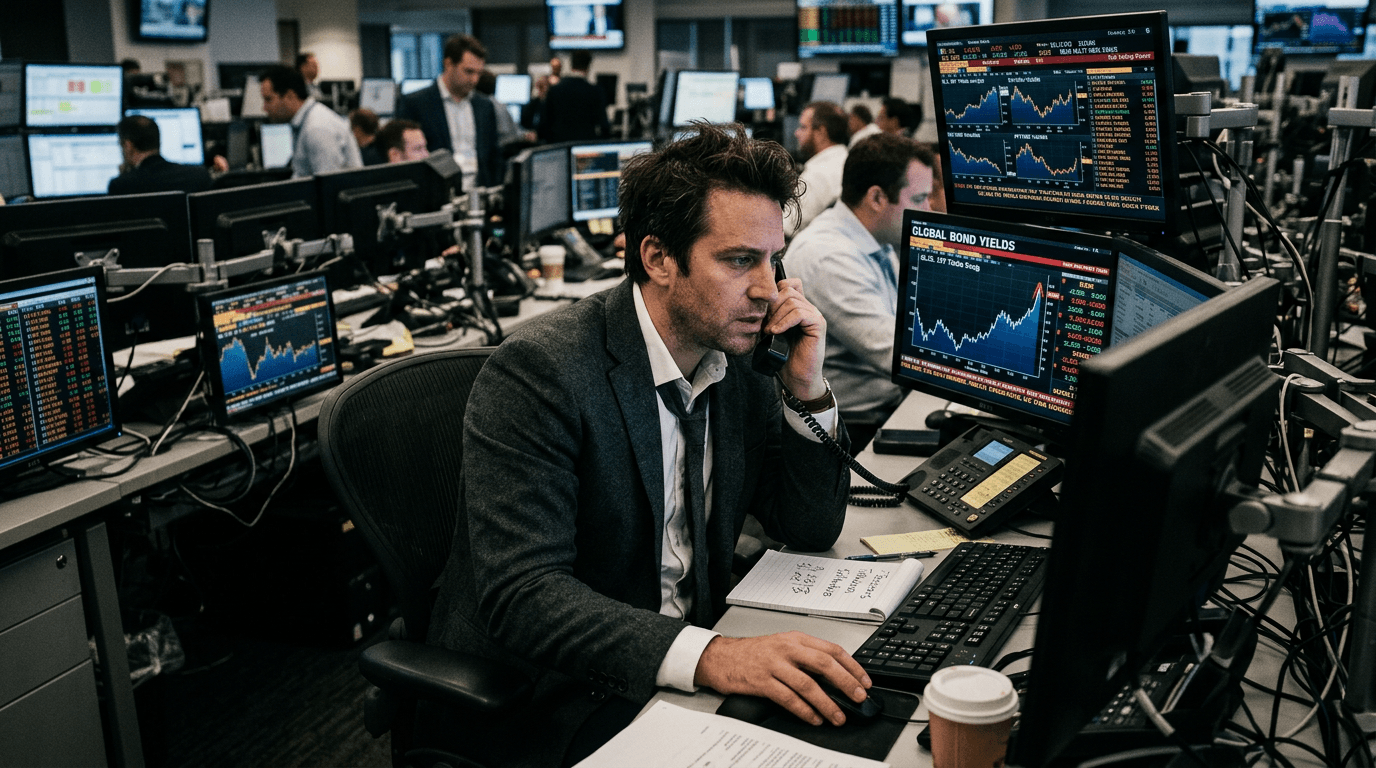
Global government bond markets are once again in the spotlight, with yields holding near multi‑week peaks as heightened U.S.–Iran tensions keep investors on edge.[12][13][17] Benchmark 10‑year U.S. Treasury yields are trading in the mid‑4% area, close to recent highs seen earlier in the conflict, while equivalent German Bund and UK gilt yields are hovering around four‑week or longer peaks.[6][12][13][17] Rather than rushing into government bonds as a traditional safe haven, investors are demanding a higher risk premium, pushing borrowing costs up across major economies.[7][8][12]
The result is a complex backdrop: war‑driven oil price gains, sticky inflation concerns, and less confidence in near‑term rate cuts are all converging in bond markets.[7][12][15][16] At the same time, higher yields are feeding directly into FX carry trades, interest‑rate futures, and equity index futures, forcing traders to reassess positioning and risk appetite.[2][14][17] For both real‑money investors and traders in simulated environments, this is an important case study in how geopolitics can overpower more benign macro narratives.
Global Bond Yields Defy The Typical Safe-haven Play
In many geopolitical crises, government bonds rally and yields fall as investors seek safety. The current U.S.–Iran standoff is different: bond prices have dropped and yields have risen, driven by fears that elevated energy prices will fuel inflation rather than slow growth.[7][8][12] Recent episodes of missile and drone exchanges, disruptions around the Strait of Hormuz, and renewed threats to shipping lanes have kept oil prices elevated, reinforcing this inflation‑first interpretation.[6][9][12]
U.S. Treasury yields across the curve have moved higher, with the 10‑year benchmark climbing above 4.3–4.5% and the 30‑year pushing past 5%, levels consistent with multi‑week or multi‑month highs.[6][12][13][17] In Europe, German 10‑year Bund yields have jumped above 3%, while UK 10‑year gilts have traded near or above 5%, the highest levels in many weeks and in some cases since the late 2000s.[3][9][12][13] Bond vigilantes—investors actively pushing back against loose inflation policy—have re‑emerged, driving short‑dated yields sharply higher as they demand compensation for inflation and fiscal risks.[10][16]
The key takeaway for traders is that “geopolitical risk = lower yields” is not a rule. When markets see conflict as inflationary and central banks as constrained, yields can rise and stay elevated even in the face of heightened uncertainty.[7][8][18]
Geopolitics, Oil, And Central Bank Expectations
The path of yields is being shaped not only by headlines from the Middle East but also by shifting expectations for central bank policy. War‑related disruptions have pushed oil higher, feeding into broader price pressures and undermining the case for rapid rate cuts.[7][12][15] In response, traders have slashed bets on near‑term easing, and in some cases begun to price the risk that rates remain “higher for longer” or even rise again if inflation re‑accelerates.[7][12][16][18]
Minutes from recent Federal Reserve meetings have reinforced a cautious tone, signaling comfort with policy rates remaining restrictive and highlighting unresolved inflation and fiscal concerns.[14][18] In Europe and the UK, similar messages from policymakers—combined with structurally higher energy sensitivity—have contributed to steeper sell‑offs in government bonds.[7][12][15] This interplay between war, oil, and central bank guidance is central to why yields have climbed and then held near their peaks rather than quickly retracing.
For market participants, the takeaway is that bond yields are now tightly linked to expectations about how long central banks can stay restrictive in the face of war‑driven inflation risks. Monitoring policy language has become as important as tracking the conflict itself.[12][14][18]
Impact On Fx Carry Trades And Rate Futures
Elevated bond yields ripple directly into FX markets, particularly carry trades that rely on interest‑rate differentials. As U.S. and European yields move higher, demand for safe‑haven currencies such as the dollar has strengthened, while risk‑sensitive currencies have come under pressure.[8][12][17][18] The combination of higher U.S. yields and geopolitical stress has drawn capital into dollar assets, making it more expensive for emerging‑market borrowers and reducing appetite for high‑yield, high‑risk carry strategies.[17]
At the same time, interest‑rate futures are repricing the entire path of policy. Markets have scaled back expectations for rate cuts, lifted implied yields in short‑dated contracts, and introduced more probability of a “higher for longer” scenario.[7][12][16][18] This has created opportunities and risks for macro traders: positions built around aggressive easing now face drawdowns, while strategies favoring steep yield curves or relative‑value spreads between regions are seeing more volatility.
The takeaway for FX and rates traders is that carry and curve trades cannot be managed in isolation. They are now tightly bound to conflict‑driven inflation expectations and fast‑changing assumptions about central bank reaction functions.[7][12][17][18]
Cautious Tone In Equity Index Futures And Risk Assets
Equity index futures have turned cautious as higher yields filter through equity valuations and risk sentiment. When the “risk‑free rate” embedded in discount models rises, the present value of future earnings falls, pressuring growth and tech‑heavy indices in particular.[12][13][17] At the same time, higher long‑term yields increase the relative attractiveness of fixed income versus equities, prompting some rebalancing away from risk assets.[12][16][18]
This does not automatically translate into a broad equity sell‑off, but it does tend to compress valuation multiples and reward sectors with strong cash flows and pricing power. Defensive equities and energy producers often benefit in such environments, while more speculative names can struggle.[12][15][17] For traders using equity index futures, this means wider intraday ranges, more sensitivity to both yield moves and geopolitical headlines, and a greater need to integrate bond market signals into equity strategies.
The takeaway here is straightforward: equity risk cannot be evaluated without a view on yields. Multi‑week peaks in global bond yields are a direct headwind to equity valuations, particularly when driven by inflation fears rather than growth optimism.[12][13][17]
Using Simulated Finance To Navigate Volatility
For many traders, this environment is both a challenge and an opportunity. Bond yields, FX, rate futures, and equity index futures are all moving off the same geopolitical narrative, creating complex cross‑asset dynamics that can be hard to manage in live markets. Simulated Finance (SimFi) platforms such as E8 Markets allow traders to test macro strategies, stress‑test portfolios, and learn how different asset classes interact when war, oil, and central bank policy collide.[17][18]
By experimenting with scenarios—rising yields alongside a stronger dollar, or sudden de‑escalation leading to a bond rally and equity relief—traders can build intuition without risking capital. This type of practice improves understanding of basis‑point moves, yield curves, and how rate expectations flow through into FX and equity pricing, all of which are critical in episodes like the current U.S.–Iran flare‑up.[7][12][17][18]
The practical takeaway is that periods of heightened geopolitical tension and elevated bond yields are ideal times to deepen macro skills in a simulated environment. Doing so prepares traders to respond more systematically when similar shocks hit live markets in the future.
Conclusion And Practical Takeaways
Global bond yields holding near multi‑week peaks in response to U.S.–Iran tensions underscore how quickly markets can reprice inflation and policy risk.[7][12][13][17] Rather than a simple flight to safety, investors are demanding higher compensation for war‑related uncertainty, oil‑driven price pressures, and doubts about the pace of future rate cuts.[7][8][12][16]
For traders and investors, several practical points stand out: geopolitical risk can push yields up, not just down; central bank communication and oil prices are critical drivers of bond markets in this episode; carry trades and rate futures are highly sensitive to these shifts; and equity valuations are directly affected by the new yield regime.[7][12][15][17][18] Using simulated environments to explore these dynamics can help build robust macro frameworks before committing capital.