
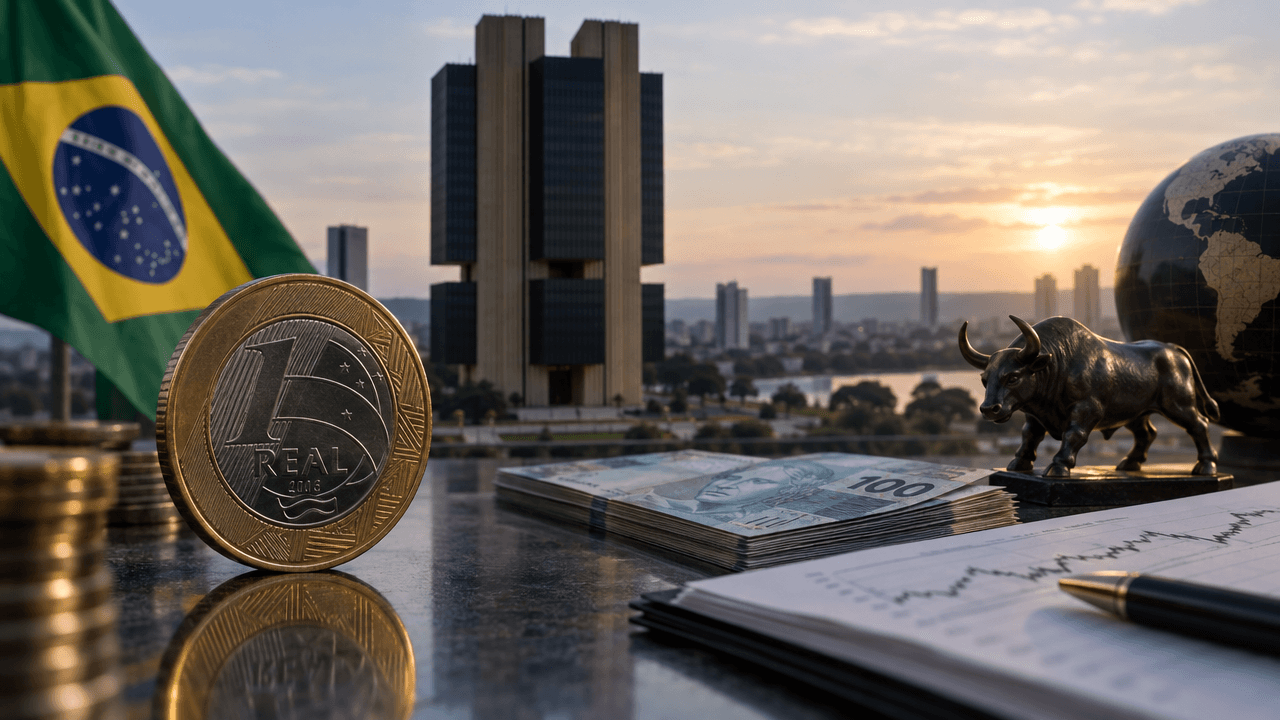
Brazil’s central bank has paused its rate-cut cycle, holding the benchmark Selic rate at 13.75% after five consecutive quarter-point reductions. The decision marks a shift from gradual monetary easing toward a more cautious phase, as policymakers weigh inflation expectations, fiscal uncertainty, global interest rates, and pressure from a firmer U.S. dollar. [1][4]
The pause was widely anticipated, but its significance extends beyond the decision itself. Brazil remains one of the highest-yielding major emerging markets, and the Selic rate influences borrowing costs, currency valuations, local bond prices, equity multiples, and expectations for economic growth. For traders, the message is clear: further cuts are no longer a straightforward base case.
Why Brazil Paused
The Selic stood at 15% at the beginning of the 2026 easing cycle. Copom, the central bank’s monetary policy committee, reduced the rate by 25 basis points in March, April, June, August, and September, bringing it down by a total of 1.25 percentage points. The November decision left the rate unchanged at 13.75%. [2][6]
A pause allows policymakers to assess whether previous cuts are sufficiently working through the economy. Monetary policy affects activity with a lag, meaning the full impact of earlier reductions may not yet be visible in consumer spending, business investment, employment, and credit demand.
At the same time, inflation expectations have deteriorated. If households, companies, and financial markets begin to anticipate persistently higher prices, businesses may adjust wages and prices more aggressively. That can make inflation harder to control and reduce the effectiveness of additional rate cuts.
Fiscal uncertainty is another important factor. Concerns about government spending, debt dynamics, and the future path of public finances can raise the risk premium demanded by investors. Higher risk premiums may push bond yields upward even when the central bank is cutting rates, weakening the transmission of monetary policy.
The Dollar And Global Pressure
A stronger U.S. dollar creates an additional challenge for Brazil. When the dollar rises against the Brazilian real, imported goods, fuel, machinery, and other dollar-priced commodities become more expensive in local currency terms. This can add to inflationary pressure and make an aggressive easing cycle less attractive.
The dollar also influences global capital flows. Investors compare the returns available in Brazil with those in the United States and other markets after accounting for currency risk. If U.S. yields remain high or the dollar strengthens, some investors may reduce exposure to emerging-market currencies and bonds.
Brazil’s high interest rates provide a substantial yield cushion, but that advantage is not permanent. If markets believe the central bank is cutting too quickly while the dollar is firm, the real could weaken. Currency depreciation would make imported inflation more likely and potentially force policymakers to keep rates elevated for longer.
What It Means For Markets
The immediate market reaction may be most visible in local interest-rate futures and government bonds. A pause can support shorter-dated yields if traders had been positioned for another cut. Futures contracts may begin pricing a longer period of restrictive policy, particularly if upcoming inflation data and central bank communications remain cautious.
Longer-dated bonds face a more complicated outlook. A stable or higher Selic rate can improve the appeal of Brazilian fixed income, but fiscal concerns may keep long-term yields elevated. Investors could demand additional compensation for holding debt with greater sensitivity to government borrowing needs and future inflation.
The Brazilian real may also receive short-term support from the decision because a higher policy rate can strengthen the currency’s yield advantage. However, the effect is not automatic. If investors focus more heavily on fiscal risks or global dollar strength, the real could remain under pressure despite Brazil’s elevated interest rates.
Equities may experience mixed effects. Banks and financial institutions can benefit from higher interest income, while companies dependent on cheap credit may face more difficult conditions. Real estate, retail, construction, and highly leveraged businesses are particularly sensitive to borrowing costs. Exporters may gain from a weaker real, especially when revenues are linked to dollar prices.
What Traders Should Watch Next
The pause does not necessarily mean the easing cycle is permanently over. The central bank has left room to respond to changing data, but future cuts will likely require clearer evidence that inflation is converging toward target and that expectations are stabilizing.
Traders should monitor four areas closely. First, inflation data will show whether price pressures are broadening or moderating. Second, fiscal announcements and debt projections could influence the risk premium embedded in Brazilian assets. Third, the U.S. dollar and Treasury yields will help determine how much room emerging-market central banks have to ease. Finally, local interest-rate futures will reveal how quickly market expectations are changing.
Position sizing and scenario planning are especially important in this environment. A trader expecting renewed cuts should define what evidence would invalidate that view. Likewise, a bearish position on Brazilian bonds or the real should account for the possibility that inflation improves and global risk sentiment turns supportive.
A More Selective Policy Environment
Brazil’s decision to hold the Selic at 13.75% signals a transition from broad monetary easing to a more data-dependent approach. The central bank is balancing the benefits of lower borrowing costs against the risks of unanchored inflation expectations, fiscal uncertainty, and a stronger U.S. dollar.
For investors and traders, the key takeaway is that the next move will depend less on the momentum of the previous five cuts and more on incoming evidence. Brazilian assets may continue to offer attractive yields, but they are likely to reward selectivity rather than simple directional bets.
The pause is not a declaration that rate cuts can never resume. It is a warning that monetary easing now faces a higher hurdle. Until inflation expectations, fiscal risks, and currency pressures become more favorable, Brazil’s central bank appears prepared to prioritize credibility and stability over the speed of additional cuts. [2][3]