
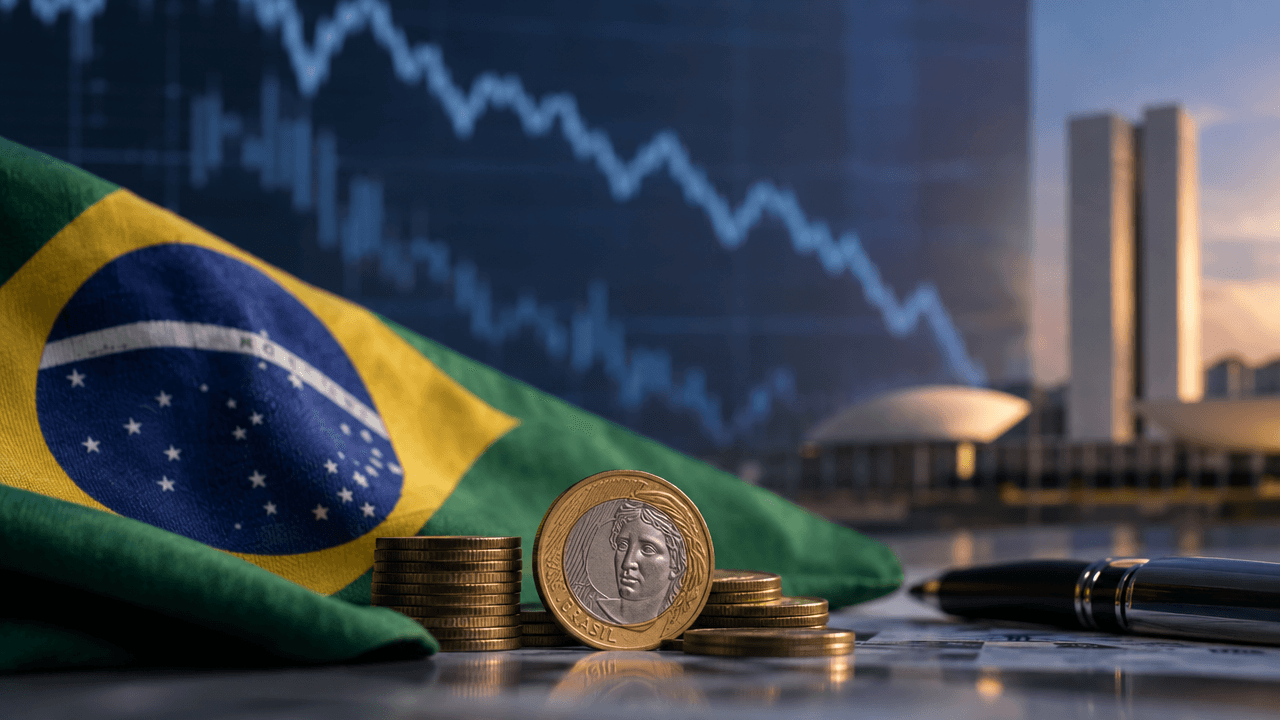
Brazil’s decision to cut its 2026 growth forecast to 2.0% from 2.3% is a modest adjustment in numerical terms, but a meaningful signal about waning domestic momentum.[1][2][7] For traders, the change reinforces a narrative of slower, more “normal” growth after a stronger post‑pandemic phase, with potential implications for Brazilian assets, the real, and local interest rates.[1][9][11]
BRAZIL’S SOFTER 2026 OUTLOOK – WHAT CHANGED
The Finance Ministry’s downgrade to 2.0% comes after data showing a clear loss of speed in Brazil’s expansion through mid‑2026.[1][2][7] Second‑quarter GDP grew just 0.5% quarter‑on‑quarter, while year‑on‑year growth of 2.0% only slightly beat expectations, highlighting a deceleration from the roughly 3.5% pace seen in 2025.[7][9][11]
The government has pointed to weaker prospects in services and industrial activity that offset a relatively stronger outlook for agriculture.[1][2] This mix matters because services and industry are more closely tied to employment, wages and domestic demand—key drivers of household consumption and corporate earnings.[1][2][7] In practical terms, investors should read the forecast cut as a warning that internal demand is not firing on all cylinders.
At the same time, the new 2.0% figure brings the official outlook closer to market and international consensus, rather than marking an extreme shift.[3][9][11] The World Bank now projects 1.6% growth for Brazil in 2026, while some private houses sit around 1.7–2.1%, and surveys of local economists cluster near 2%.[3][4][11][13] The downgrade therefore tightens the gap between government optimism and more cautious external views.
Why Growth Expectations Are Cooling
Several forces are contributing to Brazil’s slower expected growth in 2026. After years of robust expansion around 3% driven by pent‑up demand, fiscal support and a favorable commodity backdrop, the economy is converging toward an estimated potential growth rate near 1.8–2.3%.[9][13][15] As stimulus fades and high real interest rates bite, a cooling in activity is a natural late‑cycle development.
Monetary policy is a central piece of the story. Tight policy in 2025 and early 2026 helped curb inflation but also weighed on credit growth and durable goods consumption.[8][9][15] Even as the easing cycle proceeds cautiously, the lagged effects of prior rate hikes continue to show up in softer consumption and investment, especially among more leveraged households and smaller firms.[7][9]
External conditions have also become less supportive. Slower global growth and bouts of risk aversion have tempered capital flows to emerging markets, while commodity prices have seen more volatility.[3][9] For an economy where exports of agricultural and industrial goods play a key role in income and employment, these swings translate into more uncertainty for corporate investment plans and government revenue projections.[3][9][13]
Market Reaction: Equities, Rates And The Real
The headline downgrade, on its own, is unlikely to trigger a dramatic sell‑off, but it can add incremental pressure on Brazilian assets, especially if investors were positioned for a stronger domestic cycle.[1][2] When growth expectations fall, equity markets typically reassess earnings trajectories in cyclical sectors such as consumer, financials and industrials.[7][9] That can lead to a rotation toward exporters, defensives, or quality growth names less dependent on local demand.
In fixed income, a weaker growth outlook can cut both ways. On one hand, slower activity tends to reduce inflationary pressures over time, which can support lower yields at the long end of the curve.[9][15] On the other, concerns about fiscal dynamics—particularly if revenues soften while spending commitments remain high—can push term premiums higher as investors demand more compensation for sovereign risk.[9][13]
The Brazilian real is likely to react more to how the market interprets the path of monetary and fiscal policy than to the forecast revision alone.[1][2] If traders believe slower growth will encourage a more dovish central bank without a clear anchor on fiscal discipline, the currency could face depreciation pressure as rate differentials narrow and risk premia rise.[3][9][11] Conversely, if the downgrade is seen as a realistic normalization toward potential growth, while policy credibility stays intact, FX moves may be contained.
Policy Paths And Risks To Watch
For macro‑focused traders, the downgrade sharpens the focus on three main policy questions: the pace of rate cuts, the fiscal stance, and structural reforms.[1][9] The central bank’s own projections have recently nudged 2026 growth up to 2.0% from 1.6%, reflecting better‑than‑expected sectoral performance and domestic demand, but still within a low‑2% band.[12][13] That suggests policymakers see room for moderate easing, not an aggressive stimulus cycle.
On the fiscal side, a softer growth trajectory complicates revenue collection and debt stabilization targets.[9][13] If the government leans on additional spending or tax incentives to support activity, investors will scrutinize the impact on medium‑term debt dynamics and Brazil’s risk premium.[9][13][15] Credible rules and adherence to fiscal frameworks can help offset growth concerns in the eyes of bond and FX markets.
Structural reforms remain the key swing factor for Brazil’s long‑term story. Measures that raise productivity, improve infrastructure and deepen local capital markets can lift potential growth above today’s 1.8–2.3% range.[9][13][15] For traders, monitoring progress on tax reform implementation, regulatory changes and investment programs will be as important as tracking short‑term data prints.
How Traders Can Navigate This Shift
For active traders and SimFi participants, Brazil’s forecast cut is a useful case study in how macro expectations translate into asset price dynamics over time.[1][2] Rather than reacting only to the headline, it pays to map scenarios that combine growth, inflation, rates and fiscal outcomes—and then test how different asset classes might respond.
In equity simulations, consider building sector‑based strategies that overweight exporters and defensives in a slower‑growth environment, while underweighting domestically sensitive cyclicals.[7][9] In rates, explore curve trades that differentiate between inflation‑driven easing and risk‑premium‑driven steepening, especially around key policy meetings and data releases.[9][12][15]
FX simulations can focus on how the real behaves under various policy mixes and global risk regimes. Scenarios where Brazil maintains real rate carry with credible fiscal anchors might support a relatively resilient currency, while combinations of faster easing and fiscal slippage could produce more volatile, downside‑skewed paths.[3][9][11] Using a SimFi environment to iterate through these paths allows traders to refine their frameworks without capital at risk.
Ultimately, the main takeaway is that a small numerical change in a growth forecast can still carry meaningful information about where an economy sits in its cycle—and how policymakers and markets might respond.
Conclusion
Brazil’s move to lower its 2026 growth forecast to 2.0% underscores a transition from post‑pandemic outperformance toward a more subdued, near‑potential pace of expansion.[1][2][9] For markets, the news reinforces existing concerns about domestic momentum but does not, on its own, herald a crisis; the real impact will depend on the interplay between growth, inflation, rates and fiscal policy in the months ahead.[1][3][9]
For traders, the opportunity lies in understanding that macro adjustments tend to ripple through assets gradually, creating trends and mispricings rather than instant shocks. By pairing fundamental analysis with disciplined scenario testing—especially in simulated environments—market participants can turn Brazil’s forecast downgrade into a practical lesson in navigating late‑cycle dynamics and policy‑driven risk.