
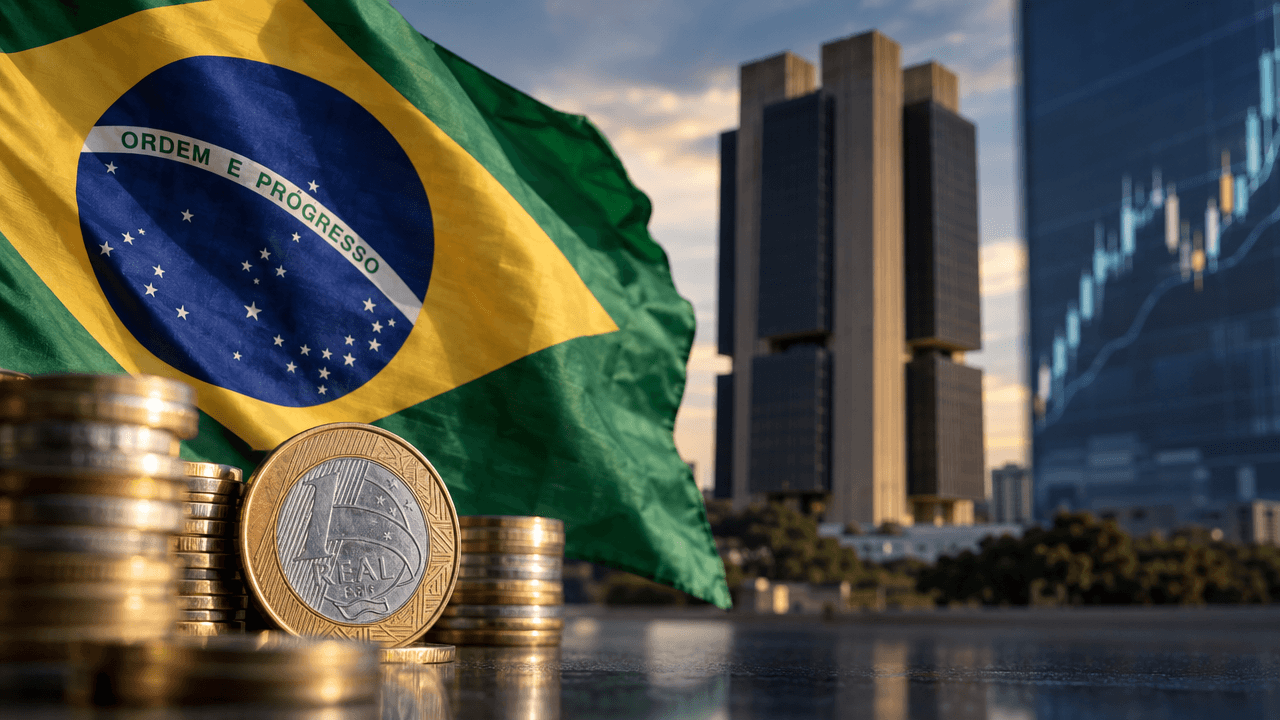
Brazil’s central bank has put its interest-rate cutting cycle on hold, keeping the benchmark Selic rate at 13.75% after five consecutive reductions. The unanimous decision was widely expected, but its message was significant: policymakers are no longer comfortable assuming that inflation will continue to ease smoothly, particularly after the election introduced fresh questions about fiscal policy, market confidence, and the direction of the economy. [2]
The Decision And Why It Matters
The pause ended a sequence of five quarter-point cuts that began in March. Those reductions lowered the Selic from a cyclical high of 15% to its current 13.75%, offering some relief to borrowers and supporting a gradual improvement in domestic economic conditions. [5]
However, monetary policy remains highly restrictive. A Selic rate near 14% raises financing costs for households, companies, and the government. It can slow credit growth, reduce demand, and discourage investment. At the same time, high interest rates can help attract foreign capital and support the Brazilian real, especially when global investors are looking for relatively high yields.
The central bank’s challenge is balancing these competing forces. Economic activity is slowing, but inflation expectations have worsened. When households, businesses, and financial markets begin to expect higher future inflation, those expectations can become self-reinforcing. Companies may raise prices more aggressively, workers may seek larger wage increases, and investors may demand higher returns to compensate for increased risk.
For COPOM, Brazil’s monetary policy committee, the message was clear: further rate cuts will require stronger evidence that inflation is returning to target and that expectations are becoming better anchored.
Election Uncertainty And Fiscal Policy
The decision also reflects the market reaction to Brazil’s election. President Luiz Inácio Lula da Silva’s reelection increased uncertainty about government spending, public debt, and the future fiscal framework. Markets are particularly sensitive to signs that government expenditure could rise without a credible plan to stabilize debt.
Fiscal policy matters directly for interest rates. If investors believe that public finances are becoming less sustainable, they may expect stronger inflationary pressure or demand a higher risk premium for holding Brazilian assets. That can weaken the real, raise import costs, and make it more difficult for the central bank to reduce rates.
This is why COPOM is watching fiscal developments as closely as traditional economic data. A government that demonstrates budget discipline could improve investor confidence and create room for future easing. Conversely, new spending commitments or uncertainty around fiscal targets could keep inflation expectations elevated and extend the period of restrictive monetary policy.
The pause should therefore be viewed as a risk-management decision rather than a permanent end to rate cuts. Policymakers have not ruled out future easing, but they are signaling that the next move will depend heavily on incoming data and government actions.
What It Means For The Brazilian Real
In the near term, the pause may support the Brazilian real. Holding rates at 13.75% preserves Brazil’s yield advantage over many other major economies and can make local fixed-income assets more attractive to international investors. A more stable currency can also help reduce imported inflation, particularly for energy, manufactured goods, and other products priced in U.S. dollars.
Yet the currency outlook is not automatically bullish. High interest rates can support the real, but fiscal concerns and political uncertainty can offset that benefit. If investors believe that rates will remain high because inflation risks are worsening, they may interpret the pause as a warning rather than a sign of strength.
Global conditions also matter. A stronger U.S. dollar, higher oil prices, or tighter monetary policy in advanced economies could place renewed pressure on emerging-market currencies. Brazil’s central bank specifically faces the difficult combination of domestic uncertainty and an unsettled external environment.
Implications For Traders And Investors
For traders, the most important change is the shift from a relatively predictable easing cycle to a more conditional policy environment. During the previous five meetings, market participants could build strategies around continued quarter-point cuts. That assumption is no longer reliable.
Brazilian interest-rate futures, government bonds, and currency markets may react sharply to inflation data, fiscal announcements, central bank speeches, and changes in global risk appetite. A stronger-than-expected inflation reading could lead markets to price a prolonged hold or even renewed tightening. Softer inflation combined with credible fiscal measures could revive expectations for rate cuts.
SimFi traders can use this event to practice scenario-based analysis rather than relying on a single directional forecast. One scenario involves persistent inflation and fiscal deterioration, which could support the real initially through higher rates but eventually weigh on Brazilian assets through rising risk premiums. Another involves improving fiscal credibility and falling inflation expectations, creating room for lower rates, stronger bond prices, and renewed economic activity.
Useful indicators to monitor include Brazil’s inflation data, inflation expectations surveys, government borrowing costs, the fiscal balance, the USD/BRL exchange rate, and global U.S. interest-rate expectations. The relationship between these markets can be as important as any individual data release.
The Broader Emerging-market Lesson
Brazil’s pause is a reminder that emerging-market easing cycles are rarely linear. Central banks may cut rates when inflation is falling, then pause when political developments, currency weakness, or fiscal concerns change the outlook. Investors must evaluate not only the current policy rate but also the credibility of the policy framework supporting it.
The immediate decision is unlikely to define Brazil’s entire monetary cycle. Its importance lies in the signal that policymakers are becoming more cautious. Future cuts remain possible, but they will depend on inflation expectations stabilizing, fiscal uncertainty declining, and the real remaining sufficiently resilient.
For markets, the central question is no longer simply how quickly Brazil can lower rates. It is whether the country can create the economic and fiscal conditions that make lower rates sustainable.