
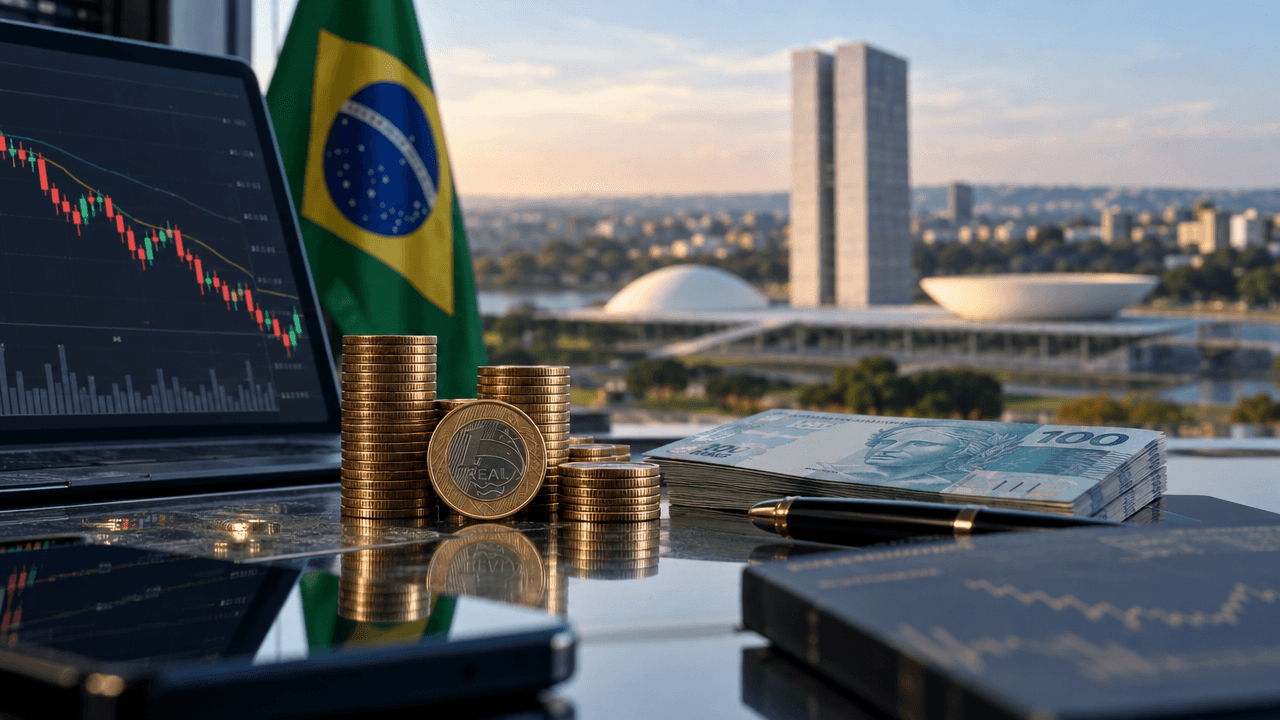
Brazil’s latest interest rate decision has caught the attention of global markets, and for good reason. The central bank’s Monetary Policy Committee (Copom) has lowered the benchmark Selic rate by 25 basis points to 13.75% per year, extending a gradual easing cycle that began when rates stood at 15%.[2][9][13][14] For traders and investors, this move reshapes the risk–reward profile of Brazilian assets at a time when U.S. yields remain elevated, making relative value and carry trades more complex.
Macro Backdrop: Why Brazil Cut Rates Again
The cut to 13.75% marks the fifth consecutive quarter‑point reduction in Brazil’s policy rate, following a prolonged period in which borrowing costs were among the highest in the world.[2][9][10][14] Copom voted unanimously for the move, signaling broad agreement that the balance of risks now allows a cautious easing of financial conditions without abandoning the inflation‑targeting framework.[2][3][13]
Recent data point to cooling inflation and a gradual moderation in economic activity, particularly in cyclical sectors that are more sensitive to high interest rates.[5][6][10] While consumer prices have slowed, inflation remains above the central bank’s 3% target, and policymakers still describe the environment as one of heightened uncertainty and deanchored expectations.[3][5][9][11] This explains why the pace of cuts remains modest: 25‑basis‑point adjustments allow the bank to respond to weaker data while preserving a relatively high real rate as insurance against renewed price pressures.
Domestic politics also add complexity. This easing step comes ahead of a closely watched presidential election, breaking with a long‑standing tendency to avoid rate cuts immediately before voting.[2][3][11] Copom’s communication seeks to reassure markets that its decisions remain grounded in the inflation mandate, not in short‑term political considerations, but the timing inevitably affects investor perceptions of policy risk.[3][11]
Impact On The Brazilian Real And Local Bond Futures
For FX traders, the key question is whether lower rates weaken the Brazilian real’s appeal as a high‑carry currency. Even after the cut, the Selic remains far above policy rates in many advanced economies, preserving a substantial yield differential.[10][13][14] However, with U.S. Treasury yields still elevated, the relative advantage of funding in dollars to buy Brazilian assets is not as clear‑cut as during past easing cycles, making carry strategies more sensitive to risk sentiment and volatility.
In the local rates market, the move to 13.75% reinforces the downward trend in short‑term yields while leaving the longer end of the curve more dependent on inflation expectations and fiscal credibility.[3][9][13] Short‑dated bond futures are likely to price in a continued, though gradual, easing path, especially as Copom has “left the door open” to further cuts if disinflation persists and growth remains subdued.[2][5][6][8][15] Any hint that inflation could re‑accelerate, or that fiscal policy might become more expansionary, could steepen the curve as investors demand higher compensation for long‑term risk.
For equity and credit markets, lower rates reduce the discount rate applied to future cash flows and ease financing costs, which tends to support valuations of rate‑sensitive sectors such as consumer discretionary, real estate and financials.[5][6][10] At the same time, banks and fixed‑income investors face margin compression as lending rates adjust more slowly than the policy corridor, rewarding those who manage duration and credit exposure carefully.
EMERGING‑MARKET CONTEXT AND GLOBAL RISK SENTIMENT
Brazil’s decision fits into a broader emerging‑market pattern: after aggressive hiking cycles to combat post‑pandemic inflation, several EM central banks have begun cautious easing as price pressures recede.[3][9][10][14] What differentiates Brazil is the combination of still‑high nominal rates, cooling inflation, and a policy stance that remains explicitly data‑dependent rather than pre‑committed to a rapid normalization.[3][6][8]
High U.S. yields are a critical part of the backdrop. When risk‑free returns in dollars rise, EM assets must offer either higher yields or clearer structural growth stories to attract capital. Brazil’s move to 13.75% keeps it in the “high‑carry” camp, but each incremental cut narrows the cushion that compensates investors for currency and political risk.[10][13][14] As a result, flows into Brazilian assets may become more selective, favoring names and instruments that combine attractive carry with strong fundamentals and liquidity.
For global portfolios, the decision underscores the importance of differentiating across EMs rather than treating the asset class as a block. Countries that cut too quickly risk destabilizing their currencies; those that remain overly restrictive may over‑tighten growth. Brazil is currently trying to thread that needle, calibrating quarter‑point moves while signaling vigilance about inflation and external shocks.[3][6][9][10]
How Simulated Finance Traders Can Leverage This Move
On a SimFi platform like E8 Markets, this kind of policy shift is a powerful live case study for developing macro trading skills. Because the environment is simulated, traders can explore how different strategies would have performed around the decision without risking real capital, building intuition about the interaction between rates, FX, and fixed‑income pricing.
For FX simulation, traders can test scenarios such as: - Long BRL versus USD to capture carry, while stress‑testing for a rise in global risk aversion. - Short BRL positions that anticipate further easing and potential currency softness if inflation expectations become less anchored.
In rates and bond futures simulation, traders can: - Position for a flattening or steepening of the yield curve based on different paths for inflation, growth, and future Copom decisions. - Explore relative‑value trades between short‑dated contracts that are tightly linked to Selic expectations and longer‑dated instruments that embed fiscal and political risk.
Equity and credit simulations can focus on how lower rates filter through to corporate earnings, valuations, and default risk. For example, traders might model how a continued easing cycle could re‑rate domestically focused sectors while leaving export‑oriented names more driven by global demand and commodity prices.
FORWARD‑LOOKING TAKEAWAYS FOR TRADERS
Several practical lessons emerge from Brazil’s move to 13.75%:
1. Monetary policy is a process, not a single event. The fifth consecutive cut illustrates that markets often react more to the expected path of rates than to any one meeting’s decision.[2][3][9][14]
2. Communication matters as much as the headline rate. Copom’s emphasis on inflation convergence, uncertainty, and data dependence shapes the pricing of future moves and volatility across assets.[3][6][8][10]
3. Relative value is dynamic. As U.S. yields and global conditions change, the attractiveness of Brazilian carry strategies must be reassessed continuously rather than assumed.[10][13][14]
4. Simulated environments are ideal for studying regime shifts. Using SimFi tools, traders can replay this and past cycles, compare strategies, and refine rules for risk management before applying them in live markets.
Conclusion
Brazil’s cut of the Selic rate to 13.75% signals a cautious transition from peak tightness toward a still‑restrictive, but less punitive, monetary stance.[2][9][13][14] Inflation is cooling yet remains above target, growth is slowing but not collapsing, and political and global factors keep uncertainty high.[3][5][6][11] For traders, the decision reshapes opportunities across FX, rates, equities and credit, demanding a nuanced approach to carry, duration, and risk sentiment. In a simulated finance environment, this is precisely the kind of macro event that can accelerate learning: it ties together monetary policy theory, market microstructure, and real‑world investor behavior in one evolving narrative.