
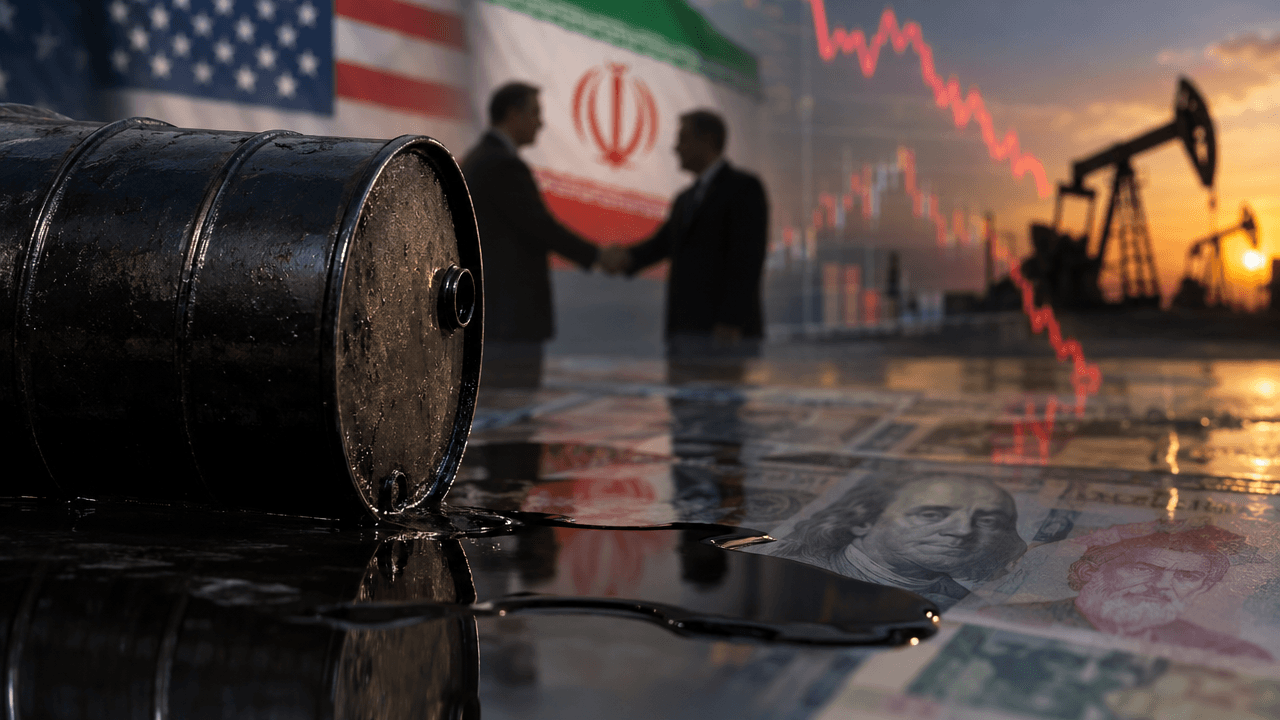
Brent crude remains under pressure near $97 after one of the oil market’s sharpest weekly declines in years. The international benchmark fell 8.7% on Wednesday to settle at $94.62, its lowest close since late August, before recovering as renewed tanker attacks reminded traders that Middle Eastern supply risks have not disappeared. By Friday, Brent was trading close to $97–$98 per barrel and was on track for its steepest weekly decline since the early stages of the COVID-19 pandemic. [11][14]
The immediate catalyst is a rapid shift in geopolitical expectations. Markets are increasingly pricing the possibility of a negotiated agreement between the United States and Iran. If diplomacy succeeds, the risk premium embedded in crude prices could continue to unwind. However, the market is also aware that negotiations remain uncertain, meaning oil can reverse quickly if talks fail or military tensions escalate.
The Geopolitical Risk Premium Is Fading
Oil prices often contain a premium for potential supply disruption. When traders fear attacks on energy infrastructure, blocked shipping routes, or sanctions that restrict exports, they bid prices higher before any physical shortage actually occurs. The opposite happens when diplomatic progress appears possible.
Recent reports indicate that Qatar has been mediating between Washington and Tehran, with a draft agreement reportedly under discussion. Hopes for a settlement have encouraged traders to anticipate more stable Middle Eastern production and transportation. That expectation has helped push Brent sharply lower, even though a final agreement has not been confirmed. [1][4]
The market’s reaction illustrates an important principle: crude prices respond not only to current supply and demand, but also to the probability of future changes. A credible agreement could reduce concerns around shipping through the Strait of Hormuz and improve expectations for regional exports. Conversely, a breakdown in negotiations could restore much of the risk premium that has recently disappeared.
Why The Price Drop Was So Fast
The speed of the decline reflects crowded positioning and changing assumptions. Traders who had bought crude as protection against an escalation in the Iran conflict may have rushed to close those positions when diplomatic headlines emerged. Momentum-focused strategies can intensify the move, creating a sharp decline that is larger than the initial change in fundamentals.
Brent’s 8.7% fall on Wednesday was followed by a rebound after fresh attacks on tankers renewed concerns about supply security. Brent gained 3.88% on Thursday and settled at $98.29, demonstrating how sensitive the benchmark remains to individual geopolitical headlines. [9]
This volatility matters for traders because a falling price does not necessarily mean risk has vanished. Instead, it may indicate that the market is rapidly repricing probabilities. A diplomatic breakthrough could send Brent lower toward levels supported by global demand and inventory trends. A military escalation, shipping disruption, or failed agreement could produce an equally rapid recovery.
Implications For Currencies And Inflation
Lower crude prices can weigh on energy-linked currencies, particularly those of major oil-exporting economies. When the value of expected oil revenue falls, investors may reassess trade balances, government income, and corporate earnings in those countries. The effect is not always immediate, but sustained weakness in Brent can reduce support for commodity-sensitive currencies.
Oil also influences inflation expectations. Energy is a direct component of consumer price indexes through fuel and heating costs, while transportation expenses affect the price of many goods and services. A decline toward $97 could ease some inflation pressure if it persists and passes through to retail fuel markets.
That could influence expectations for central-bank policy. If lower energy prices help reduce headline inflation, investors may become more comfortable pricing slower rate increases or eventual easing. However, oil is only one part of the inflation picture. Core services, wages, housing, and food prices can remain elevated even when crude declines.
What Traders Should Watch Next
The most important signal is whether Brent can establish a stable trading range below $100. A sustained break beneath that psychological level would suggest that the market is assigning greater probability to improved supply conditions and softer energy demand. Failure to hold lower levels, especially alongside new shipping disruptions, would indicate that geopolitical risk remains underpriced.
Traders should monitor four developments closely
First, watch for evidence of a formal U.S.–Iran agreement rather than relying on unconfirmed headlines. Second, track shipping activity through the Strait of Hormuz and reports involving tankers or energy infrastructure. Third, follow inventory data and signs of changing global demand. Finally, monitor the U.S. dollar, since oil is priced in dollars and currency movements can amplify or offset changes in crude.
Risk management is particularly important in this environment. Large daily moves can make tight stop-loss orders vulnerable to sudden volatility, while excessive leverage can turn a temporary headline-driven reversal into a substantial loss. Scenario planning is more useful than attempting to predict the next headline: traders can define responses for a confirmed agreement, a prolonged stalemate, and a renewed escalation.
The Broader Market Signal
Brent’s move near $97 is more than a headline about gasoline and energy shares. It reflects a wider change in how markets are assessing geopolitical risk, future supply, and inflation. Lower oil prices could support consumers and reduce inflation expectations, but they may also pressure energy producers, oil-exporting economies, and commodity-linked currencies.
For SimFi participants, the episode offers a practical lesson in cross-market analysis. A single geopolitical development can affect crude, currencies, equity futures, inflation expectations, and interest-rate pricing at the same time. The strongest approach is to identify the primary catalyst, map its likely impact across markets, and avoid treating an initial price move as confirmation that the trend is permanent.
Brent crude remains under pressure near $97 because traders are pricing the possibility of less geopolitical disruption. Until an agreement is signed and shipping risks normalize, however, the market remains vulnerable to sharp reversals. The key question is not simply whether oil falls next, but whether the diplomatic optimism is strong enough to replace the risk premium that has supported prices for much of the year.