
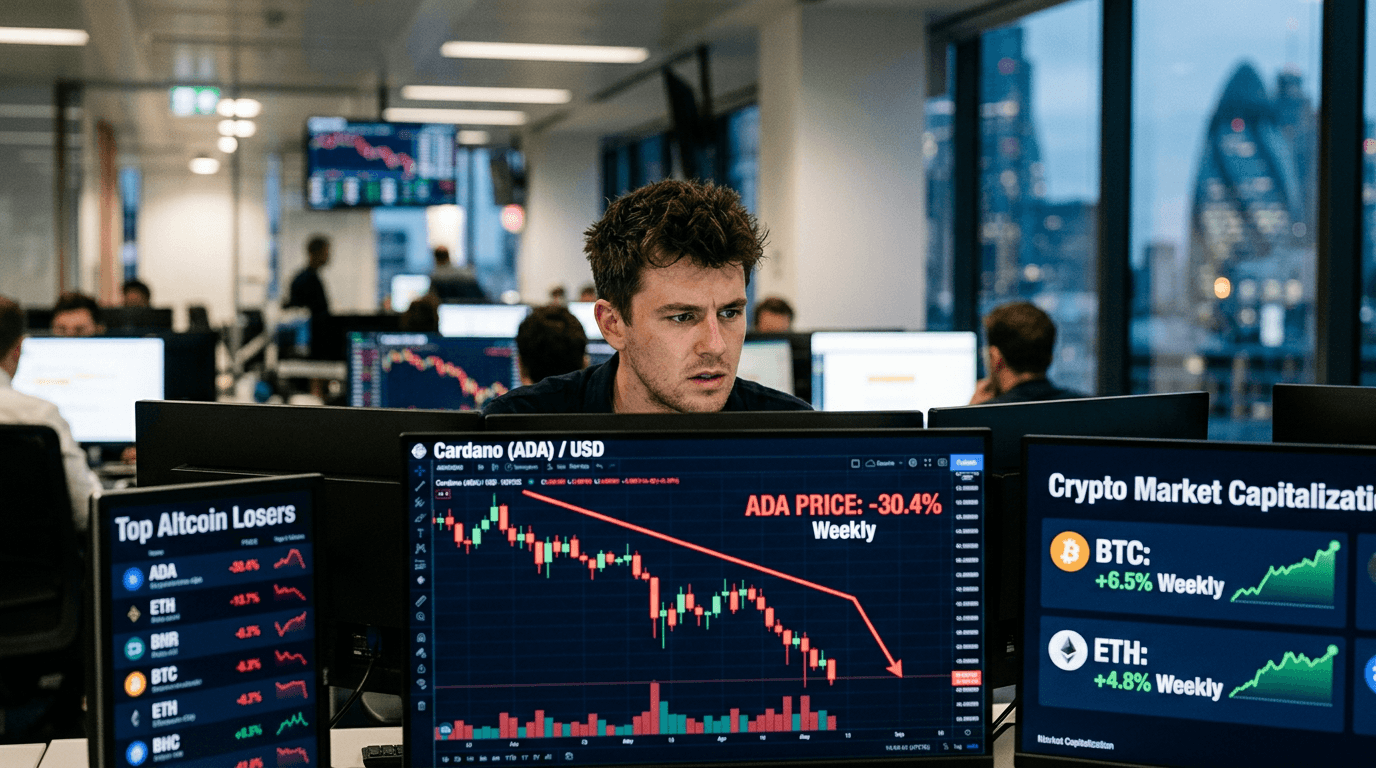
Cardano’s latest sell-off has pushed it to the forefront of altcoin losses, with ADA sliding roughly 10% in a single day and more than 30% over the past week.[1] Against a backdrop of relatively more resilient Bitcoin and Ethereum, this underperformance is shining a spotlight on capital rotation within the broader crypto complex and forcing traders to reassess where they take risk.
Market Recap: Ada Leads The Losers
Recent price data show Cardano trading around the $0.16 level, down sharply from prior sessions and more than 70% below levels seen a year ago.[4] Over just seven days, ADA’s price has fallen by about 30%, a drawdown that far exceeds the moves seen in the largest-cap names like Bitcoin and Ethereum.[1] For a top‑tier altcoin, that kind of decline is significant: it represents not just a broad risk‑off move, but a relative rotation away from Cardano specifically.
Underlying this weakness are worries about Cardano’s ecosystem health and longer‑term project funding, which have shaken investor confidence.[1] When concerns shift from short‑term price action to structural questions about a network’s growth and sustainability, selling pressure can accelerate as both traders and longer‑term holders move to the sidelines.
From a technical perspective, the backdrop is equally heavy. Short‑term models and indicator-based forecasts generally flag a bearish trend, with far more technical indicators pointing down than up and very high day‑to‑day volatility.[2] That mix—fundamental doubts plus negative technicals—is exactly the environment in which a high‑beta asset can underperform its peers.
Rotation Within The Crypto Complex
Cardano’s slide is not happening in isolation; it is part of a broader rotation within crypto. In every market cycle, capital tends to move along a spectrum of risk:
First, toward high‑liquidity “blue chips” like Bitcoin and Ethereum, which typically act as the core holdings for institutions and more conservative crypto investors.
Second, away from smaller, more speculative altcoins when uncertainty rises or when narratives around their fundamentals weaken.
Cardano’s steep weekly decline versus more modest moves in BTC and ETH is a textbook example of this rotation. As investors question the near‑term payoff of Cardano’s long development roadmap, they may prefer to concentrate exposure in assets with clearer adoption metrics, stronger on‑chain activity, or more immediate catalysts.
This internal rotation also extends into crypto‑linked equities and derivatives. When a large altcoin underperforms, it can dampen sentiment toward:
Crypto exchanges and brokerages that rely heavily on altcoin trading volumes.
Publicly listed companies with significant altcoin treasury exposure.
Derivatives markets, where traders may see widening basis, rising implied volatility, or skewed options demand as they hedge altcoin risk or rotate into Bitcoin and Ethereum exposure.
Even if BTC and ETH hold up relatively well, weakness in major altcoins like ADA can still drag on the “crypto beta” that equity and derivatives traders use to size positions and manage risk.
FUNDAMENTALS VS. PRICE: WHERE DOES CARDANO STAND?
One reason this drawdown is attracting so much attention is that Cardano has long marketed itself as a research‑driven, methodically developed proof‑of‑stake blockchain with a multi‑phase roadmap.[5] Its development is organized into distinct eras—Byron, Shelley, Goguen, Basho, and Voltaire—each focused on aspects like decentralization, smart contracts, scalability, and governance.[5] On paper, that gives ADA a strong long‑term narrative.
However, markets often price expectations and execution very differently. Concerns about ecosystem momentum and funding have raised questions about how quickly that roadmap translates into real‑world adoption and sustainable on‑chain activity.[1] When price compresses this aggressively, it usually reflects a gap between what the roadmap promises and what traders currently see in usage, developer traction, and applications.
Technical and sentiment data reinforce this caution. Algorithmic forecasts describe Cardano’s near‑term outlook as generally bearish, with a large majority of indicators signaling weakness and very high realized volatility.[2] Short‑term projections even suggest the possibility of further modest declines, or at best sideways trading, rather than an immediate snap‑back rally.[2] For traders, that means any attempt to “buy the dip” is effectively a bet on a shift in narrative or macro conditions, not just on mean reversion.
Strategies For Traders In A Rotating Market
For active traders, a sharp weekly drop of more than 30% in a major altcoin presents both risk and opportunity. The key is to treat it as part of a broader rotation, not just a single‑asset story.
A few practical approaches
Reassess relative exposure If Bitcoin and Ethereum are holding up while Cardano and other altcoins break down, portfolios may have become too concentrated in high‑beta names. Rotating part of that exposure into majors or even into cash and stablecoins can help reduce volatility and tail risk.
Focus on pairs, not just dollar prices Traders can monitor pairs like ADA/BTC or ADA/ETH to see whether Cardano is merely following the market lower or decisively underperforming. Persistent underperformance on these crosses is often a sign that rotation away from the asset is still in progress.
Use volatility consciously Very high volatility cuts both ways. It can offer attractive trading ranges but also increases the chances of getting stopped out. Sizing positions smaller, widening stop‑losses slightly, or using options where available can help manage this risk.
Differentiate time horizons Short‑term traders may focus primarily on momentum and technical levels; longer‑term investors will want to revisit the fundamental thesis: network growth, DApp traction, governance progress, funding runway, and competitive positioning versus other smart‑contract platforms.
Simulated trading environments, such as those offered by SimFi platforms like E8 Markets, can be particularly useful in this kind of rotation. They allow traders to test how shifting from altcoins to majors (or vice versa) would have affected drawdowns, Sharpe ratios, and margin usage—without putting real capital at risk.
Key Takeaways For Ada And The Altcoin Landscape
Cardano’s more than 30% weekly decline is an important signal about where we are in the current crypto cycle. It suggests that the market is:
Rewarding assets with clearer, near‑term adoption stories and stronger liquidity.
Punishing projects where questions around ecosystem health and funding are rising.[1]
Demanding more than just a compelling roadmap; it wants visible delivery and usage.[5]
For traders and investors, this is a reminder that “altcoin season” is not a permanent state. Internal rotations within crypto can be as violent as major market downturns, especially when sentiment turns against a once‑favored name. In that environment, risk management, diversification, and a clear framework for evaluating fundamentals become more important than chasing the latest narrative.
Whether this episode marks a temporary shakeout or a more enduring shift in capital allocation will depend on what Cardano delivers next—both in terms of on‑chain activity and ecosystem resilience. Until then, the market has sent a clear message: in a maturing crypto complex, differentiation is real, and not all large‑cap altcoins are treated equally.