
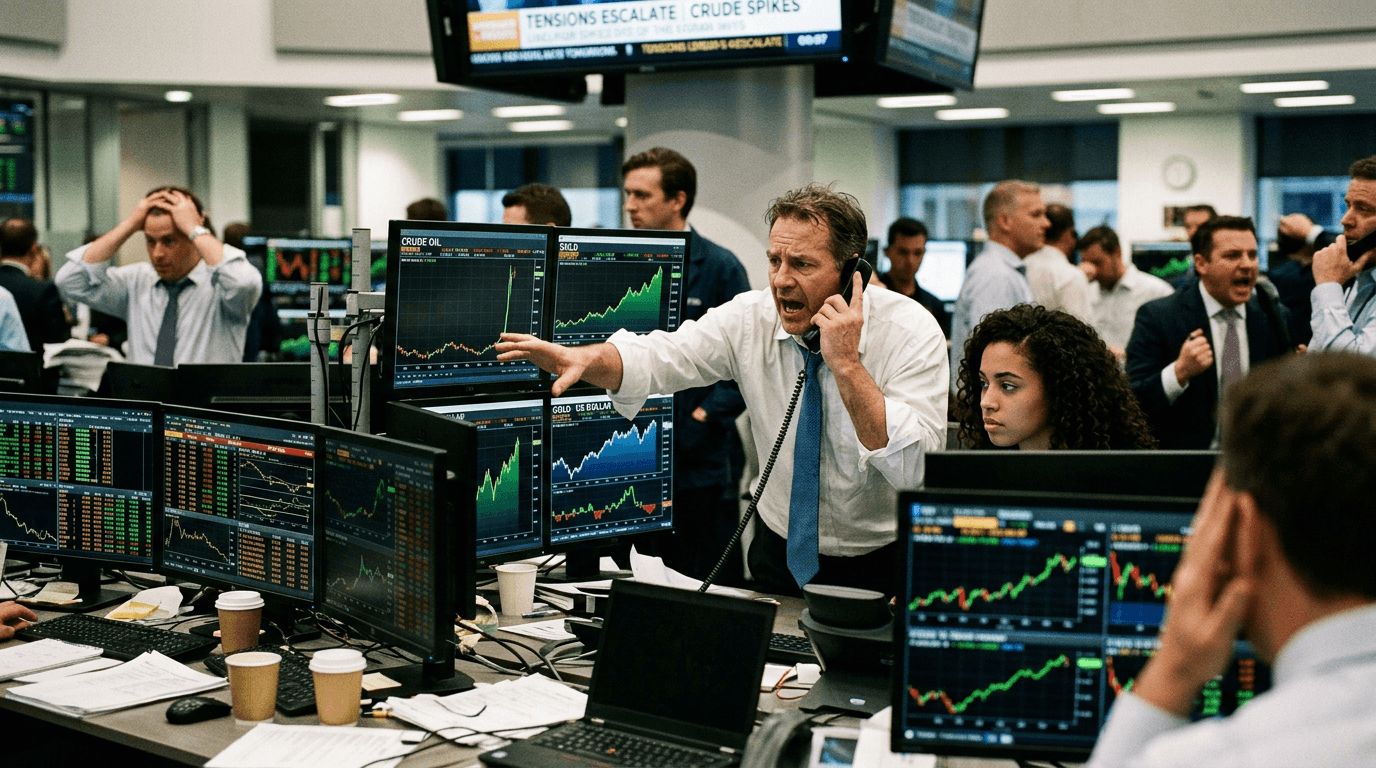
Escalating conflict in the Middle East, particularly involving Iran and the US, has jolted global markets, driving a sharp rally in oil, renewed demand for safe havens, and pronounced moves in major FX pairs.[1][5][6] West Texas Intermediate (WTI) crude has snapped back above the $79–81 range after a roughly 6–9% jump, briefly trading near $81–82, while Brent has been lifted toward the mid‑$80s, embedding an estimated $18 per‑barrel geopolitical risk premium.[1][5][6] For traders, this isn’t just another headline—it is a live stress test of how energy shocks, geopolitics and macro expectations feed through oil, currencies, gold and indices in real time.
Markets Jolt As Middle East Risks Escalate
The latest flare‑up in the Middle East comes on top of already strained energy and security dynamics, with Iran‑related disruptions around the Strait of Hormuz—a route that carries roughly 20% of global oil flows—at the center of market concerns.[2][4][14] Attacks on shipping, strikes on energy infrastructure, and fears of broader regional escalation have revived memories of past oil shocks, but the response is now filtered through a more complex global supply picture and more data‑driven markets.[2][14]
Global energy prices are projected to surge by about 24% this year, the biggest increase since the Ukraine war, with the World Bank warning of a severe shock rippling through commodity markets.[5] Stock markets have softened, bond yields have risen and volatility has picked up across major economies as investors reassess growth, inflation and policy trajectories.[1][10][12] In this environment, intraday moves are being driven as much by news flow—missile strikes, diplomatic talks, shipping incidents—as by scheduled data releases, making risk management and scenario analysis more important than ever for traders.
OIL’S GEOPOLITICAL RISK PREMIUM RETURNS
Oil is once again the primary transmission channel for Middle East risk into global markets. Earlier in the conflict, Brent crude posted one of the largest monthly percentage gains on record, and prices have climbed more than 50% from pre‑war levels at various points as traders priced in the possibility of major and sustained supply outages.[3][8] The International Energy Agency has warned that conflict and blockades could curtail regional production by millions of barrels per day, potentially cutting global output by around 8 million barrels even after offsetting increases elsewhere.[2][8]
Today’s move in WTI back above $79–81, with highs around $81–82, and Brent into the mid‑$80s, reflects not only actual disruptions but a sizeable geopolitical risk premium—estimated near $18 per barrel—that compensates for uncertainty around future supply.[1][5][6] That risk premium can expand or contract rapidly with headlines: a credible cease‑fire or reopening of shipping lanes can compress it; new attacks or sanctions can inflate it.
For traders, the implications are clear:
- Oil is trading as a risk asset with embedded optionality on war outcomes, not just on fundamentals.
- Volatility in energy futures is elevated; option skew has widened as markets pay up for upside protection.
- Correlations with equity indices, cyclical FX and inflation expectations have strengthened, making oil a key macro driver rather than a sector‑specific story.
Safe Havens Back In Focus: Dollar And Gold
As energy prices surge and geopolitical risk rises, classic safe‑haven assets are back in the spotlight. The US dollar has gained broadly, supported by its status as the world’s reserve currency and by expectations that higher energy‑driven inflation could delay rate cuts by key central banks.[6][12] That demand for dollars is visible in pressure on EUR/USD, which has slipped toward multi‑week lows as investors rotate out of the euro and into the greenback.[1][5][6]
Gold, another traditional refuge in times of uncertainty, has benefited from the confluence of war risk, inflation anxiety and choppy equity markets.[1][5] Even against a backdrop of higher nominal yields, demand for gold as a hedge has remained resilient, underpinned by concerns about the durability of the conflict and the potential for further shocks to shipping or infrastructure.[12][14]
For portfolio and FX traders, several dynamics stand out:
- Risk‑off episodes triggered by Middle East headlines typically see the dollar and gold bid, while pro‑risk currencies and equities sell off.
- Safe‑haven flows can occur even when economic data or central bank guidance would otherwise argue for weaker USD—geopolitics temporarily override the macro script.
- Cross‑asset signals (oil up, gold up, USD up) are a strong indication of genuine stress rather than isolated sector moves.
Fx And Risk Assets: How Currencies Are Adjusting
Beyond EUR/USD, the conflict is reverberating through a wide range of FX pairs and crosses. Higher energy prices tend to support net commodity exporters and pressure energy importers, but in practice the picture is more nuanced when war risk and central bank expectations are layered on top.[6][12]
- Energy‑importing economies in Europe and parts of Asia face deteriorating terms of trade and higher headline inflation, which can weigh on their currencies and constrain central banks’ ability to ease.[5][6][12]
- Some commodity‑linked currencies may benefit from improved export revenues, but can still be hit by global risk‑off sentiment and equity market weakness.[10][12]
- Volatility in FX has risen, particularly in pairs linked to energy‑sensitive economies, as traders rapidly adjust interest rate expectations based on oil’s path.[1][5][6]
Central banks in Asia and emerging markets have already signaled that persistent high energy prices could force them to keep rates higher for longer or delay previously expected cuts.[6][12] That feedback loop—oil shocks pushing inflation up, central banks leaning hawkish, currencies reacting to shifting yield differentials—is a central theme in current FX markets and a critical focus area for macro‑oriented traders.
What Traders Can Do: Practical Takeaways
For both live and simulated finance traders, this episode offers a rich environment to practice navigating complex macro shocks and fast‑moving cross‑asset dynamics. Several practical takeaways stand out:
- Build and test scenarios: Map out war‑related paths (rapid de‑escalation, prolonged stalemate, further escalation) and translate them into assumptions for oil, inflation, central bank policy and FX. Use these scenarios to stress‑test strategies and portfolios.[5][6][12]
- Watch correlations, not just prices: Track how oil moves with equity indices, gold, the dollar and key FX pairs day‑to‑day. Shifts in correlation regimes often signal changes in market narrative—from pure geopolitics to growth fears or inflation worries.[1][10][12]
- Focus on risk management: Elevated volatility in energy, index futures and FX crosses demands tighter risk controls—clear stop levels, position sizing rules and defined maximum drawdowns.[1][5][6]
- Separate structural from tactical views: Long‑term trends, such as diversification of global energy supply and evolving Middle East influence, may dampen the structural impact of conflicts on oil prices.[9] Tactically, however, short‑term shocks can still be sharp, offering both risk and opportunity for nimble traders.
Simulated environments are particularly valuable in periods like this, allowing traders to rehearse responses to headline‑driven moves, refine execution around key levels in oil and FX, and build disciplined frameworks for trading news‑sensitive markets—without the emotional and financial pressure of live capital at risk.
Ultimately, the Middle East war and Iran conflict have reminded markets that geopolitics can still override models, forcing rapid repricing across oil, safe havens and currencies. For traders, the challenge is to stay informed, manage risk and translate complex macro shocks into structured strategies, rather than reactive bets.