
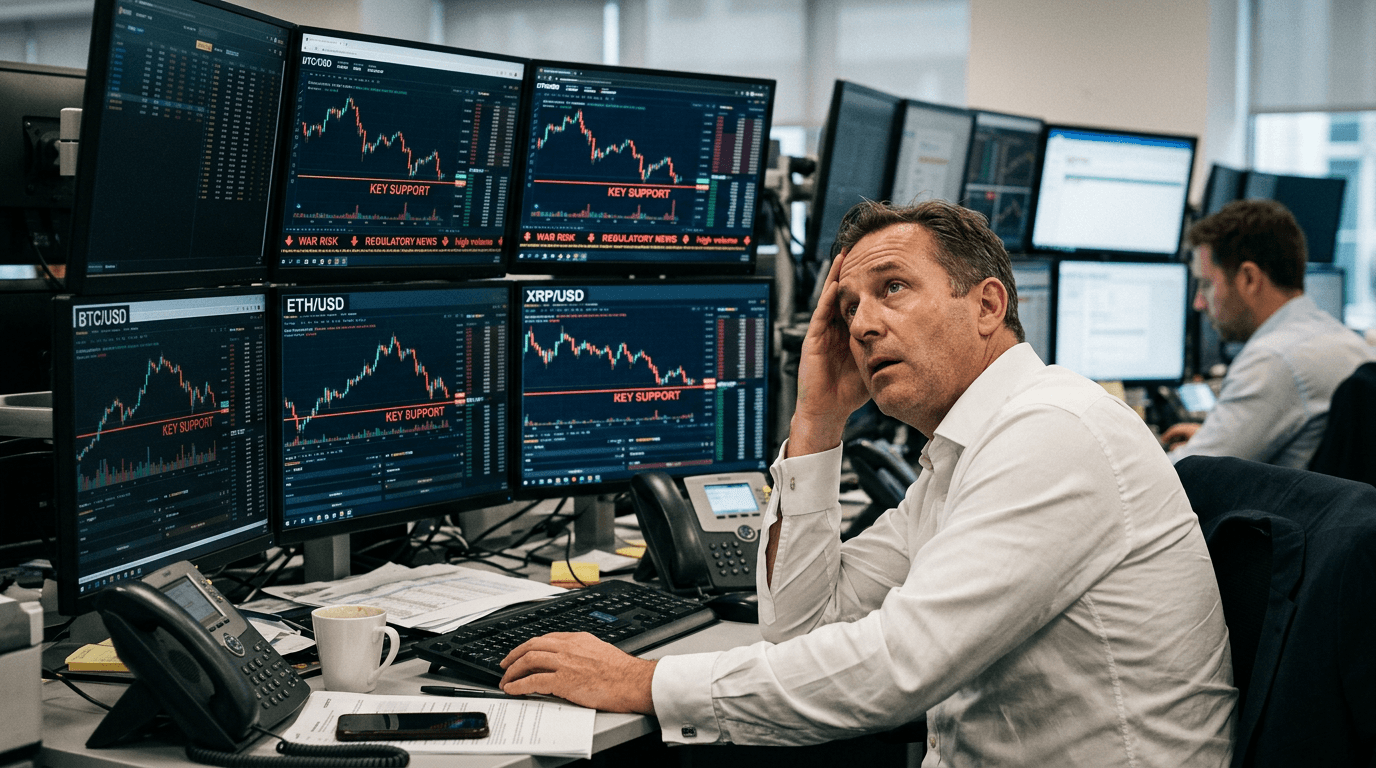
Bitcoin, Ethereum and XRP are once again reminding traders that “cautious” can still mean highly volatile, as prices oscillate around key support zones while war headlines and regulatory news drive rapid shifts in sentiment across spot and derivatives markets[2][8]. Instead of the aggressive dip‑buying seen earlier in the year, flows now reflect a market that is headline‑sensitive, wary of leverage, and highly reactive to every new data point on geopolitics and policy[2][10][15].
Market Caution Around Key Support
Major crypto benchmarks are hovering near levels that many traders see as lines in the sand, with bitcoin holding in the low‑$70,000 area and ether consolidating around the $2,000 region[2][3]. That positioning matters because when prices cluster near widely watched supports, small changes in positioning or news can trigger outsized moves as stops and options hedges are forced into the market[2][10]. Recent pullbacks have already flushed out some leveraged longs in perpetual futures, while options markets show traders paying up for downside protection but not fully abandoning the medium‑term bullish trend[10][14].
This mix of lingering optimism and defensive positioning is visible in two‑way volatility: sharp intraday rallies on positive headlines are quickly faded when subsequent news turns risk‑off, and vice versa[2][8]. For active traders, it means that directional conviction matters less than agility, order placement, and risk sizing; for longer‑term investors, it argues for patience and clear invalidation levels rather than chasing every swing[10][15].
War Headlines Keep Risk Sentiment Fragile
Crypto’s integration into the broader macro risk ecosystem is on full display as conflict in the Middle East and concerns around Iran keep global markets on edge[2][3][10]. Escalating tensions around key energy chokepoints have driven episodes of risk‑off across equities and credit, with crypto selling off alongside other high‑beta assets when oil prices spike and uncertainty around supply feeds into inflation expectations[2][3][10]. Regulators such as the Central Bank of Ireland have explicitly warned crypto firms about war‑related operational and market risks, highlighting vulnerabilities around liquidity, funding, and counterparty exposures during periods of turbulence[3].
Interestingly, bitcoin has still managed to outperform many traditional assets since the start of the Iran conflict, posting gains of around 7% even as volatility remains high[3]. This reflects the asset’s dual identity: part “digital risk asset” that trades like tech stocks, part “macro hedge” that can attract flows when conventional safe havens are crowded[2][3][10]. For traders, the key is recognizing regime changes: in some weeks, war headlines trigger selling across all risk assets; in others, they spark rotation into crypto as speculative capital searches for asymmetric upside[10][15].
Takeaways for readers: - Treat geopolitical risk as a volatility driver, not just a directional signal. - Watch correlations with equities, oil, and gold to understand crypto’s current role in the macro mix. - Avoid over‑leveraging into binary geopolitical events; size positions so unexpected headlines are survivable.
Regulatory Crosswinds: From Clarity To Confusion
While geopolitics sets the tone for risk appetite, regulatory developments are increasingly determining where capital is willing to stay invested. In the United States, the proposed Digital Asset Clarity Act has become a central narrative driver, with legislative progress or setbacks repeatedly triggering whipsaw moves in bitcoin and major altcoins[8][11][14]. Optimistic comments from policymakers have pushed prices higher by boosting expectations of a stable, rules‑based environment for institutional participation, while criticism or delays have quickly unwound those gains[8][11].
Beyond one bill, there is a broader structural shift under way. Joint releases from securities and derivatives regulators have begun formalizing taxonomies that distinguish digital commodities from securities, providing much‑needed clarity for how exchanges and brokers can list and custody different tokens[7][14]. At the same time, initiatives such as the New York Stock Exchange’s work with tokenization specialists to build native infrastructure for tokenized securities show that traditional markets are preparing for on‑chain settlement and fractionalized instruments at scale[7]. Parallel efforts around regulated commodity‑backed tokens, like frameworks for silver‑backed assets in Hong Kong, further underscore that tokenization is moving from concept to implementation[7].
ETF and derivatives regulation adds another layer. Guidance that treats digital asset derivatives similarly to traditional contracts and that opens the door for banks and insured institutions to engage in crypto‑related activities provides structural support for the market, but also ties it more closely to traditional regulatory cycles[10][12][13]. As rules around stablecoins, tokenized treasuries, and yield‑bearing products evolve, traders must track not only price charts but also policy calendars.
Key implications: - Regulatory clarity can compress risk premiums and support higher valuations; regulatory uncertainty does the opposite. - Tokenized securities and regulated ETFs are likely to deepen order books and improve liquidity over time. - Legal classification (commodity vs security) will increasingly shape listing, leverage, and margin rules across venues.
Practical Playbook For Traders In Two-way Volatility
In an environment where war headlines and regulatory updates both move the tape, traders need a playbook that emphasizes process over prediction. One practical approach is to separate “event risk” from “trend risk”: event risk relates to scheduled votes, hearings, or geopolitical milestones, while trend risk captures the underlying direction driven by adoption, macro, and flows[10][15]. Positioning smaller ahead of binary events, widening stop‑losses or using options to define risk, and increasing size only after the market reveals its reaction can help avoid being on the wrong side of liquidation cascades[10][13].
Risk management should incorporate derivatives data. Funding rates, options skew, and open interest in perpetual futures can signal when the market is leaning too heavily in one direction and is susceptible to squeezes[10][15]. During the recent pullback, signs of crowded long positioning preceded forced deleveraging, illustrating why reading positioning is as important as reading price[2][10]. Diversification across narratives—layer‑1s, infrastructure tokens, and regulated tokenization themes—can also reduce idiosyncratic regulatory risk.
Practical steps: - Define maximum portfolio drawdown and stick to it, especially during headline‑driven weeks. - Use simulated scenarios to plan responses to both positive and negative policy outcomes. - Lean on liquid majors (BTC, ETH) for event trading; avoid over‑exposure in illiquid tokens when volatility spikes.
Simulated Finance: Building Skill Without Real-pnl Stress
High‑volatility, headline‑driven markets are ideal training grounds for developing trading discipline—as long as the learning environment allows for mistakes without permanent damage. Simulated finance platforms create that sandbox by mirroring real market conditions, including slippage, margin rules, and derivatives behavior, while protecting traders from actual capital loss. This is particularly valuable when practicing responses to war‑related shock moves or sudden regulatory announcements that can move prices by double‑digit percentages in hours[2][8][10].
By using live‑like data feeds and realistic execution mechanics, SimFi environments enable traders to test strategies around support and resistance, volatility breakouts, and event‑driven entries and exits. Participants can build and refine playbooks for scenarios such as “bill passes,” “bill fails,” or “ceasefire announced,” tracking how their rules perform under stress before deploying them in live markets. Over time, this structured practice helps traders shift from emotional, reactive decision‑making to rule‑based, probabilistic thinking.
Conclusion
The current crypto backdrop is defined by caution: prices clustered near key supports, volatility elevated, and sentiment oscillating with each new headline on war and regulation[2][8][10]. Yet beneath the noise, structural developments—regulatory taxonomies, tokenized securities infrastructure, and more predictable frameworks for ETFs and derivatives—are gradually building a foundation for deeper, more institutional markets[7][10][14]. For traders and investors, the challenge is to navigate the near‑term turbulence without losing sight of the longer‑term trajectory.
Focusing on robust risk management, understanding the interplay between geopolitics and policy, and rehearsing responses in simulated environments can turn a difficult trading landscape into a powerful learning opportunity. In a market where caution is warranted and volatility is here to stay, preparedness and process are the most valuable assets of all.