
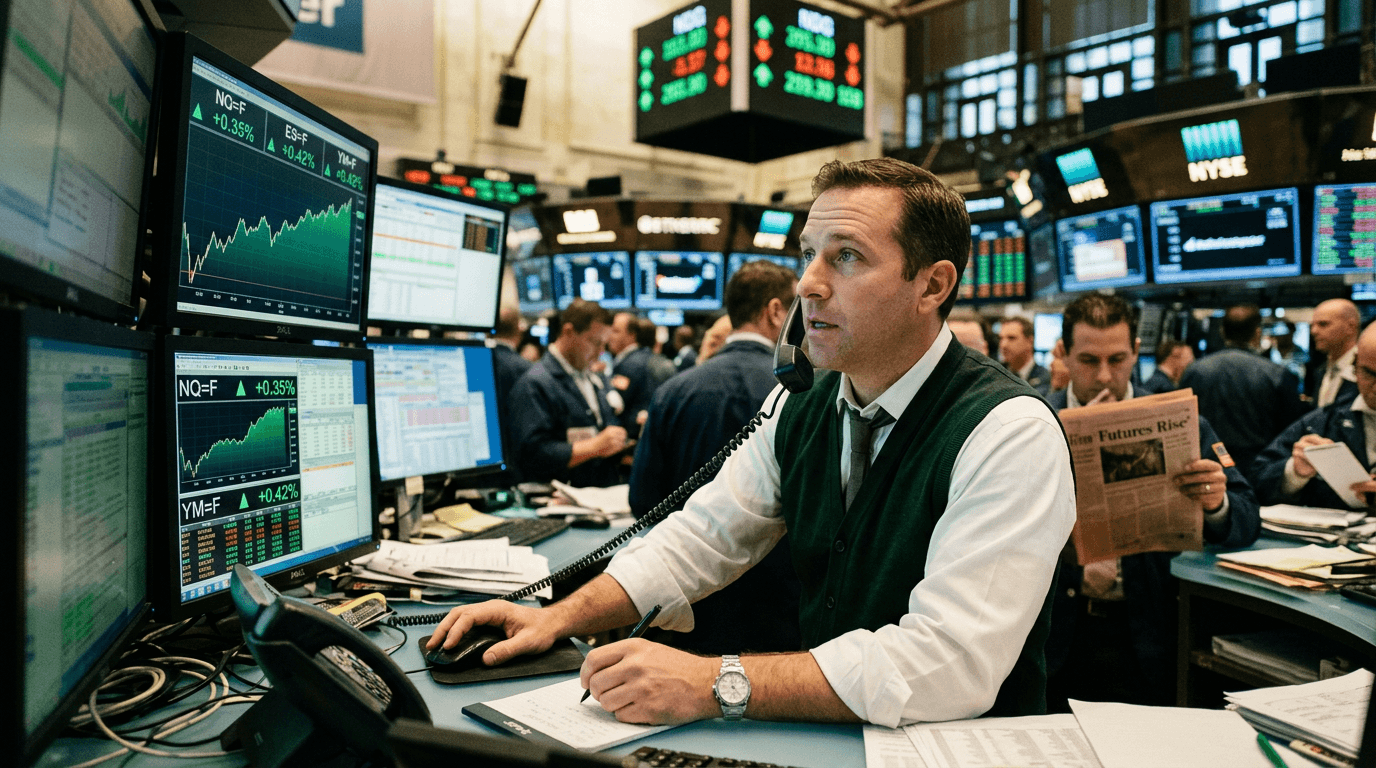
US equity futures are stabilizing in early Tuesday trade, turning modestly higher after a tech-led pullback that rattled risk sentiment in recent sessions.[3][5][12] The move is not an aggressive surge but a measured rebound, with Dow futures up around 0.2% and S&P 500 and Nasdaq futures also slightly in the green.[3][12] For traders, that combination—small gains following sharp sector-specific selling—often marks the start of a cautious risk-on tone rather than a full-throttle return of bullish euphoria.
Markets Stabilize After Tech-led Pullback
The latest futures action follows a period where technology and AI-linked names bore the brunt of profit-taking and valuation anxiety.[1][2][6] Recent tech routs have seen the Nasdaq 100 drop more sharply than the broader S&P 500, highlighting the market’s sensitivity to earnings surprises and shifting expectations around AI-related spending.[3][6][9] When the most crowded growth trades wobble, portfolio managers typically trim risk, rotate into defensives, or sit on the sidelines until price action stabilizes.
Today’s modest uptick in index futures suggests that phase of urgent de-risking is easing, as dip buyers cautiously re-engage with beaten-down tech and growth names.[1][2][5] Futures tied to the S&P 500 and Nasdaq are edging higher, showing that investors are willing to add exposure—but only incrementally—while they assess incoming data, earnings and any new macro surprises.[3][12] The shift from heavy selling to a mild bid is often the first step in rebuilding confidence after a sector-led shock.
WHAT A “CAUTIOUS RISK-ON” TONE REALLY MEANS
A genuine risk-on phase typically features broad participation, strong momentum and rising volumes across equities, credit, commodities and high-beta FX pairs. In contrast, a cautious risk-on tone, like the one signaled by today’s futures, tends to show up as small percentage gains in index futures, selective dip buying, and still-elevated volatility.[3][6][12] Traders are testing the waters rather than jumping in.
In practical terms, this means equity futures are positive but not surging, credit spreads are stable rather than aggressively tightening, and safe-haven flows into Treasuries, JPY and CHF begin to slow without fully reversing.[3][6][11] Options markets may show demand for upside calls returning, but put protection remains in place, reflecting lingering concern about macro risks, earnings quality and geopolitical headlines.[6][9] For discretionary and systematic traders alike, this environment rewards nuance—scaling in, using options overlays, and paying close attention to how different asset classes confirm or contradict the equity signal.
Tech, Crypto And Cross-asset Risk Flows
The rebound in tech futures is happening alongside a broader risk-on mood supported by strength in cryptocurrencies, which have increasingly become a barometer for speculative appetite. While the magnitude of crypto moves can far exceed equity swings, synchronized upticks in both arenas often signal that investors are more comfortable owning volatility and growth narratives again.[3][5] This is particularly visible after a period when AI, semiconductors and other high-beta tech segments experience sharp drawdowns, only to attract dip buyers once valuations look more reasonable or catalysts re-emerge.[1][2][6]
Cross-asset traders watch these relationships closely. When Nasdaq futures, crypto benchmarks and high-beta sectors move higher together, it suggests that risk tolerance is rebuilding, even if defensive assets are not yet being fully abandoned.[1][3][5] At the same time, the modest scale of the equity futures move keeps the door open to renewed downside if earnings disappoint or macro data surprises negatively.[3][6][11] In other words, today’s tone is constructive but fragile—supportive of tactical longs, not necessarily of leveraged, unhedged risk-taking.
Implications For Index Futures, Options And Funding Fx
The stabilizing tone in US index futures has direct implications for how portfolios are rebalanced across derivatives and FX. After a tech-led selloff, many managers adjust their S&P 500 and Nasdaq futures exposure, often reducing long positions, increasing hedges, or shifting to more neutral stances.[3][6][12] As futures turn modestly higher, some of those hedges are gradually unwound, while new longs are added in smaller size to avoid being caught by another downdraft.
Equity options often tell a complementary story. Steep pullbacks typically drive demand for downside puts, lifting implied volatility and skew, particularly in tech-heavy indices.[6][9][10] As futures stabilize, call volumes tend to pick up, especially in names or sectors seen as oversold, but put interest remains elevated as traders prefer defined-risk structures. In a cautious risk-on phase, strategies like call spreads, collars and short-dated call buying against core positions allow traders to participate in upside while keeping tail risk in check.
Funding currencies such as the Japanese yen and Swiss franc play an important role in this rebalancing. When risk appetite improves, leveraged investors often fund positions by borrowing in low-yielding currencies and going long higher-yielding or higher-beta assets, which can weaken JPY and CHF against the dollar and other majors.[3][6][11] Conversely, during risk-off episodes these currencies strengthen as carry trades are unwound. The move from sharp tech selling to modestly higher US futures and a stronger crypto tone suggests some funding trades may start to re-engage, but position sizes are likely to remain conservative until the macro backdrop looks more stable.[6][11]
Practical Takeaways For Simulated And Live Traders
For traders using simulated environments and live markets alike, today’s backdrop offers several practical lessons. First, the transition from a tech-led drawdown to a cautious risk-on phase is a classic scenario to model: practice how your strategy behaves when volatility spikes, then gradually subsides as futures stabilize.[3][6][12] Stress-testing entries, exits and position sizing around such inflection points can help refine rules before capital is put at risk.
Second, this environment is ideal for exploring cross-asset relationships. Simulated portfolios can be constructed that link index futures with options structures and FX exposure in funding currencies, forcing traders to think in terms of overall risk budget rather than isolated trades.[3][6][11] For example, pairing a modest long in Nasdaq futures with protective puts and a small short position in JPY can highlight how equity and FX legs interact during both risk-off and risk-on shifts.
Third, focus on behavior rather than headlines alone. Modest upticks in futures after a selloff are easy to dismiss, but they often mark important turning points where the balance of fear and greed begins to change.[3][5][12] Training yourself to read price action, derivatives positioning and FX flows in concert can help identify whether the market is merely pausing, staging a dead-cat bounce, or entering a more durable risk-on phase.
Conclusion
US equity futures turning modestly higher after a tech-led pullback signal that the worst of the immediate de-risking may be behind us, but conviction remains tentative.[3][5][12] The cautious risk-on tone—supported by stronger crypto markets and selective dip buying in tech—invites tactical risk-taking, not complacency. For traders, the opportunity lies in treating this as a live exercise in cross-asset risk management: balancing index futures, options hedges and funding FX exposure to navigate a market that is rebuilding confidence one small step at a time.