
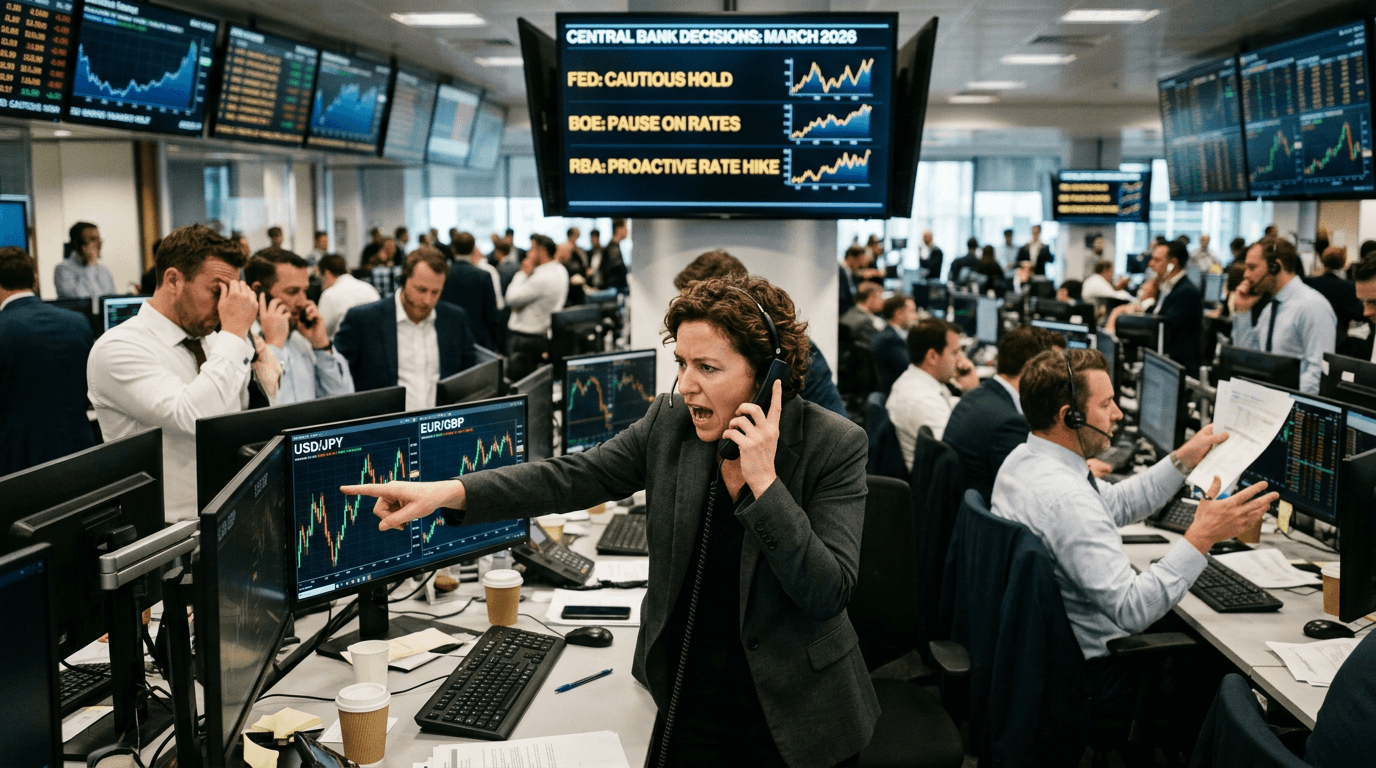
March 2026 emerged as a pivotal month for central bank decisions, marked by a compressed schedule of significant policy meetings that brought notable volatility to forex markets. As central banks convened to assess their monetary policy stances, traders navigated a complex landscape shaped by not just policy decisions but also heightened geopolitical tensions that intensified risk sentiment fluctuations. This intersection of central bank actions and external market pressures presented both opportunities and risks, demanding careful navigation from forex participants at all levels.
The Fed Holds Firm While Markets Look Ahead
The Federal Reserve's meeting on March 17-18 resulted in a predictable outcome: maintaining interest rates within the 3.50%-3.75% range, which markets had largely anticipated. With the CME FedWatch tool indicating nearly 99% odds of no change, the rate hold itself was no surprise. However, the real market driver was the tone and forward guidance from Fed officials. Market expectations pointed to the first rate cut likely occurring in September 2026, suggesting that policymakers were in a wait-and-see mode, considering the evolving economic landscape and headline risks.
In this context, the Fed's messaging became crucial. By emphasizing a cautious narrative and acknowledging geopolitical uncertainties, policymakers focused trader attention on near-term risk sentiment rather than immediate policy changes. This strategy effectively shifted the next significant policy checkpoint to the April 29 meeting, allowing markets time to digest both economic data and external developments. For forex traders, this meant that USD strength could persist in the short term as investors maintained their positions around the higher-for-longer rate narrative that has bolstered the dollar throughout 2026.
Global Central Banks Navigate Sticky Inflation And Growth Concerns
While the Federal Reserve stayed its course, other major central banks faced more complex policy challenges. The Bank of England, meeting on March 19, decided to hold rates steady at 3.75%, marking a shift in market expectations. Just weeks earlier, some market participants had anticipated a potential rate cut, but persistent inflation combined with rising oil prices due to geopolitical tensions made near-term easing less appealing. The BoE's decision to pause highlighted the broader challenge for central banks globally: balancing growth concerns with persistent inflationary pressures.
In contrast, the Reserve Bank of Australia took a more proactive stance, labeling its March 16-17 meeting as a "live" decision point. Markets and polling data suggested a 25-basis-point rate hike was possible, with RBA Governor Michele Bullock explicitly challenging the notion that policymakers would simply wait for the next quarterly inflation report. This stance reinforced the view that the RBA was prepared to act if necessary, creating differentiated expectations across major central banks and contributing to cross-currency volatility.
The Bank of Japan also held its March meeting, though with important caveats regarding market dynamics. With USD/JPY trading above the 159 level, intervention risk became a key consideration. Potential verbal warnings from Japanese officials about yen weakness added another layer of uncertainty, leaving traders exposed to sharp moves in both directions depending on official messaging and market conditions.
Geopolitical Tensions Reshape Risk Sentiment Dynamics
Beneath the scheduled central bank meetings lay a significant external factor that amplified volatility: ongoing geopolitical tensions centered on the Iran conflict. These headline risks reignited persistent demand for safe-haven currencies throughout March, fundamentally altering the risk sentiment environment that typically influences forex trading decisions. Safe-haven demand naturally benefits currencies like the U.S. dollar and Swiss franc while pressuring higher-yielding currencies, creating reactive trading patterns that sometimes override standard fundamental narratives.
The Iran conflict also impacted oil prices, which remained elevated throughout the month. This dynamic created an interesting cross-market relationship: persistent inflation concerns, partly driven by elevated energy costs, supported the case for central banks to maintain hawkish positioning even as growth concerns increased. Traders in this environment found themselves navigating fast-moving markets where tactical positioning often took precedence over strategic, longer-term views.
Practical Takeaways For Forex Traders
The March 2026 central bank calendar offered several key lessons for traders managing forex majors. First, focusing on central bank tone rather than immediate policy decisions remains crucial; understanding the guidance and messaging framework provides an edge that extends well beyond the announcement itself. Second, geopolitical developments can quickly override technical analysis and standard fundamental relationships, requiring traders to maintain flexibility and broad market awareness.
Third, differentiated central bank stances across major economies create trading opportunities in currency pairs where policy divergence is most pronounced. The divergence between the Fed's cautious hold, the BoE's steady pause, and the RBA's hawkish stance created meaningful directional bias in certain pairs. Finally, this period underscored the importance of position sizing and risk management when central bank calendars compress, as the combination of scheduled meetings and unexpected headline developments can rapidly shift market direction with substantial impact.
As markets transition from March and traders prepare for April's Fed decision and subsequent policy announcements, the lessons from this crowded calendar period remain highly relevant for anyone active in the forex space.
NEWSIMPACTSCORE: 7